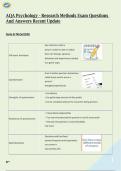
AQA Psychology - Research Methods Exam Questions
And Answers Recent Update
Terms In This Set (145)
Any method in which a
person is asked to state or explain
their own feelings, opinions,
Self-report techniques
behaviors and experiences related
to a given topic.
A set of written questions (sometimes
called items) used to access a
Questionnaire
persons'
thoughts/experiences
+ Cost effective
Strengths of questionnaires + Can gather large amounts of data quickly
+ Can be completed without the researcher being present
- Can produce response bias
Weaknesses of questionnaires
- P.ps may misunderstand the question or read it incorrectly
- Demand Characteristics / Social Desirability
may occur
Questions with no fixed
answer/response and respondents
Open Questions
can answer in
any way they wish.
©® 1
, + Get more information
Advantages & Disadvantages of + Produces qualitative data - depth and detail
an Open Question - People can miss them out as they can't be bothered to
answer them
- Harder to analyse
Questions with a fixed answer/ the
choice of response is determined by
Closed Question
the question setter.
+ People have to same perception of the Q&A
+ Quick and easy to answer
Advantages & Disadvantages of
+ Quantitative data is easier to analyse
a Closed Question
- Not detailed or in depth answers
- Don't find out the meaning behind the answer
A live encounter (face to face or
on the phone)
where one person asks a set of
questions to assess an
Interview
interviewees
thoughts/experiences. They can be
structured, semi
structured or unstructured.
Made up of pre-determined questions and are asked in a fixed
Structured Interview order. Basically like a
questionnaire but conducted face to face.
Works like a conversation.There are no set questions. There is a
Unstructured Interview general aim that a certain topic will be discussed and
interaction tends
to be free flowing.
©® 2
, There is a list of questions that have been worked out in
Semi-structured Interview advance but interviewers are
also free to ask follow up questions when they
feel it is appropriate.
+ Straight forward to replicate
+ Reduces differences between interviews
Strengths & Weaknesses of + Easier to analyse
Structured Interview + Get answers you're looking for
- Get less information as P.ps can't deviate from the
point
- Don't find out people's worldwide views
+ Can get more detailed answers as people can elaborate
+ More flexible as you can gain insight
Strengths & Weaknesses of
- Not easy to replicate
Unstructured
Interview - Not easy to analyse as you get irrelevant information
- Experimenter effects can occur
Encourages P.ps to give a particular answer e.g
Leading Questions
don't you think...?
Questions which can be interpreted in various ways. They can
Ambiguity mean different things to
different people.
They are questions which contain emotive language which is
Loaded Questions likely to produce an
emotional reaction in the respondent.
Double-barreled They contain two options within a single
Questions question.
©® 3
And Answers Recent Update
Terms In This Set (145)
Any method in which a
person is asked to state or explain
their own feelings, opinions,
Self-report techniques
behaviors and experiences related
to a given topic.
A set of written questions (sometimes
called items) used to access a
Questionnaire
persons'
thoughts/experiences
+ Cost effective
Strengths of questionnaires + Can gather large amounts of data quickly
+ Can be completed without the researcher being present
- Can produce response bias
Weaknesses of questionnaires
- P.ps may misunderstand the question or read it incorrectly
- Demand Characteristics / Social Desirability
may occur
Questions with no fixed
answer/response and respondents
Open Questions
can answer in
any way they wish.
©® 1
, + Get more information
Advantages & Disadvantages of + Produces qualitative data - depth and detail
an Open Question - People can miss them out as they can't be bothered to
answer them
- Harder to analyse
Questions with a fixed answer/ the
choice of response is determined by
Closed Question
the question setter.
+ People have to same perception of the Q&A
+ Quick and easy to answer
Advantages & Disadvantages of
+ Quantitative data is easier to analyse
a Closed Question
- Not detailed or in depth answers
- Don't find out the meaning behind the answer
A live encounter (face to face or
on the phone)
where one person asks a set of
questions to assess an
Interview
interviewees
thoughts/experiences. They can be
structured, semi
structured or unstructured.
Made up of pre-determined questions and are asked in a fixed
Structured Interview order. Basically like a
questionnaire but conducted face to face.
Works like a conversation.There are no set questions. There is a
Unstructured Interview general aim that a certain topic will be discussed and
interaction tends
to be free flowing.
©® 2
, There is a list of questions that have been worked out in
Semi-structured Interview advance but interviewers are
also free to ask follow up questions when they
feel it is appropriate.
+ Straight forward to replicate
+ Reduces differences between interviews
Strengths & Weaknesses of + Easier to analyse
Structured Interview + Get answers you're looking for
- Get less information as P.ps can't deviate from the
point
- Don't find out people's worldwide views
+ Can get more detailed answers as people can elaborate
+ More flexible as you can gain insight
Strengths & Weaknesses of
- Not easy to replicate
Unstructured
Interview - Not easy to analyse as you get irrelevant information
- Experimenter effects can occur
Encourages P.ps to give a particular answer e.g
Leading Questions
don't you think...?
Questions which can be interpreted in various ways. They can
Ambiguity mean different things to
different people.
They are questions which contain emotive language which is
Loaded Questions likely to produce an
emotional reaction in the respondent.
Double-barreled They contain two options within a single
Questions question.
©® 3