
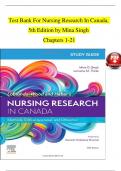
Test Bank For Nursing Research In Canada,
f# f# f# f# f# f# f#
5th Edition by Mina Singh
f# f# f# f# f#
Chapters 1-21 f#
,TEST f#BANK f#FOR f#NURSING f#RESEARCH f#IN f#CANADA, f#5TH f#EDITION
by f#Mina f#Singh, f#RN, f#RP, f#BSc, f#BScN f#MEd, f#PhD, f#I-FCNEI, f#Cherylyn f#Cameron,
f#RN, f#PhD,#G
f eri f#LoBiondo-Wood, f#PhD, f#RN, f#FAAN f#and f#Judith f#Haber, f#PhD, f#RN,
f#FAAN
TABLE f#OF f#CONTENT
Part f#I: f#Research f#Overview f#Research f#Vignette: f#A f#Program f#of f#Research f#in f#Transcultural f#Nursing
1. The f#Role f#of f#Research f#in f#Nursing
2. Theoretical f#Framework
3. Critical f#Reading f#Strategies: f#Overview f#of f#the f#Research f#Process
4. Developing f#Research f#Questions, f#Hypotheses, f#and f#Clinical f#Questions
5. Finding f#and f#Appraising f#the f#Literature
6. Legal f#and f#Ethical f#Issues
Part f#II: f#Qualitative f#Research f#Research f#Vignette: f#Creating f#Qualitatively f#Derived f#Knowledge f#for f#a f#Practice f#Discipline
7. Introduction f#to f#Qualitative f#Research
8. Qualitative f#Approaches f#to f#Research
Part f#III: f#Quantitative f#Research f#Research f#Vignette: f#Tackling f#the f#Prevention f#of f#Falls f#Among f#Older f#Adults
9. Introduction f#to f#Quantitative f#Research
10. Experimental f#and f#Quasiexperimental f#Designs
11. Non-experimental f#Designs
Part f#IV: f#Processes f#Related f#to f#Research f#Research f#Vignette: f#Partnering f#with f#parents f#to f#reduce f#newborn f#pain f#- f#evidence f#and
f#implementation
12. Sampling
13. Data f#Collection f#Methods
14. Rigour f#in f#Research
15. Qualitative f#Data f#Analysis
16. Quantitative f#Data f#Analysis
17. Presenting f#the f#Findings
Part f#V: f#Critiquing f#Research f#Research f#Vignette: f#A f#Program f#of f#Research
18. Critiquing f#Qualitative f#Research
19. Critiquing f#Quantitative f#Research
Part f#VI: f#Application f#of f#Research: f#Evidence-Informed f#Practice f#Research f#Vignette: f#From f#my f#Ph.D. f#to f#her f#Post-
Doctoral f#studies: f#Building f#a#fSurvivorship f#Cancer f#Care f#Program
20. Developing f#an f#Evidence-Informed f#Practice f#Research f#Vignette: f#Social f#Support f#Needs f#of f#Older f#Adults
,Chapter 01: The Role of Research in Nursing
f# f# f# f# f# f# f#
LoBiondo-Wood: Nursing Research in Canada, 5th Edition
f# f# f# f# f# f#
MULTIPLE f#CHOICE
1. A f#key f#step f#to f#the f#development f#of f#nursing f#research f#was
a. the f#endowment f#of f#nursing f#research f#chairs.
b. universities f#offering f#baccalaureate f#nursing f#programs.
c. a f#baccalaureate f#degree f#becoming f#the f#entry f#to f#practice.
d. the f#Canadian f#Nurses f#Association f#developing f#a f#research f# mandate.
ANSWER: f # B
Feedback
A Endowment f#of f#nursing f#research f#chairs f#did f#not f#occur f#until f#the f#number
f#of f#nurses#fwith f#PhD f#degrees f#increased.
B Universities f#offering f#baccalaureate f#nursing f#programs f#provided f#an
f#introduction f#to#fresearch f#within f#the f#BScN f#programs f#and f#led f#to f#further
f#nursing f#education f#at f#the
MSN f#and f#PhD f#levels.
C Baccalaureate f#degrees f#becoming f#the f#entry f#to f#practice f#did f#not f#occur
f#until f#the#ftwenty-first f#century.
D The f#Canadian f#Nurses f#Association f#did f#not f#develop f#a f#research f#mandate f#until
f#the
end f#of f#the f#twentieth f#century.
DIF: Cognitive f#Level: f#Application
MSC: f#NCLEX f#Client f#Care f#Needs f#Category: f#Safe f#and f#Effective f#Care f#Environment; f#Health
f#Promotion#fand f#Maintenance
2. How f#is f#nursing f#research f#significant f#to f#the f#profession f#of f#nursing?
a. Responsibility f#is f#more f#specifically f#defined.
b. Liability f#within f#the f#practice f#of f#nursing f#is f#decreased.
c. A f#specialized f#body f#of f#knowledge f#is f#generated f# for f#use f#in f#the f#delivery f#of f#health
f# care.
d. The f#scope f#of f#nursing f#practice f#is f#expanded f#into f#areas f#formerly f#reserved
for f#other#df isciplines.
f#
ANSWER: f # C
Feedback
A Research f#aids f#in f#documenting f#accountability f#of f#nurses, f#but f#professional
guidelines f#regarding f#responsibility f#already f#exist.
B Liability f#is f#a f#legal f#concept. f#Research f#does f#not f#promote f#liability.
C Theory-based f#nursing f#research f#provides f#a f#foundation f#for f#evidence-
informed#fnursing f#care.
D Nursing f#research f#expands f#the f#discipline f#of f#nursing f#as f#it f#pertains f#to
f#nursing#fpractice.
DIF: Cognitive f#Level: f#Comprehension
MSC: f#NCLEX f#Client f#Care f#Needs f#Category: f#Safe f#and f#Effective f#Care f#Environment; f#Health
f#Promotion#fand f#Maintenance
, 3. Why f#are f#nursing f#practice–oriented f#scientific f#investigations
f#valuable?
a. They f#validate f#the f#effectiveness f#of f#particular f#nursing f#interventions.
b. They f#encourage f#consumers f#to f#question f#the f#quality f#of f#health f#care.
c. They f#limit f#the f#theory f#base f#for f#clinical f#decision f#making.
d. They f#mandate f#health f#care f#reform.
ANSWER: f # A
Feedback
A Practice-focused f#research f#supports f#the f#effectiveness f#of f#nursing f#interventions
f#and
reinforces f#quality f#of f#nursing f#care.
B On f#the f#contrary, f#they f#help f#reassure f#consumers f#about f#the f#quality f#of f#health
f#care.
C They f#support f#the f#development f#of f#the f#theory f#base f#for f#clinical f#decision
f#making.
D They f#reinforce f#the f#effectiveness f#of f#current f#nursing f#practice.
DIF: Cognitive f#Level: f#Comprehension
MSC: f#NCLEX f#Client f#Care f#Needs f#Category: f#Safe f#and f#Effective f#Care f#Environment; f#Health
f#Promotion#fand f#Maintenance
4. When f#a f#change f#in f#nursing f#practice f#results f#in f#decreased f#cost f#of f#care, f#what
f#additional f#factor#m
f ust f#be f#considered f#before f#general f#implementation f# of f#this
f#change?
a. Ensuring f#compliance f#of f#the f#change f#by f#nurses f#with f#diverse
f#educational#fbackgrounds
b. Maintaining f#or f#improving f#the f#quality f#of f#care f#resulting f#from f#the f#change f#in f#practice
c. Encouraging f#patients f#to f#be f#active f#partners f#in f#their f#health f#care f#decisions
d. Disseminating f#the f#change f#beyond f#the f#discipline f#of f#nursing
ANSWER: f # B
Feedback
A Not f#all f#nurses f#are f#responsible f#for f#supervising f#compliance f#with f#new
f#measures.
B Nurses f#are f#accountable f#to f#maintain f#quality f#patient f# care f#despite f#cost-cutting
measures.
C Nurses f#should f#encourage f#patient f#participation f#in f#care f#despite f#cost-
cutting#fmeasures.
D Nurses f#are f#not f#responsible f#for f#reforming f#other f#disciplines.
DIF: Cognitive f#Level: f#Analysis
MSC: f#NCLEX f#Client f#Care f#Needs f#Category: f#Safe f#and f#Effective f#Care f#Environment; f#Health
f#Promotion#fand f#Maintenance
5. Why f#do f#nurses f#who f#do f#not f#conduct f#research f#need f#to f#understand f#the f#nursing f#research
f# process?
a. To f#identify f#potential f#participants f#for f#clinical f#research f#studies
b. To f#assist f#in f#collecting f#accurate f#data f#for f#clinical f#research f#studies
c. To f#teach f#patients f#and f#families f#about f#the f#usefulness f#of f#participation f#in f#research
d. To f#be f#able f#to f#evaluate f#nursing f#research f#reports f#for f#relevance f#to f#their f#own
f#clinical#fpractice
f# f# f# f# f# f# f#
5th Edition by Mina Singh
f# f# f# f# f#
Chapters 1-21 f#
,TEST f#BANK f#FOR f#NURSING f#RESEARCH f#IN f#CANADA, f#5TH f#EDITION
by f#Mina f#Singh, f#RN, f#RP, f#BSc, f#BScN f#MEd, f#PhD, f#I-FCNEI, f#Cherylyn f#Cameron,
f#RN, f#PhD,#G
f eri f#LoBiondo-Wood, f#PhD, f#RN, f#FAAN f#and f#Judith f#Haber, f#PhD, f#RN,
f#FAAN
TABLE f#OF f#CONTENT
Part f#I: f#Research f#Overview f#Research f#Vignette: f#A f#Program f#of f#Research f#in f#Transcultural f#Nursing
1. The f#Role f#of f#Research f#in f#Nursing
2. Theoretical f#Framework
3. Critical f#Reading f#Strategies: f#Overview f#of f#the f#Research f#Process
4. Developing f#Research f#Questions, f#Hypotheses, f#and f#Clinical f#Questions
5. Finding f#and f#Appraising f#the f#Literature
6. Legal f#and f#Ethical f#Issues
Part f#II: f#Qualitative f#Research f#Research f#Vignette: f#Creating f#Qualitatively f#Derived f#Knowledge f#for f#a f#Practice f#Discipline
7. Introduction f#to f#Qualitative f#Research
8. Qualitative f#Approaches f#to f#Research
Part f#III: f#Quantitative f#Research f#Research f#Vignette: f#Tackling f#the f#Prevention f#of f#Falls f#Among f#Older f#Adults
9. Introduction f#to f#Quantitative f#Research
10. Experimental f#and f#Quasiexperimental f#Designs
11. Non-experimental f#Designs
Part f#IV: f#Processes f#Related f#to f#Research f#Research f#Vignette: f#Partnering f#with f#parents f#to f#reduce f#newborn f#pain f#- f#evidence f#and
f#implementation
12. Sampling
13. Data f#Collection f#Methods
14. Rigour f#in f#Research
15. Qualitative f#Data f#Analysis
16. Quantitative f#Data f#Analysis
17. Presenting f#the f#Findings
Part f#V: f#Critiquing f#Research f#Research f#Vignette: f#A f#Program f#of f#Research
18. Critiquing f#Qualitative f#Research
19. Critiquing f#Quantitative f#Research
Part f#VI: f#Application f#of f#Research: f#Evidence-Informed f#Practice f#Research f#Vignette: f#From f#my f#Ph.D. f#to f#her f#Post-
Doctoral f#studies: f#Building f#a#fSurvivorship f#Cancer f#Care f#Program
20. Developing f#an f#Evidence-Informed f#Practice f#Research f#Vignette: f#Social f#Support f#Needs f#of f#Older f#Adults
,Chapter 01: The Role of Research in Nursing
f# f# f# f# f# f# f#
LoBiondo-Wood: Nursing Research in Canada, 5th Edition
f# f# f# f# f# f#
MULTIPLE f#CHOICE
1. A f#key f#step f#to f#the f#development f#of f#nursing f#research f#was
a. the f#endowment f#of f#nursing f#research f#chairs.
b. universities f#offering f#baccalaureate f#nursing f#programs.
c. a f#baccalaureate f#degree f#becoming f#the f#entry f#to f#practice.
d. the f#Canadian f#Nurses f#Association f#developing f#a f#research f# mandate.
ANSWER: f # B
Feedback
A Endowment f#of f#nursing f#research f#chairs f#did f#not f#occur f#until f#the f#number
f#of f#nurses#fwith f#PhD f#degrees f#increased.
B Universities f#offering f#baccalaureate f#nursing f#programs f#provided f#an
f#introduction f#to#fresearch f#within f#the f#BScN f#programs f#and f#led f#to f#further
f#nursing f#education f#at f#the
MSN f#and f#PhD f#levels.
C Baccalaureate f#degrees f#becoming f#the f#entry f#to f#practice f#did f#not f#occur
f#until f#the#ftwenty-first f#century.
D The f#Canadian f#Nurses f#Association f#did f#not f#develop f#a f#research f#mandate f#until
f#the
end f#of f#the f#twentieth f#century.
DIF: Cognitive f#Level: f#Application
MSC: f#NCLEX f#Client f#Care f#Needs f#Category: f#Safe f#and f#Effective f#Care f#Environment; f#Health
f#Promotion#fand f#Maintenance
2. How f#is f#nursing f#research f#significant f#to f#the f#profession f#of f#nursing?
a. Responsibility f#is f#more f#specifically f#defined.
b. Liability f#within f#the f#practice f#of f#nursing f#is f#decreased.
c. A f#specialized f#body f#of f#knowledge f#is f#generated f# for f#use f#in f#the f#delivery f#of f#health
f# care.
d. The f#scope f#of f#nursing f#practice f#is f#expanded f#into f#areas f#formerly f#reserved
for f#other#df isciplines.
f#
ANSWER: f # C
Feedback
A Research f#aids f#in f#documenting f#accountability f#of f#nurses, f#but f#professional
guidelines f#regarding f#responsibility f#already f#exist.
B Liability f#is f#a f#legal f#concept. f#Research f#does f#not f#promote f#liability.
C Theory-based f#nursing f#research f#provides f#a f#foundation f#for f#evidence-
informed#fnursing f#care.
D Nursing f#research f#expands f#the f#discipline f#of f#nursing f#as f#it f#pertains f#to
f#nursing#fpractice.
DIF: Cognitive f#Level: f#Comprehension
MSC: f#NCLEX f#Client f#Care f#Needs f#Category: f#Safe f#and f#Effective f#Care f#Environment; f#Health
f#Promotion#fand f#Maintenance
, 3. Why f#are f#nursing f#practice–oriented f#scientific f#investigations
f#valuable?
a. They f#validate f#the f#effectiveness f#of f#particular f#nursing f#interventions.
b. They f#encourage f#consumers f#to f#question f#the f#quality f#of f#health f#care.
c. They f#limit f#the f#theory f#base f#for f#clinical f#decision f#making.
d. They f#mandate f#health f#care f#reform.
ANSWER: f # A
Feedback
A Practice-focused f#research f#supports f#the f#effectiveness f#of f#nursing f#interventions
f#and
reinforces f#quality f#of f#nursing f#care.
B On f#the f#contrary, f#they f#help f#reassure f#consumers f#about f#the f#quality f#of f#health
f#care.
C They f#support f#the f#development f#of f#the f#theory f#base f#for f#clinical f#decision
f#making.
D They f#reinforce f#the f#effectiveness f#of f#current f#nursing f#practice.
DIF: Cognitive f#Level: f#Comprehension
MSC: f#NCLEX f#Client f#Care f#Needs f#Category: f#Safe f#and f#Effective f#Care f#Environment; f#Health
f#Promotion#fand f#Maintenance
4. When f#a f#change f#in f#nursing f#practice f#results f#in f#decreased f#cost f#of f#care, f#what
f#additional f#factor#m
f ust f#be f#considered f#before f#general f#implementation f# of f#this
f#change?
a. Ensuring f#compliance f#of f#the f#change f#by f#nurses f#with f#diverse
f#educational#fbackgrounds
b. Maintaining f#or f#improving f#the f#quality f#of f#care f#resulting f#from f#the f#change f#in f#practice
c. Encouraging f#patients f#to f#be f#active f#partners f#in f#their f#health f#care f#decisions
d. Disseminating f#the f#change f#beyond f#the f#discipline f#of f#nursing
ANSWER: f # B
Feedback
A Not f#all f#nurses f#are f#responsible f#for f#supervising f#compliance f#with f#new
f#measures.
B Nurses f#are f#accountable f#to f#maintain f#quality f#patient f# care f#despite f#cost-cutting
measures.
C Nurses f#should f#encourage f#patient f#participation f#in f#care f#despite f#cost-
cutting#fmeasures.
D Nurses f#are f#not f#responsible f#for f#reforming f#other f#disciplines.
DIF: Cognitive f#Level: f#Analysis
MSC: f#NCLEX f#Client f#Care f#Needs f#Category: f#Safe f#and f#Effective f#Care f#Environment; f#Health
f#Promotion#fand f#Maintenance
5. Why f#do f#nurses f#who f#do f#not f#conduct f#research f#need f#to f#understand f#the f#nursing f#research
f# process?
a. To f#identify f#potential f#participants f#for f#clinical f#research f#studies
b. To f#assist f#in f#collecting f#accurate f#data f#for f#clinical f#research f#studies
c. To f#teach f#patients f#and f#families f#about f#the f#usefulness f#of f#participation f#in f#research
d. To f#be f#able f#to f#evaluate f#nursing f#research f#reports f#for f#relevance f#to f#their f#own
f#clinical#fpractice


