
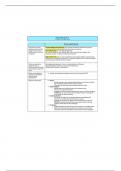
MED SURG QUIZ 14
Chapter 62 Med Surg
FOCUS FOCUS
If someone is having Alcohol withdrawal syndrome: The most life-threatening withdrawal syndrome
withdrawals what are the compared with those associated with other drugs, even heroin.
things that you should Early withdrawal:- 6-12 hrs after the last drink.
watch and or do not want s/s:- anxiety, agitation, and irritability. BP, pulse, and temperature begin to rise.
to happen? Sweating, nausea, vomiting, and diarrhea are typical.
Major withdrawal:- approx 3 days (sometimes less). Begins with the onset of seizure
hallucination, and delirium tremens (DT). extreme temperature, BP, and pulse elevation
and they became disoriented and confused.
When you approach a Non-judgemental approach. Focus on understanding, not blaming.
patient who has a Allow the patient to share their story without interruptions.
substance abuse disorder Validate their feelings and experiences.
how should you approach
them?
When you are doing an ● Assess mental status and alertness, level of consciousness (LOC)
assessment what is the
hallmark of the
assessment?
Defense mechanisms ● Denial:
○ Readily apparent when patients state that they do not have a problem
with drug abuse despite evidence to the contrary.
○ They deny that they need help in staying clean and sober.
● Rationalization:
○ Addicts attempt to justify the reasons for substance use.
○ This is an “excuse” for addiction
○ Example: an individual who insists that they had to use heroin because
no other way to cope with the pain of physical energy “The drugs the
doctor gave me weren't working”
● Intellectualization:
○ The person focuses only on objective facts to avoid dealing with
unconscious conflicts and the emotions they evoke.
○ Example: an alcoholic who killed someone while driving under the
influence of alcohol and stated that it was better that the victim die
suddenly rather than live as a paraplegic.
● Projection:
○ Shifting the blame for their behavior onto someone or something else.
○ Might insist that they became addicted to alcohol as a result of the
pressure to drink at work-related social functions to keep colleagues


