3 key properties of DNA : stores genetic info directs synthesis of macromolecules and replicate itself
·
, ,
32 1 DNA replication
.
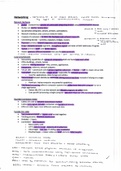
is the basis of inheritance and occurs semiconservatively
Base DNA strands run antiparallel (one runs 5'-3 ; other runs 3-51)
pairing replication fork-the site at which the two strands of the double helix unwind strands
+
separate into single
-
each strand becomes template for complementary daughter strands
Semi-semiconservative replication -
DNA replication mechanism where each new DNA molecule consists of one strand that
conservative
Replication was originally part of the parental strand and one newly-synthesized strand
32 2 replication strand is synthesized continuously
During DNA one and the other discontinuously
.
,
DNA ·
DNA replication starts at replication forkIseparation of parental strands)
Replication
Enzymes ① Helicase splits parent strand by breaking H-bonds between base pairs
② single-strand protein binds to single-strand DNA to prevent parental strands from
rejoining Ro
③ topoisomerase works up to relieve stress of unwinding DNA 3
family of enzymes that wind/unwind DNA to relieve stress
during replication
>
-
to poisomerase -
+
transcription
④ DNA is replicated by DNA polymerase
>
-
DNA polymerase =
component of a large protein complex that carries out all DNA replication
highly conserved
·
1 Helicase
.
.
2
Single strand binding proteins
. Topoisomerase
3
DNA polymerase has 2 crucial functions :
·
4 RNA primase
.
>
-
5 .
Polymerase
DNA
can only attach one nucleotide to only elongate DNA or RNA
anothere 6 :
Ligase
>
-
each new strand must start with a primer
·
primer =
made up by primace , which synthesizes short RNA strand complementary to DNA strand
·
once RNA primer is synthesized , DNA nucleotides are added -send
to
-
add nucleotides to 3 end of nucleotides * DNA synthesis or polymerization
can only ,
-
occurs only from 5'-3' direction
due to polarity of 3' end's hydroxyl group (vs 5's phosphate group)
·
energy for rx comes from breaking phosphate bond releases 2 phosphate groups
· -
nucleotides added at 3
·
Leading's DNA strands run antiparallel -
>
2 daughter strands synthesized differently
O
lagging ⑧
strands e 5'-3' vS 31-5' . clongates
·
leading strand-bottom daughter strand synthesized comminuously
>
-
3'end pointed towards replication fork -
as helix unwinds nucleotides added on to 3' end
,
·
lagging strand-top daughter strand synthesized a
continuously
s
>
- 5' end pointed toward replication fork
·
nucleotides can only be added to 3' ->
multiple RNA primers at intervals of 100s to 1 , 000s of nucleotides
·
lagging strand synthesized in Okazaki fragments relatively
-
short discontinuous pieces of DNA
,
>
- one primer for every
fragment
·
, ,
32 1 DNA replication
.
is the basis of inheritance and occurs semiconservatively
Base DNA strands run antiparallel (one runs 5'-3 ; other runs 3-51)
pairing replication fork-the site at which the two strands of the double helix unwind strands
+
separate into single
-
each strand becomes template for complementary daughter strands
Semi-semiconservative replication -
DNA replication mechanism where each new DNA molecule consists of one strand that
conservative
Replication was originally part of the parental strand and one newly-synthesized strand
32 2 replication strand is synthesized continuously
During DNA one and the other discontinuously
.
,
DNA ·
DNA replication starts at replication forkIseparation of parental strands)
Replication
Enzymes ① Helicase splits parent strand by breaking H-bonds between base pairs
② single-strand protein binds to single-strand DNA to prevent parental strands from
rejoining Ro
③ topoisomerase works up to relieve stress of unwinding DNA 3
family of enzymes that wind/unwind DNA to relieve stress
during replication
>
-
to poisomerase -
+
transcription
④ DNA is replicated by DNA polymerase
>
-
DNA polymerase =
component of a large protein complex that carries out all DNA replication
highly conserved
·
1 Helicase
.
.
2
Single strand binding proteins
. Topoisomerase
3
DNA polymerase has 2 crucial functions :
·
4 RNA primase
.
>
-
5 .
Polymerase
DNA
can only attach one nucleotide to only elongate DNA or RNA
anothere 6 :
Ligase
>
-
each new strand must start with a primer
·
primer =
made up by primace , which synthesizes short RNA strand complementary to DNA strand
·
once RNA primer is synthesized , DNA nucleotides are added -send
to
-
add nucleotides to 3 end of nucleotides * DNA synthesis or polymerization
can only ,
-
occurs only from 5'-3' direction
due to polarity of 3' end's hydroxyl group (vs 5's phosphate group)
·
energy for rx comes from breaking phosphate bond releases 2 phosphate groups
· -
nucleotides added at 3
·
Leading's DNA strands run antiparallel -
>
2 daughter strands synthesized differently
O
lagging ⑧
strands e 5'-3' vS 31-5' . clongates
·
leading strand-bottom daughter strand synthesized comminuously
>
-
3'end pointed towards replication fork -
as helix unwinds nucleotides added on to 3' end
,
·
lagging strand-top daughter strand synthesized a
continuously
s
>
- 5' end pointed toward replication fork
·
nucleotides can only be added to 3' ->
multiple RNA primers at intervals of 100s to 1 , 000s of nucleotides
·
lagging strand synthesized in Okazaki fragments relatively
-
short discontinuous pieces of DNA
,
>
- one primer for every
fragment