
NUR 215 Exam 4
Study online at https://quizlet.com/_gvutu9
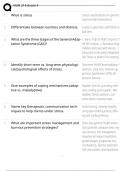
1. What is stress Stress is any disturbance in a person's
balanced state (homeostasis)
2. Differentiate between eustress and distress. Eustress is good stress and Distress is
bad stress
3. What are the three stages of the General Adap- 1. Alarm: "Fight or Flight" response (‘
tation Syndrome (GAS)? HR, ‘BP, ‘cortisol)., 2. Resistance: Body
stabilizes and copes with stressor., 3.
Exhaustion (or Recovery): Adaptation
fails ’illness or death (if no recovery).
4. Identify short-term vs. long-term physiologi- Short-term: ‘HR/BP, bronchodilation, ‘
cal/psychological effects of stress. alertness., Long-term: Immune sup-
pression, hypertension (HTN), de-
pression, burnout.
5. Give examples of coping mechanisms (adap- Adaptive: Exercise, journaling, relax-
tive vs. maladaptive) ation, seeking social support., Mal-
adaptive: Denial, avoidance, sub-
stance abuse, excessive anger.
6. Name key therapeutic communication tech- Active listening, showing empathy,
niques to help clients under stress. using open-ended questions, offer-
ing self, clarifying feelings.
7. What are important stress management and Stress management: Health promo-
burnout prevention strategies? tion (good diet, adequate sleep, reg-
ular exercise), time management,
relaxation techniques (meditation,
guided imagery, progressive mus-
cle relaxation)., Burnout prevention:
Self-care routines, clear boundaries,
, NUR 215 Exam 4
Study online at https://quizlet.com/_gvutu9
seeking professional/social support,
delegating tasks.
8. What should a nurse assess regarding cultural How the culture perceives and ex-
considerations in stress and coping? presses stress., Cultural coping styles
and support systems., Beliefs around
acceptable emotional expression and
help-seeking.
9. What is the normal urinary output per hour? Typically 50-60 mL/hr (with a mini-
mum of e30 mL/hr to ensure ade-
quate kidney function).
10. List signs/symptoms of a UTI and prevention Signs/Symptoms: Dysuria, frequency,
measures. urgency, cloudy/foul-smelling urine,
suprapubic pain, possible fever., Pre-
vention: Proper hygiene, increased
fluid intake, voiding after intercourse,
avoiding irritating products, proper
catheter care if applicable.
11. Describe 4 types of urinary incontinence. Stress Incontinence: Leakage with in-
creased abdominal pressure (e.g.,
coughing, sneezing)., Urge Inconti-
nence: Overactive bladder—sudden
urge to void., Overflow Incontinence:
Retention leading to over-distension
and dribbling., Functional Inconti-
nence: Factors outside urinary tract
(mobility or cognitive impairment)
prevent timely toileting.
12. What is urinary retention?
, NUR 215 Exam 4
Study online at https://quizlet.com/_gvutu9
Incomplete bladder emptying, may
show dribbling, bladder distention.
13. Key points to catheter care. Maintain a sterile closed sys-
tem and prevent backflow., Ensure
free drainage (no kinks)., Remove
catheter as soon as possible to pre-
vent infection., For intermittent caths:
done periodically to relieve retention
or collect specimens.
14. What is urostomy Surgical diversion of urine through a
stoma when the bladder is nonfunc-
tional or removed.
15. What is Stoma care Stoma should be pink/red and moist.
Maintain skin integrity with proper
fitting of appliance and observe out-
put.
16. What is a normal bowel movement Frequency varies by individual; stool
should be soft, formed, and passed
without straining.
17. What are common bowel alterations Constipation (hard, infrequent
stools), diarrhea (watery stools), in-
continence (loss of control), and risk
of impaction with severe constipa-
tion.
18. What is Ileostomy Created at the ileum; output is liq-
uid/continuous.
Study online at https://quizlet.com/_gvutu9
1. What is stress Stress is any disturbance in a person's
balanced state (homeostasis)
2. Differentiate between eustress and distress. Eustress is good stress and Distress is
bad stress
3. What are the three stages of the General Adap- 1. Alarm: "Fight or Flight" response (‘
tation Syndrome (GAS)? HR, ‘BP, ‘cortisol)., 2. Resistance: Body
stabilizes and copes with stressor., 3.
Exhaustion (or Recovery): Adaptation
fails ’illness or death (if no recovery).
4. Identify short-term vs. long-term physiologi- Short-term: ‘HR/BP, bronchodilation, ‘
cal/psychological effects of stress. alertness., Long-term: Immune sup-
pression, hypertension (HTN), de-
pression, burnout.
5. Give examples of coping mechanisms (adap- Adaptive: Exercise, journaling, relax-
tive vs. maladaptive) ation, seeking social support., Mal-
adaptive: Denial, avoidance, sub-
stance abuse, excessive anger.
6. Name key therapeutic communication tech- Active listening, showing empathy,
niques to help clients under stress. using open-ended questions, offer-
ing self, clarifying feelings.
7. What are important stress management and Stress management: Health promo-
burnout prevention strategies? tion (good diet, adequate sleep, reg-
ular exercise), time management,
relaxation techniques (meditation,
guided imagery, progressive mus-
cle relaxation)., Burnout prevention:
Self-care routines, clear boundaries,
, NUR 215 Exam 4
Study online at https://quizlet.com/_gvutu9
seeking professional/social support,
delegating tasks.
8. What should a nurse assess regarding cultural How the culture perceives and ex-
considerations in stress and coping? presses stress., Cultural coping styles
and support systems., Beliefs around
acceptable emotional expression and
help-seeking.
9. What is the normal urinary output per hour? Typically 50-60 mL/hr (with a mini-
mum of e30 mL/hr to ensure ade-
quate kidney function).
10. List signs/symptoms of a UTI and prevention Signs/Symptoms: Dysuria, frequency,
measures. urgency, cloudy/foul-smelling urine,
suprapubic pain, possible fever., Pre-
vention: Proper hygiene, increased
fluid intake, voiding after intercourse,
avoiding irritating products, proper
catheter care if applicable.
11. Describe 4 types of urinary incontinence. Stress Incontinence: Leakage with in-
creased abdominal pressure (e.g.,
coughing, sneezing)., Urge Inconti-
nence: Overactive bladder—sudden
urge to void., Overflow Incontinence:
Retention leading to over-distension
and dribbling., Functional Inconti-
nence: Factors outside urinary tract
(mobility or cognitive impairment)
prevent timely toileting.
12. What is urinary retention?
, NUR 215 Exam 4
Study online at https://quizlet.com/_gvutu9
Incomplete bladder emptying, may
show dribbling, bladder distention.
13. Key points to catheter care. Maintain a sterile closed sys-
tem and prevent backflow., Ensure
free drainage (no kinks)., Remove
catheter as soon as possible to pre-
vent infection., For intermittent caths:
done periodically to relieve retention
or collect specimens.
14. What is urostomy Surgical diversion of urine through a
stoma when the bladder is nonfunc-
tional or removed.
15. What is Stoma care Stoma should be pink/red and moist.
Maintain skin integrity with proper
fitting of appliance and observe out-
put.
16. What is a normal bowel movement Frequency varies by individual; stool
should be soft, formed, and passed
without straining.
17. What are common bowel alterations Constipation (hard, infrequent
stools), diarrhea (watery stools), in-
continence (loss of control), and risk
of impaction with severe constipa-
tion.
18. What is Ileostomy Created at the ileum; output is liq-
uid/continuous.


