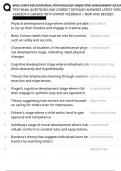
WGU D307 EDUCATIONAL PSYCHOLOGY OBJECTIVE ASSESSMENT EXAM
TEST BANK QUESTIONS AND CORRECT DETAILED ANSWERS LATEST VERSI
ALREADY A GRADED WITH EXPERT FEEDBACK | NEW AND REVISED
1. Physical development stage where children are able Early Childhood
to zip up their hoodies and engage in creative play.
2. Basic human needs that must be met for survival, Physiological needs
such as safety and security.
3. Characteristic of students in the adolescence phys- Accelerated growth
ical development stage, indicating rapid physical
changes.
4. Cognitive development stage where individuals can Formal operations stage
think abstractly and hypothetically.
5. Theory that emphasizes learning through social in- Vygotsky's learning theory
teraction and experiences.
6. Piaget's cognitive development stage where chil- Pre-operational level
dren engage in symbolic play and are egocentric.
7. Theory suggesting that women are more focused Gilligan's theory
on caring for others than for themselves.
8. Erikson's stage where a child works hard to gain Industry versus inferiority
approval and competence.
9. Kohlberg's stage of moral development where indi- Conventional Level
viduals conform to societal rules and expectations.
10. Bandura's theory that suggests individuals learn be- Observational learning
haviors by watching others.
11. Telegraphic stage
, WGU D307 EDUCATIONAL PSYCHOLOGY OBJECTIVE ASSESSMENT EXAM
TEST BANK QUESTIONS AND CORRECT DETAILED ANSWERS LATEST VERSI
ALREADY A GRADED WITH EXPERT FEEDBACK | NEW AND REVISED
Language development stage characterized by the
use of meaningful words that convey purpose.
12. Skinner's theory of language development where Operant conditioning
behavior is influenced by rewards and conse-
quences.
13. The concept that language acquisition can be en- Positive reinforcement
hanced when paired with rewarding outcomes.
14. A theory of learning that emphasizes the role of re- Skinner's operant condition-
inforcement and punishment in shaping behavior. ing
15. The difference between what a learner can do with- Vygotsky's zone of proximal
out help and what they can do with help. development
16. A psychological theory that categorizes human Maslow's hierarchy of needs
needs into a five-tier model, often depicted as a
pyramid.
17. The theory that humans are born with an innate Chomsky's universal gram-
ability to learn language. mar
18. True or False: Chomsky believed that humans are Chomsky's belief about lan-
born with the ability to learn language. guage learning
19. Persistent challenges with communication, sensory Characteristic behavior of a
issues, and repetitive behaviors. student with autism spectrum
disorder
20. Physical barrier due to difficulty seeing what the William's barrier in the class-
teacher is writing on the board. room
, WGU D307 EDUCATIONAL PSYCHOLOGY OBJECTIVE ASSESSMENT EXAM
TEST BANK QUESTIONS AND CORRECT DETAILED ANSWERS LATEST VERSI
ALREADY A GRADED WITH EXPERT FEEDBACK | NEW AND REVISED
21. Cognitive and social-emotional barriers. Types of barriers experienced
by a student with TBI
22. Jack & Fatima might have difficulties in communi- Students with communication
cating their needs to the teacher. difficulties
23. Access to nutritious, sufficient food is the issue un- Maria's primary learning
derlying her challenges. need
24. The student is likely to need modified curriculum Impact of intellectual disabili-
and support with independent functioning. ty on classroom performance
25. The student is likely to complete work more slowly Impact of learning disabili-
and less accurately. ty on functioning and perfor-
mance
26. Fatima has difficulties with speech and communi- Fatima's challenges
cation, sensory sensitivity, and challenges in social
interaction with peers.
27. A condition that requires sensory input for engage- Sensory sensitivity
ment and focus.
28. A potential need that Fatima might display in class. Difficulty focusing
29. A theory that postulates intelligence consists of nu- Thurstone's theory of the pri-
merous factors rather than a single entity. mary mental abilities
30. A theory that suggests there are multiple types of Gardner's multiple intelli-
intelligence. gence theory
31.
TEST BANK QUESTIONS AND CORRECT DETAILED ANSWERS LATEST VERSI
ALREADY A GRADED WITH EXPERT FEEDBACK | NEW AND REVISED
1. Physical development stage where children are able Early Childhood
to zip up their hoodies and engage in creative play.
2. Basic human needs that must be met for survival, Physiological needs
such as safety and security.
3. Characteristic of students in the adolescence phys- Accelerated growth
ical development stage, indicating rapid physical
changes.
4. Cognitive development stage where individuals can Formal operations stage
think abstractly and hypothetically.
5. Theory that emphasizes learning through social in- Vygotsky's learning theory
teraction and experiences.
6. Piaget's cognitive development stage where chil- Pre-operational level
dren engage in symbolic play and are egocentric.
7. Theory suggesting that women are more focused Gilligan's theory
on caring for others than for themselves.
8. Erikson's stage where a child works hard to gain Industry versus inferiority
approval and competence.
9. Kohlberg's stage of moral development where indi- Conventional Level
viduals conform to societal rules and expectations.
10. Bandura's theory that suggests individuals learn be- Observational learning
haviors by watching others.
11. Telegraphic stage
, WGU D307 EDUCATIONAL PSYCHOLOGY OBJECTIVE ASSESSMENT EXAM
TEST BANK QUESTIONS AND CORRECT DETAILED ANSWERS LATEST VERSI
ALREADY A GRADED WITH EXPERT FEEDBACK | NEW AND REVISED
Language development stage characterized by the
use of meaningful words that convey purpose.
12. Skinner's theory of language development where Operant conditioning
behavior is influenced by rewards and conse-
quences.
13. The concept that language acquisition can be en- Positive reinforcement
hanced when paired with rewarding outcomes.
14. A theory of learning that emphasizes the role of re- Skinner's operant condition-
inforcement and punishment in shaping behavior. ing
15. The difference between what a learner can do with- Vygotsky's zone of proximal
out help and what they can do with help. development
16. A psychological theory that categorizes human Maslow's hierarchy of needs
needs into a five-tier model, often depicted as a
pyramid.
17. The theory that humans are born with an innate Chomsky's universal gram-
ability to learn language. mar
18. True or False: Chomsky believed that humans are Chomsky's belief about lan-
born with the ability to learn language. guage learning
19. Persistent challenges with communication, sensory Characteristic behavior of a
issues, and repetitive behaviors. student with autism spectrum
disorder
20. Physical barrier due to difficulty seeing what the William's barrier in the class-
teacher is writing on the board. room
, WGU D307 EDUCATIONAL PSYCHOLOGY OBJECTIVE ASSESSMENT EXAM
TEST BANK QUESTIONS AND CORRECT DETAILED ANSWERS LATEST VERSI
ALREADY A GRADED WITH EXPERT FEEDBACK | NEW AND REVISED
21. Cognitive and social-emotional barriers. Types of barriers experienced
by a student with TBI
22. Jack & Fatima might have difficulties in communi- Students with communication
cating their needs to the teacher. difficulties
23. Access to nutritious, sufficient food is the issue un- Maria's primary learning
derlying her challenges. need
24. The student is likely to need modified curriculum Impact of intellectual disabili-
and support with independent functioning. ty on classroom performance
25. The student is likely to complete work more slowly Impact of learning disabili-
and less accurately. ty on functioning and perfor-
mance
26. Fatima has difficulties with speech and communi- Fatima's challenges
cation, sensory sensitivity, and challenges in social
interaction with peers.
27. A condition that requires sensory input for engage- Sensory sensitivity
ment and focus.
28. A potential need that Fatima might display in class. Difficulty focusing
29. A theory that postulates intelligence consists of nu- Thurstone's theory of the pri-
merous factors rather than a single entity. mary mental abilities
30. A theory that suggests there are multiple types of Gardner's multiple intelli-
intelligence. gence theory
31.