
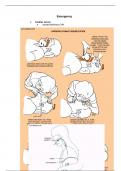
Emergency
I. Cardiac Arrest
A. Adult/child/infant CPR
1. Definition of ages
a. adult and older child (15 and older)
b. child – 1 to 14 years
c. infant – less than 1 year
2. Assess responsiveness
a. shake gently
b. shout "are you okay?"
3. If unresponsive, activate the emergency response system
a. if hypoxic arrest call emergency response system
after 2 minutes of CPR
b. if child or infant call after 2 minutes of CPR unless
sudden witnessed arrest call emergency response
system first
4. Call for a defibrillator
5. Position the client to a resuscitation position, if no evidence
of trauma (if trauma, see section III of this lesson)
6. Open the airway
a. head tilt-chin lift
b. jaw thrust (if trauma is evident or spinal injury
suspected)
7. Assess for breathing: look, listen and feel
a. if breathing, position in a recovery position
b. if not breathing, give 2 rescue breaths at 1
second/breath
c. assess if breaths go into lungs by chest movement
d. if air does not go in, reposition airway (see #4
above)
e. if air still does not go in, check for foreign body
i. abdominal thrust for adults, older child and
child (Heimlich maneuver)
, ii. back blows and chest thrusts for infants
iii. do not proceed until airway and rescue
breathing is established
iv. no blind finger sweeps
f. when airway is clear, check for presence of a pulse
i. check pulse for 10 seconds or less
ii. adult or older child – check carotid
iii. child – check carotid or femoral
iv. infant – brachial or femoral
g. begin chest compressions if pulse is absent or in
child/infant if heart rate is < 60 with signs of poor
perfusion
i. be sure client is on a firm surface
ii. hand position is critical
adult/older child – center of chest
between nipples; two hands with
heel of one hand and the other hand
on top
child – center of chest between
nipples; one hand or two hands with
use of the heel(s) of the hands
infant – just below the nipple line;
one rescuer - two fingers or two
rescuers – two thumbs encircling
hands around chest
iii. compression depth
adults/older child - 1.5 to 2 inches
child/infants – 1/3 to 1/2 the depth of
the chest
iv. compression rate 100 compressions per
minute for all ages
v. “PUSH HARD, PUSH FAST” for chest
compressions
vi. allow chest recoil
vii. minimize interruptions in chest compression
– keep at 10 seconds or less
viii. compressions-ventilation ratios
adult/child – 30:2 [30 compressions
to 2 breaths] for one or two rescuers
child or infant –
one rescuers 30:2 (30
compressions to 2 breaths)
two rescuers 15:2 (30
, h. apply monitor or defibrillator when available
i. reassess cardiopulmonary status after every five
cycles of compressions to ventilations
j. continue until ACLS providers take over or the
client starts to move
k. differences for lay persons
i. lay rescuers do not need to assess for pulse
or signs of circulation for an unresponsive
victim
ii. lay rescuers do not need to provide rescue
breathing without chest compressions
II. Early defibrillation
In adults, the arrhythmia most correctable is ventricular fibrillation
if treated promptly
Before starting CPR for ventricular fibrillation, call for help
II. Shock - see the discussion of shock in Cardiovascular
III. Trauma Care
A. Airway with simultaneous cervical spine immobilization
1. Must use jaw thrust
2. Do not use head-tilt chin-lift: it could injure neck
B. Breathing
1. Look, listen and feel for respirations
2. Follow CPR procedure
C. Circulation
1. Assess pulses
a. carotid pulse: BP at least 60
b. femoral pulse: BP at least 70
c. radial pulse: BP at least 80
2. Stop any active, visible bleeding by applying direct pressure
3. After initial assessment, start two large-bore IVs
, D. Disability: brief neurological exam
1. Level of consciousness
2. Pupil response to light
3. Ability to move extremities
4. Ability to move against resistance
E. Expose
1. Undress client
2. Inspect for injuries or deformities
F. Fahrenheit
1. Take temperature
2. Maintain warmth
a. warm blankets
b. warming lights
G. Get vitals
1. Pulse
2. Respiratory rate
3. Blood pressure
H. History and head-to-toe full assessment
1. How did injury occur - mechanism of injury
2. Client's medical history
3. Full body system assessment
I. Inspect the back
1. Roll the client over - log roll with help
2. Inspect for injuries or deformities
CPR
Early defibrillation is the key to successful resuscitation for many adults.
Continually reassess during CPR to see if the client regains a pulse or begins
breathing. Reassess to see that the chest moves and pulses are palpable during
CPR.
SHOCK
In shock, the first hour of treatment is most critical. Early detection is key.
There are different ways to categorize shock. Basically, shock presents three
potential problems:
1. Not enough fluid in the blood vessels (hypovolemia) OR
2. Fluid has moved outside the vessels, so cannot be pumped to the organs
(distributive) OR
3. Heart cannot pump fluid that is present (cardiogenic)
Shock and Temperature
In septic shock, the skin and body temperature may increase. In other shock
states, body and skin temperature will decrease.
I. Cardiac Arrest
A. Adult/child/infant CPR
1. Definition of ages
a. adult and older child (15 and older)
b. child – 1 to 14 years
c. infant – less than 1 year
2. Assess responsiveness
a. shake gently
b. shout "are you okay?"
3. If unresponsive, activate the emergency response system
a. if hypoxic arrest call emergency response system
after 2 minutes of CPR
b. if child or infant call after 2 minutes of CPR unless
sudden witnessed arrest call emergency response
system first
4. Call for a defibrillator
5. Position the client to a resuscitation position, if no evidence
of trauma (if trauma, see section III of this lesson)
6. Open the airway
a. head tilt-chin lift
b. jaw thrust (if trauma is evident or spinal injury
suspected)
7. Assess for breathing: look, listen and feel
a. if breathing, position in a recovery position
b. if not breathing, give 2 rescue breaths at 1
second/breath
c. assess if breaths go into lungs by chest movement
d. if air does not go in, reposition airway (see #4
above)
e. if air still does not go in, check for foreign body
i. abdominal thrust for adults, older child and
child (Heimlich maneuver)
, ii. back blows and chest thrusts for infants
iii. do not proceed until airway and rescue
breathing is established
iv. no blind finger sweeps
f. when airway is clear, check for presence of a pulse
i. check pulse for 10 seconds or less
ii. adult or older child – check carotid
iii. child – check carotid or femoral
iv. infant – brachial or femoral
g. begin chest compressions if pulse is absent or in
child/infant if heart rate is < 60 with signs of poor
perfusion
i. be sure client is on a firm surface
ii. hand position is critical
adult/older child – center of chest
between nipples; two hands with
heel of one hand and the other hand
on top
child – center of chest between
nipples; one hand or two hands with
use of the heel(s) of the hands
infant – just below the nipple line;
one rescuer - two fingers or two
rescuers – two thumbs encircling
hands around chest
iii. compression depth
adults/older child - 1.5 to 2 inches
child/infants – 1/3 to 1/2 the depth of
the chest
iv. compression rate 100 compressions per
minute for all ages
v. “PUSH HARD, PUSH FAST” for chest
compressions
vi. allow chest recoil
vii. minimize interruptions in chest compression
– keep at 10 seconds or less
viii. compressions-ventilation ratios
adult/child – 30:2 [30 compressions
to 2 breaths] for one or two rescuers
child or infant –
one rescuers 30:2 (30
compressions to 2 breaths)
two rescuers 15:2 (30
, h. apply monitor or defibrillator when available
i. reassess cardiopulmonary status after every five
cycles of compressions to ventilations
j. continue until ACLS providers take over or the
client starts to move
k. differences for lay persons
i. lay rescuers do not need to assess for pulse
or signs of circulation for an unresponsive
victim
ii. lay rescuers do not need to provide rescue
breathing without chest compressions
II. Early defibrillation
In adults, the arrhythmia most correctable is ventricular fibrillation
if treated promptly
Before starting CPR for ventricular fibrillation, call for help
II. Shock - see the discussion of shock in Cardiovascular
III. Trauma Care
A. Airway with simultaneous cervical spine immobilization
1. Must use jaw thrust
2. Do not use head-tilt chin-lift: it could injure neck
B. Breathing
1. Look, listen and feel for respirations
2. Follow CPR procedure
C. Circulation
1. Assess pulses
a. carotid pulse: BP at least 60
b. femoral pulse: BP at least 70
c. radial pulse: BP at least 80
2. Stop any active, visible bleeding by applying direct pressure
3. After initial assessment, start two large-bore IVs
, D. Disability: brief neurological exam
1. Level of consciousness
2. Pupil response to light
3. Ability to move extremities
4. Ability to move against resistance
E. Expose
1. Undress client
2. Inspect for injuries or deformities
F. Fahrenheit
1. Take temperature
2. Maintain warmth
a. warm blankets
b. warming lights
G. Get vitals
1. Pulse
2. Respiratory rate
3. Blood pressure
H. History and head-to-toe full assessment
1. How did injury occur - mechanism of injury
2. Client's medical history
3. Full body system assessment
I. Inspect the back
1. Roll the client over - log roll with help
2. Inspect for injuries or deformities
CPR
Early defibrillation is the key to successful resuscitation for many adults.
Continually reassess during CPR to see if the client regains a pulse or begins
breathing. Reassess to see that the chest moves and pulses are palpable during
CPR.
SHOCK
In shock, the first hour of treatment is most critical. Early detection is key.
There are different ways to categorize shock. Basically, shock presents three
potential problems:
1. Not enough fluid in the blood vessels (hypovolemia) OR
2. Fluid has moved outside the vessels, so cannot be pumped to the organs
(distributive) OR
3. Heart cannot pump fluid that is present (cardiogenic)
Shock and Temperature
In septic shock, the skin and body temperature may increase. In other shock
states, body and skin temperature will decrease.


