Human Anatomy & Physiology, 8e (Marieb/Hoehn)
Chapter 9 Muscles and Muscle Tissue
Matching Questions
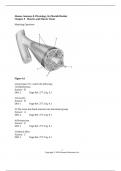
Figure 9.1
Using Figure 9.1, match the following:
1) Endomysium.
Answer: B
Diff: 1 Page Ref: 277; Fig. 9.1
2) Fascicle.
Answer: D
Diff: 1 Page Ref: 277; Fig. 9.1
3) The tissue that binds muscles into functional groups.
Answer: A
Diff: 2 Page Ref: 277; Fig. 9.1
4) Perimysium.
Answer: E
Diff: 1 Page Ref: 277; Fig. 9.1
5) Muscle fiber.
Answer: C
Diff: 1 Page Ref: 277; Fig. 9.1
1
Copyright © 2010 Pearson Education, Inc.
,Figure 9.2
Using Figure 9.2, match the following:
6) I band.
Answer: C
Diff: 1 Page Ref: 280; Fig. 9.2
7) H zone.
Answer: B
Diff: 1 Page Ref: 280; Fig. 9.2
8) A band.
Answer: D
Diff: 2 Page Ref: 280; Fig. 9.2
9) Z disc.
Answer: A
Diff: 1 Page Ref: 280; Fig. 9.2
10) M line.
Answer: E
Diff: 1 Page Ref: 280; Fig. 9.2
2
Copyright © 2010 Pearson Education, Inc.
, Match the following:
A) Fast (oxidative or glycolytic), fatigable fibers
B) Slow (oxidative), fatigue-resistant fibers
11) Depends on oxygen delivery and aerobic mechanisms.
Diff: 1 Page Ref: 302; Tbl. 9.2
12) Have very fast-acting myosin ATPases and depend upon anaerobic metabolism during
contraction.
Diff: 1 Page Ref: 302; Tbl. 9.2
13) Red fibers, the smallest of the fiber types.
Diff: 2 Page Ref: 302; Tbl. 9.2
14) Contain abundant amounts of glycogen.
Diff: 2 Page Ref: 302; Tbl. 9.2
15) Abundant in muscles used to maintain posture.
Diff: 2 Page Ref: 302; Tbl. 9.2
16) A relatively high percentage are found in successful marathon runners.
Diff: 2 Page Ref: 302; Tbl. 9.2
Answers: 11) B 12) A 13) B 14) A 15) B
16) B
Match the following:
A) Treppe
B) Tetanus
C) Wave summation
D) Multiple motor unit summation
E) Maximal stimulus
17) The stimulus above which no stronger contraction can be elicited, because all motor units are
firing in the muscle.
Diff: 1 Page Ref: 295
18) The phenomenon in which the contraction strength of a muscle increases, due to increased
Ca2+ availability and enzyme efficiency during the warm-up.
Diff: 2 Page Ref: 295
19) Continued sustained smooth contraction due to rapid stimulation.
Diff: 2 Page Ref: 295
3
Copyright © 2010 Pearson Education, Inc.
Chapter 9 Muscles and Muscle Tissue
Matching Questions
Figure 9.1
Using Figure 9.1, match the following:
1) Endomysium.
Answer: B
Diff: 1 Page Ref: 277; Fig. 9.1
2) Fascicle.
Answer: D
Diff: 1 Page Ref: 277; Fig. 9.1
3) The tissue that binds muscles into functional groups.
Answer: A
Diff: 2 Page Ref: 277; Fig. 9.1
4) Perimysium.
Answer: E
Diff: 1 Page Ref: 277; Fig. 9.1
5) Muscle fiber.
Answer: C
Diff: 1 Page Ref: 277; Fig. 9.1
1
Copyright © 2010 Pearson Education, Inc.
,Figure 9.2
Using Figure 9.2, match the following:
6) I band.
Answer: C
Diff: 1 Page Ref: 280; Fig. 9.2
7) H zone.
Answer: B
Diff: 1 Page Ref: 280; Fig. 9.2
8) A band.
Answer: D
Diff: 2 Page Ref: 280; Fig. 9.2
9) Z disc.
Answer: A
Diff: 1 Page Ref: 280; Fig. 9.2
10) M line.
Answer: E
Diff: 1 Page Ref: 280; Fig. 9.2
2
Copyright © 2010 Pearson Education, Inc.
, Match the following:
A) Fast (oxidative or glycolytic), fatigable fibers
B) Slow (oxidative), fatigue-resistant fibers
11) Depends on oxygen delivery and aerobic mechanisms.
Diff: 1 Page Ref: 302; Tbl. 9.2
12) Have very fast-acting myosin ATPases and depend upon anaerobic metabolism during
contraction.
Diff: 1 Page Ref: 302; Tbl. 9.2
13) Red fibers, the smallest of the fiber types.
Diff: 2 Page Ref: 302; Tbl. 9.2
14) Contain abundant amounts of glycogen.
Diff: 2 Page Ref: 302; Tbl. 9.2
15) Abundant in muscles used to maintain posture.
Diff: 2 Page Ref: 302; Tbl. 9.2
16) A relatively high percentage are found in successful marathon runners.
Diff: 2 Page Ref: 302; Tbl. 9.2
Answers: 11) B 12) A 13) B 14) A 15) B
16) B
Match the following:
A) Treppe
B) Tetanus
C) Wave summation
D) Multiple motor unit summation
E) Maximal stimulus
17) The stimulus above which no stronger contraction can be elicited, because all motor units are
firing in the muscle.
Diff: 1 Page Ref: 295
18) The phenomenon in which the contraction strength of a muscle increases, due to increased
Ca2+ availability and enzyme efficiency during the warm-up.
Diff: 2 Page Ref: 295
19) Continued sustained smooth contraction due to rapid stimulation.
Diff: 2 Page Ref: 295
3
Copyright © 2010 Pearson Education, Inc.