
• Wrong document? Swap it for free
  • Written by students who passed
  • Immediately available after payment
  • Read online or as PDF
Sell
Where do you study
Your language
Document preview thumbnail
Preview 3 out of 24 pages
Exam (elaborations)

Concorde Career Colleges BIOL AP110; Multiple Choice Quiz on Endocrine Glands and Hormones, Answered 2025.

Document preview thumbnail
Preview 3 out of 24 pages

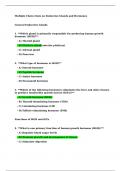
Multiple Choice Quiz on Endocrine Glands and Hormones General Endocrine Glands 1. **Which gland is primarily responsible for producing human growth hormone (HGH)?** - A) Thyroid gland - B) Pituitary gland(anterior pituitary) - C) Adrenal gland - D) Pancreas 2. **What type of hormone is HGH?** - A) Steroid hormone - B) Peptide hormone - C) Amine hormone - D) Eicosanoid hormone 3. **Which of the following hormones stimulates the liver and other tissues to produce insulin-like growth factors (IGFs)?** - A) Growth hormone (HGH) - B) Thyroid-stimulating hormone (TSH) - C) Luteinizing hormone (LH) - D) Follicle-stimulating hormone (FSH) Functions of HGH and IGFs 4. **What is one primary function of human growth hormone (HGH)?** - A) Regulate blood sugar levels - B) Promote growth and development of tissues - C) Stimulate digestion- D) Control stress responses 5. **What effect do insulin-like growth factors (IGFs) primarily have on the body?** - A) Increase metabolism - B) Promote cellular growth and development - C) Regulate electrolyte balance - D) Stimulate the immune response 6. **How does HGH affect protein synthesis in muscle cells?** - A) Decreases protein synthesis - B) Has no effect - C) Increases protein synthesis - D) Alters the structure of proteins #### Regulation of HGH 7. **What stimulates the secretion of growth hormone-releasing hormone (GHRH)?** - A) High blood sugar levels - B) Low blood glucose levels - C) Sleep and exercise 8. **Which hormone inhibits the release of growth hormone (GH)?** - A) GHRH - B) Insulin - C) Growth hormone-inhibiting hormone (GHIH) - D) Cortisol9. **Where is growth hormone-inhibiting hormone (GHIH) produced?** - A) Hypothalamus - B) Pituitary gland - C) Pancreas - D) Adrenal gland #### Effects and Interactions 10. **What is one potential effect of excess HGH in adults?** - A) Increased muscle mass - B) Decreased bone density - C) Acromegaly - D) Reduced energy levels - **Correct Answer:** C 11. **Which of the following statements about IGFs is TRUE?** - A) They are produced only in the pituitary gland. - B) They have a role in mediating the effects of HGH. - C) They are primarily produced in the pancreas. - D) They are only involved in fat metabolism. 12. **What role do GHRH and GHIH play in the regulation of HGH?** - A) GHRH stimulates and GHIH inhibits the release of HGH. - B) Both stimulate the release of HGH. - C) Both inhibit the release of HGH. - D) GHRH has no effect on HGH.#### Hormonal Feedback Mechanisms 13. **What type of feedback mechanism primarily regulates HGH secretion?** - A) Positive feedback - B) Negative feedback - C) Synergistic feedback - D) Permissive feedback 14. **Which hormone can have a synergistic effect on HGH by promoting growth?** - A) Insulin - B) Thyroid hormones - C) Testosterone - D) All of the above 15. **What might happen if there is a deficiency of GHRH?** - A) Increased secretion of HGH - B) Decreased growth and development - C) Elevated levels of IGFs - D) Enhanced metabolic rate Gonads 16. What are the primary functions of the gonads? o A) Produce hormones and regulate metabolism o B) Produce gametes and secrete hormones o C) Store nutrients and produce enzymes o D) Filter blood and regulate blood pressure 17.What hormones do the ovaries produce? o A) Testosterone and progesteroneo B) Estrogens and inhibin o C) Relaxin and follicle-stimulating hormone o D) Androgens and luteinizing hormone 18.What hormone is produced by the testes? o A) Estrogen o B) Relaxin o C) Testosterone o D) Melatonin 19.Which hormone inhibits the secretion of follicle-stimulating hormone (FSH)? o A) Estrogen o B) Progesterone o C) Inhibin o D) Relaxin 20.What role does relaxin play during pregnancy? o A) Increases testosterone levels o B) Enhances flexibility of the pubic symphysis o C) Promotes breast development o D) Inhibits estrogen production Pineal Gland 21.What hormone does the pineal gland secrete? o A) Estrogen o B) Melatonin o C) Testosterone o D) Thyroid hormone 22.What is the primary function of melatonin? o A) Regulates metabolism o B) Sets the body’s biological clock o C) Stimulates the immune response o D) Promotes growth23.When is melatonin secretion typically highest? o A) During daylight o B) At sunrise o C) During darkness o D) At noon 24. How does melatonin affect reproductive functions in some animals? a. A) Stimulates reproduction year-round b. B) Inhibits reproductive functions outside breeding season c. C) Increases testosterone production d. D) Enhances follicle development Thymus 25.Where is the thymus located? o A) In the brain o B) Behind the sternum between the lungs o C) In the abdominal cavity o D) In the pelvic cavity 26.What is the primary role of thymosin produced by the thymus? o A) Stimulate digestion o B) Promote maturation of T cells o C) Regulate blood sugar o D) Increase muscle mass Eicosanoids 27.Which of the following is NOT a type of eicosanoid? o A) Prostaglandins o B) Leukotrienes o C) Thymosins o  D) Both A and B 28. What do eicosanoids primarily bind to in order to exert their effects?  A) DNA B) Mitochondria  C) Receptors on target-cell plasma membranes  D) Ribosomes 28. What are the primary effects of prostaglandins?  A) Alter smooth muscle contraction and promote inflammation  B) Stimulate red blood cell production  C) Increase appetite  D) Regulate sleep patterns 29.Which of the following functions do leukotrienes have?  A) Stimulate platelet function  B) Mediate inflammation and attract white blood cells  C) Promote muscle growth  D) Regulate hormone levels #### Basic Concepts 30. **What is required for a target cell to respond to a hormone?** - A) The hormone must be in excess - B) The target cell must have specific receptors for the hormone - C) The hormone must be lipid-soluble - D) The target cell must be actively dividing 31. **What happens during down-regulation?** - A) Increase in receptor sensitivity - B) Decrease in the number of receptors - C) Increase in hormone production - D) Decrease in hormone secretion 32. **Which type of hormones are lipid-soluble?**- A) Amine hormones - B) Peptide hormones - C) Steroid hormones - D) Protein hormones 33. **Which hormones are considered water-soluble?** - A) Thyroid hormones(lipid soluble ) - B) Steroid hormones(lipid soluble) - C) Eicosanoid hormones - D) Both B and C #### Target Cell Responses 34. **Which of the following is NOT a response of target cells to hormones?** - A) Synthesis of molecules - B) Alteration of cell membrane permeability - C) Growth of muscle mass - D) Contraction of smooth or cardiac muscle 35. **What factors influence the responsiveness of target cells?** - A) Temperature and pressure - B) Hormone concentration, receptor abundance, and other hormones - C) Age and gender - D) Nutritional status #### Hormone Transport36. **How do most water-soluble hormones circulate in the blood?** - A) Bound to transport proteins - B) In a "free" form - C) Only as inactive precursors - D) Both A and C 37. **What is one function of transport proteins for lipid-soluble hormones?** - A) Increase hormone degradation - B) Make lipid-soluble hormones temporarily water-soluble - C) Decrease hormone levels in the blood - D) Facilitate hormone receptor binding #### Mechanism of Hormone Action 38. **Where are the receptors for lipid-soluble hormones typically located?** - A) On the cell membrane - B) In the cytosol or nucleus of target cells - C) In the extracellular fluid - D) On ribosomes 39. **What is the first messenger in the mechanism of action of water-soluble hormones?** - A) cAMP - B) ATP - C) The hormone itself - D) The transport protein 40. **What role does cyclic AMP (cAMP) play in hormone action?**- A) It is a transport protein - B) It acts as a second messenger - C) It degrades hormones - D) It synthesizes hormones #### Hormonal Interactions 41. **What is an example of a permissive effect of hormones?** - A) Insulin and glucagon - B) Epinephrine and thyroid hormones - C) Estrogens and progesterone - D) Cortisol and aldosterone 42. **What occurs when two hormones have a synergistic effect?** - A) Their combined effect is less than the sum of their individual effects - B) One hormone increases the effect of the other - C) They work independently with no interaction - D) They inhibit each other’s actions 43. **Which of the following pairs of hormones have antagonistic effects?** - A) Insulin and glucagon - B) Estrogens and progesterone - C) Thyroid hormones and growth hormone - D) Epinephrine and norepinephrine #### Control of Hormone Secretion44. **How is hormone secretion primarily regulated?** - A) By temperature changes - B) Through signals from the nervous system, blood chemical changes, and other hormones - C) By dietary intake - D) By external environmental factors - **Correct Answer:** B 45. **What typically characterizes the release pattern of most hormones?** - A) Continuous secretion throughout the day - B) Occasional bursts of secretion - C) Secretion only during the night - D) Secretion only during exercise - **Correct Answer:** B 46. **What is an example of chemical changes in the blood regulating hormone secretion?** - A) Stress levels affecting cortisol - B) Blood Ca²⁺ levels regulating parathyroid hormone - C) Blood glucose levels affecting insulin - D) All of the above - **Correct Answer:** D ### Quiz on Parathyroid Glands 1. Where are the parathyroid glands located?** A) In the anterior surface of the thyroid gland B) On the posterior surface of the lateral lobes of the thyroid gland C) In the pancreas D) In the adrenal glands**2. How many parathyroid glands are typically present?** A) Two B) Three C) Four D) Five **3. What is the name of the cells that produce parathyroid hormone?** A) Oxyphil cells B) Chief cells C) Follicular cells D) C cells **4. What is known about the function of oxyphil cells?** A) They produce insulin. B) Their function is well understood. C) Their function is not known. D) They produce parathyroid hormone. **5. How are the parathyroid glands classified based on their position?** A) Anterior and posterior B) Superior and inferior C) Lateral and medial D) Upper and lower ### Answers: 1. B 2. C 3. B 4. C5. B ### Revised Quiz on Parathyroid Hormone (PTH) **1. What is the primary function of parathyroid hormone (PTH)?** A) To regulate blood glucose levels B) To stimulate red blood cell production C) To regulate levels of calcium, magnesium, and phosphate in the blood D) To decrease blood pressure **2. Which cells are stimulated by PTH to increase bone resorption?** A) Osteoblasts B) Chondrocytes C) Osteoclasts D) Fibroblasts **3. How does PTH affect urinary loss of calcium (Ca2+) and magnesium (Mg2+)? ** A) Increases their urinary loss B) Has no effect on their urinary loss C) Decreases their urinary loss D) Promotes their reabsorption into bone **4. What is one of the effects of PTH on the kidneys?** A) Decreases phosphate (HPO42−) loss in urine B) Increases calcitriol production C) Inhibits the formation of urine D) Promotes the loss of calcium **5. What hormone is released in response to higher-than-normal blood calcium levels?**A) Calcitriol B) Insulin C) Parathyroid hormone (PTH) D) Calcitonin **6. What effect does calcitonin have on osteoclast activity?** A) Promotes the formation of osteoblasts B) Inhibits osteoclast activity C) Stimulates osteoclast activity D) Has no effect on osteoclasts **7. How does calcitriol influence calcium levels in the blood?** A) Increases absorption of calcium from food B) Decreases calcium release from bones C) Decreases absorption of calcium from food D) Has no effect on calcium levels ### Quiz on Hormones and Hormone Action **1. How do hormones affect specific target cells?** A) By circulating freely in the blood B) By chemically binding to specific protein receptors C) By changing the blood's pH D) By directly altering DNA in all cells **2. What is down-regulation in the context of hormone receptors?** A) An increase in hormone production B) A decrease in the number of receptors due to excess hormone C) The breakdown of hormones in the liver D) The stimulation of more receptor production**3. Which of the following hormones is classified as lipid-soluble?** A) Insulin B) Antidiuretic hormone C) Thyroid hormones D) Epinephrine **4. What type of hormone is synthesized from cholesterol?** A) Peptide hormones B) Eicosanoids C) Steroid hormones D) Amine hormones **5. What is the primary function of transport proteins for lipid-soluble hormones? ** A) To increase their secretion rate B) To make them water-soluble C) To promote their interaction with receptors D) To synthesize them in target cells **6. When a water-soluble hormone binds to a receptor on a target cell, what is the first messenger?** A) Cyclic AMP (cAMP) B) The hormone itself C) The receptor D) The transport protein **7. What is an example of a synergistic effect between two hormones?** A) Insulin and glucagon B) Follicle-stimulating hormone and estrogensC) Luteinizing hormone and testosterone D) Parathyroid hormone and calcitonin **8. What type of feedback mechanism primarily regulates hormone secretion?** A) Positive feedback B) Negative feedback C) Direct feedback D) Inhibitory feedback **9. What is the role of a permissive hormone?** A) It decreases the action of another hormone B) It is produced in response to another hormone C) It enhances the effects of another hormone D) It inhibits hormone receptor synthesis **10. Which hormone is released during childbirth to stimulate uterine contractions?** A) Parathyroid hormone B) Estrogen C) Oxytocin D) Progesterone ### Answers: 1. B 2. B 3. C 4. C 5. B 6. B 7. B8. B 9. C 10. C ### Quiz on Hormones and Their Functions **1. What determines a target cell's response to a hormone?** A) The target cell's size B) The hormone's concentration, receptor abundance, and other hormones' influences C) The type of tissue in which the target cell resides D) The age of the target cell **2. What happens to hormone receptors when there is a deficiency of a hormone? ** A) They are destroyed B) The number of receptors increases (up-regulation) C) They become inactive D) Their affinity decreases **3. Which type of hormone is NOT classified as water-soluble?** A) Insulin B) Thyroid hormones C) Peptide hormones D) Amine hormones **4. What is the role of cyclic AMP (cAMP) in the action of water-soluble hormones?** A) It binds to the hormone B) It serves as a second messenger to activate enzymes C) It deactivates the hormoneD) It transports the hormone in the blood **5. How do lipid-soluble hormones initiate a response in target cells?** A) By binding to receptors on the plasma membrane B) By binding to receptors inside the target cell C) By activating other hormones D) By increasing blood flow to the target cell **6. What effect do synergistic hormones have when acting together?** A) Their combined effect is less than the sum of their individual effects B) They oppose each other's actions C) Their combined effect is greater than the sum of their individual effects D) They have no effect on each other **7. Which of the following is an example of a water-soluble hormone?** A) Testosterone B) Estrogen C) Epinephrine D) Cortisol **8. What is the main regulatory mechanism for hormone secretion during childbirth?** A) Negative feedback B) Positive feedback C) Hormonal regulation D) Neural regulation **9. What do eicosanoids primarily derive from?** A) Amino acids B) CholesterolC) Arachidonic acid D) Nucleotides **10. Which hormone stimulates the synthesis of glycogen in liver cells?** A) Glucagon B) Cortisol C) Insulin D) Epinephrine ### Answers: 1. B 2. B 3. B 4. B 5. B 6. C 7. C 8. B 9. C 10. C ### **1. What shape do the adrenal glands have?** - A) Circular - B) Triangular - C) Flattened pyramidal - D) Oval ### **2. What percentage of the adrenal gland does the adrenal cortex comprise? ** - A) 50-60%- B) 70-80% - C) 80-90% - D) 90-100% ### **3. Which of the following is the function of mineralocorticoids?** - A) Regulate sodium and potassium homeostasis - B) Control blood glucose levels - C) Stimulate the fight-or-flight response - D) Promote protein synthesis ### **4. Which hormone is the major mineralocorticoid secreted by the adrenal cortex?** - A) Cortisol - B) Aldosterone - C) Epinephrine - D) ACTH ### **5. What activates the renin–angiotensin–aldosterone pathway?** - A) Increased blood pressure - B) Increased potassium levels - C) Dehydration, Na+ deficiency, or hemorrhage - D) Elevated cortisol levels ### **6. Which enzyme converts angiotensin I into angiotensin II?** - A) Renin - B) Aldosterone - C) ACE (Angiotensin-converting enzyme) - D) ACTH### **7. Which hormone promotes the reabsorption of sodium and water by the kidneys?** - A) Glucocorticoid - B) Aldosterone - C) Epinephrine - D) Cortisol ### **8. Which of the following hormones is NOT a glucocorticoid?** - A) Cortisol - B) Cortisone - C) Aldosterone - D) Corticosterone ### **9. What is the most abundant glucocorticoid in the body?** - A) Cortisone - B) Corticosterone - C) Cortisol - D) Epinephrine ### **10. What stimulates the release of ACTH from the anterior pituitary?** - A) High levels of aldosterone - B) Corticotropin-releasing hormone (CRH) - C) Decreased blood pressure - D) Increased blood glucose ### **11. Which of the following is a key function of glucocorticoids?** - A) Increase glucose uptake by cells - B) Promote sodium retention - C) Increase resistance to stress - D) Lower heart rate### **12. High doses of glucocorticoids can be useful for:** - A) Enhancing tissue repair - B) Increasing muscle growth - C) Treating chronic inflammatory disorders - D) Enhancing immune response ### **13. Which hormone contributes to female libido and post-menopausal estrogen levels?** - A) Cortisol - B) Testosterone - C) Aldosterone - D) Adrenal androgens ### **14. What is the primary function of the adrenal medulla?** - A) Secrete mineralocorticoids - B) Secrete glucocorticoids - C) Release epinephrine and norepinephrine to intensify sympathetic responses - D) Control blood sodium levels ### **15. Which of the following is NOT an effect of epinephrine and norepinephrine?** - A) Increase heart rate - B) Dilate airways to the lungs - C) Promote protein breakdown - D) Increase blood pressure ### **16. How does the body respond to low blood levels of glucocorticoids?**- A) By decreasing the release of ACTH - B) By stimulating the secretion of renin - C) By promoting the release of CRH from the hypothalamus - D) By increasing aldosterone secretion ### **17. What is the process called when amino acids or lactic acid are converted into glucose?** - A) Glycogenesis - B) Gluconeogenesis - C) Lipolysis - D) Glycolysis ### **18. What effect do glucocorticoids have on the immune system?** - A) Stimulate immune responses - B) Depress immune responses - C) Promote inflammation - D) Enhance white blood cell activity ### **19. Which hormone from the adrenal medulla is responsible for increasing the pumping output of the heart?** - A) Cortisol - B) Aldosterone - C) Epinephrine - D) ACTH ### **20. What is the major stimulus for the release of hormones from the adrenal medulla?** - A) High blood sugar - B) Sympathetic innervation from the autonomic nervous system - C) Increased ACTH levels- D) Low blood pressure

Content preview

Multiple Choice Quiz on Endocrine Glands and Hormones


General Endocrine Glands


1. **Which gland is primarily responsible for producing human growth
hormone (HGH)?**
- A) Thyroid gland
- B) Pituitary gland(anterior pituitary)
- C) Adrenal gland
- D) Pancreas


2. **What type of hormone is HGH?**
- A) Steroid hormone
- B) Peptide hormone
- C) Amine hormone
- D) Eicosanoid hormone


3. **Which of the following hormones stimulates the liver and other tissues
to produce insulin-like growth factors (IGFs)?**
- A) Growth hormone (HGH)
- B) Thyroid-stimulating hormone (TSH)
- C) Luteinizing hormone (LH)
- D) Follicle-stimulating hormone (FSH)


Functions of HGH and IGFs


4. **What is one primary function of human growth hormone (HGH)?**
- A) Regulate blood sugar levels
- B) Promote growth and development of tissues
- C) Stimulate digestion

, - D) Control stress responses


5. **What effect do insulin-like growth factors (IGFs) primarily have on the
body?**
- A) Increase metabolism
- B) Promote cellular growth and development
- C) Regulate electrolyte balance
- D) Stimulate the immune response


6. **How does HGH affect protein synthesis in muscle cells?**
- A) Decreases protein synthesis
- B) Has no effect
- C) Increases protein synthesis
- D) Alters the structure of proteins


#### Regulation of HGH


7. **What stimulates the secretion of growth hormone-releasing hormone
(GHRH)?**
- A) High blood sugar levels
- B) Low blood glucose levels
- C) Sleep and exercise


8. **Which hormone inhibits the release of growth hormone (GH)?**
- A) GHRH
- B) Insulin
- C) Growth hormone-inhibiting hormone (GHIH)
- D) Cortisol

, 9. **Where is growth hormone-inhibiting hormone (GHIH) produced?**
- A) Hypothalamus
- B) Pituitary gland
- C) Pancreas
- D) Adrenal gland


#### Effects and Interactions


10. **What is one potential effect of excess HGH in adults?**
- A) Increased muscle mass
- B) Decreased bone density
- C) Acromegaly
- D) Reduced energy levels
- **Correct Answer:** C


11. **Which of the following statements about IGFs is TRUE?**
- A) They are produced only in the pituitary gland.
- B) They have a role in mediating the effects of HGH.
- C) They are primarily produced in the pancreas.
- D) They are only involved in fat metabolism.


12. **What role do GHRH and GHIH play in the regulation of HGH?**
- A) GHRH stimulates and GHIH inhibits the release of HGH.
- B) Both stimulate the release of HGH.
- C) Both inhibit the release of HGH.
- D) GHRH has no effect on HGH.


Document information

Uploaded on
April 4, 2025
Number of pages
24
Written in
2024/2025
Type
Exam (elaborations)
Contains
Questions & answers
$14.99

Wrong document? Swap it for free Within 14 days of purchase and before downloading, you can choose a different document. You can simply spend the amount again.
Written by students who passed
Immediately available after payment
Read online or as PDF

Seller avatar
Reputation scores are based on the amount of documents a seller has sold for a fee and the reviews they have received for those documents. There are three levels: Bronze, Silver and Gold. The better the reputation, the more your can rely on the quality of the sellers work.
MindCraft
3.9
(55)
Sold
465
Followers
11
Items
2954
Last sold
1 day ago


Why students choose Stuvia

Created by fellow students, verified by reviews

Quality you can trust: written by students who passed their exams and reviewed by others who've used these revision notes.

Didn't get what you expected? Choose another document

No problem! You can straightaway pick a different document that better suits what you're after.

Pay as you like, start learning straight away

No subscription, no commitments. Pay the way you're used to via credit card and download your PDF document instantly.

Student with book image

“Bought, downloaded, and smashed it. It really can be that simple.”

Alisha Student

Working on your references?

Create accurate citations in APA, MLA and Harvard with our free citation generator.

Working on your references?

Frequently asked questions
