
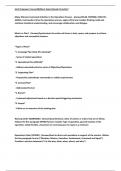
Joint Firepower Course (Midterm Exam) Solved Correctly!!
Major Missions Command Activities in the Operations Process - (Answer)PLAN, PREPARE, EXECUTE,
ASSESS. Commanders drive the operations process, apply critical and creative thinking, build and
maintain situational understanding, and encourage collaboration and dialogue
What is a Plan? - (Answer)Synchronizes the actions of forces in time, space, and purpose to achieve
objectives and accomplish missions.
*Types of Plans*
*1. Campaign Plan (Only JFCs develop)*
- Series of related operations
*2. Operational Plan (OPLAN)*
- Address extended period or series of Objectives/Operations
*3. Supporting Plan*
- Prepared by subordinate commander to satisfy requirements
*4. Concept Plan*
- Abbreviated format
*5. Branch*
- A planned adjustment based on a decision point/triggering mechanism
*6. Sequel*
- Follow on or extension of the existing plan
Warning Order (WARNORD) - (Answer)A preliminary notice of actions or orders that are to follow.
Follows the five paragraph OPORD format. Includes Type of operation, general location of the
operation, initial timeline, movement or reconnaissance to iniate as a minimum
Operations Order (OPORD) - (Answer)Used to direct unit operations in support of the mission. Utilizes
the five paragraph format (*Situation, Mission, Execution, Sustainment, Command and Signal*)
Provides a mission statement (*it is the who, what, when, where, and why*)
,Joint Firepower Course (Midterm Exam) Solved Correctly!!
Fragmentary Order (FRAGORD) - (Answer)Provides timely changes of existing orders to subordinates
while providing notifications to higher. Follows the five paragraph OPORD format, but addresses only
the parts of the original order that have changed.
Key Battalion/Brigade Staff Positions - XO - (Answer)Executive Officer (XO)
- Commanders principal assistant; XO at Brigade and below, Chief of Staff at Division or higher
Key Battalion/Brigade Staff Positions - S-3 - (Answer)Operations Officer (S-3)
- Coordinating staff officer; Responsible for, and synchronizes, all maneuver and maneuver support
elements.
Key Battalion/Brigade Staff Positions - S-2 - (Answer)Intelligence (S-2)
- Coordinating staff officer; Responsible for information collection including all ISR.
Key Battalion/Brigade Staff Positions - Fire Support Officer (FSO) - (Answer)Fire Support Officer (FSO)
- Special staff officer; Plans, coordinates, and executes all fires, also responsible for the Fires Cell (FC);
FSO at Brigade and below, DFSCOORD at Division/Corps
Key Battalion/Brigade Staff Positions - Air Liaison Officer (ALO) - (Answer)Air Liaison Officer (ALO
- Special staff office; Advises commander/staff on aerospace assets, coordinates tactical air support
missions with the FSO and manages the TACP
Key Battalion/Brigade Staff Positions - Brigade Aviation Element (BAE) - (Answer)Brigade Aviation
Element
- Special staff officer (Rated aviation officer); Performs the airspace control function (Airspace
integrator). Often collocated with the Air Defense Airspace Management Officer (ADAM/BAE)
,Joint Firepower Course (Midterm Exam) Solved Correctly!!
Key Battalion/Brigade Staff Positions - Air Defense Airspace Management (ADAM) - (Answer)Air
Defense Airspace Management
- Special staff officer; Senior air defense artillery officer in the command, coordinates airspace control
measures to support air and missile defense operations (Airspace Integrator). Often collocated with
the Brigade Aviation Element
Seven steps of the Military Decision Making Process: - (Answer)The MDMP process provides an
analyzed solution to a tactical military problem.
*Seven Steps of MDMP*
*1) Receive the mission*
- Alerts all participants of the pending plan requirements, enabling them to determine amount of
time available for planning.
*2) Mission Analysis*
- An assessment of the situation that enables units to better see themselves and the enemy. (The
WHAT, WHEN, WHERE, AND WHY)
*3) Course of Action Development*
- Development of options for subsequent analysis and comparison (The HOW)
*4) Course of Action Analysis (Wargaming)*
- Identifies which COAs accomplish the mission
*5) Course of Action Comparison*
- Independent evaluation of each COAs strenght/weaknesses
*6) Course of Action Approval*
- Commander selects the COA that best accomplishes the mission and his intent.
*7) Orders Production*
- Turns the selected COA into a five paragraph OPORD
, Joint Firepower Course (Midterm Exam) Solved Correctly!!
Five Paragraphs of an Operations Order - (Answer)Situation, Mission, Execution, Sustainment,
Command and Signal. Also includes many appendices and annexes *(Annex D, Appendix 5: Air
Support (CAS Task and Distribution)*
Situation Paragraph of an OPORD - (Answer)*Situation (1st Paragraph of an OPORD)*
- Area of interest, area of operations, enemy and friendly forces, interagency and NGOs, civil
considerations, attachments and detachments, assumptions
Mission Paragraph of an OPORD - (Answer)*Mission (2nd Paragraph of an OPORD)*
- Mission critical elements include the WHO, WHAT (Task), WHEN, WHERE, and WHY.
Execution Paragraph of an OPORD - (Answer)*Execution (3rd Paragraph of an OPORD)*
- Includes the commanders intent (PURPOSE, KEY TASK, AND ENDSTATE). Overall concept of the
operation, including scheme of employment for each warfighting function (Scheme of fires to include
air operations).
- Individual tasks to subordinate units (Task and Purpose)
- Coordinating instructions to two or more units.
Sustainment Paragraph of an OPORD - (Answer)*Sustainment (4th Paragraph of an OPORD)*
- States the concept of support before, during, and after the operation. Includes administrative
movements, transportation, logistics, personnel, and Army health system support
Command and Signal Paragraph of an OPORD - (Answer)*Command and Signal (5th Paragraph of an
OPORD)*
- Location of the commander, location of command posts, signal support
Combat Reconnaissance Vehicles - (Answer)Vehicles designed for operations *AT OR BEYOND THE
FLOT*, not to initiate combat but to survive if engaged. Includes *Armored Scout Cars, Light Patrol
Vehicles, and Light Strike Vehicles.*
Major Missions Command Activities in the Operations Process - (Answer)PLAN, PREPARE, EXECUTE,
ASSESS. Commanders drive the operations process, apply critical and creative thinking, build and
maintain situational understanding, and encourage collaboration and dialogue
What is a Plan? - (Answer)Synchronizes the actions of forces in time, space, and purpose to achieve
objectives and accomplish missions.
*Types of Plans*
*1. Campaign Plan (Only JFCs develop)*
- Series of related operations
*2. Operational Plan (OPLAN)*
- Address extended period or series of Objectives/Operations
*3. Supporting Plan*
- Prepared by subordinate commander to satisfy requirements
*4. Concept Plan*
- Abbreviated format
*5. Branch*
- A planned adjustment based on a decision point/triggering mechanism
*6. Sequel*
- Follow on or extension of the existing plan
Warning Order (WARNORD) - (Answer)A preliminary notice of actions or orders that are to follow.
Follows the five paragraph OPORD format. Includes Type of operation, general location of the
operation, initial timeline, movement or reconnaissance to iniate as a minimum
Operations Order (OPORD) - (Answer)Used to direct unit operations in support of the mission. Utilizes
the five paragraph format (*Situation, Mission, Execution, Sustainment, Command and Signal*)
Provides a mission statement (*it is the who, what, when, where, and why*)
,Joint Firepower Course (Midterm Exam) Solved Correctly!!
Fragmentary Order (FRAGORD) - (Answer)Provides timely changes of existing orders to subordinates
while providing notifications to higher. Follows the five paragraph OPORD format, but addresses only
the parts of the original order that have changed.
Key Battalion/Brigade Staff Positions - XO - (Answer)Executive Officer (XO)
- Commanders principal assistant; XO at Brigade and below, Chief of Staff at Division or higher
Key Battalion/Brigade Staff Positions - S-3 - (Answer)Operations Officer (S-3)
- Coordinating staff officer; Responsible for, and synchronizes, all maneuver and maneuver support
elements.
Key Battalion/Brigade Staff Positions - S-2 - (Answer)Intelligence (S-2)
- Coordinating staff officer; Responsible for information collection including all ISR.
Key Battalion/Brigade Staff Positions - Fire Support Officer (FSO) - (Answer)Fire Support Officer (FSO)
- Special staff officer; Plans, coordinates, and executes all fires, also responsible for the Fires Cell (FC);
FSO at Brigade and below, DFSCOORD at Division/Corps
Key Battalion/Brigade Staff Positions - Air Liaison Officer (ALO) - (Answer)Air Liaison Officer (ALO
- Special staff office; Advises commander/staff on aerospace assets, coordinates tactical air support
missions with the FSO and manages the TACP
Key Battalion/Brigade Staff Positions - Brigade Aviation Element (BAE) - (Answer)Brigade Aviation
Element
- Special staff officer (Rated aviation officer); Performs the airspace control function (Airspace
integrator). Often collocated with the Air Defense Airspace Management Officer (ADAM/BAE)
,Joint Firepower Course (Midterm Exam) Solved Correctly!!
Key Battalion/Brigade Staff Positions - Air Defense Airspace Management (ADAM) - (Answer)Air
Defense Airspace Management
- Special staff officer; Senior air defense artillery officer in the command, coordinates airspace control
measures to support air and missile defense operations (Airspace Integrator). Often collocated with
the Brigade Aviation Element
Seven steps of the Military Decision Making Process: - (Answer)The MDMP process provides an
analyzed solution to a tactical military problem.
*Seven Steps of MDMP*
*1) Receive the mission*
- Alerts all participants of the pending plan requirements, enabling them to determine amount of
time available for planning.
*2) Mission Analysis*
- An assessment of the situation that enables units to better see themselves and the enemy. (The
WHAT, WHEN, WHERE, AND WHY)
*3) Course of Action Development*
- Development of options for subsequent analysis and comparison (The HOW)
*4) Course of Action Analysis (Wargaming)*
- Identifies which COAs accomplish the mission
*5) Course of Action Comparison*
- Independent evaluation of each COAs strenght/weaknesses
*6) Course of Action Approval*
- Commander selects the COA that best accomplishes the mission and his intent.
*7) Orders Production*
- Turns the selected COA into a five paragraph OPORD
, Joint Firepower Course (Midterm Exam) Solved Correctly!!
Five Paragraphs of an Operations Order - (Answer)Situation, Mission, Execution, Sustainment,
Command and Signal. Also includes many appendices and annexes *(Annex D, Appendix 5: Air
Support (CAS Task and Distribution)*
Situation Paragraph of an OPORD - (Answer)*Situation (1st Paragraph of an OPORD)*
- Area of interest, area of operations, enemy and friendly forces, interagency and NGOs, civil
considerations, attachments and detachments, assumptions
Mission Paragraph of an OPORD - (Answer)*Mission (2nd Paragraph of an OPORD)*
- Mission critical elements include the WHO, WHAT (Task), WHEN, WHERE, and WHY.
Execution Paragraph of an OPORD - (Answer)*Execution (3rd Paragraph of an OPORD)*
- Includes the commanders intent (PURPOSE, KEY TASK, AND ENDSTATE). Overall concept of the
operation, including scheme of employment for each warfighting function (Scheme of fires to include
air operations).
- Individual tasks to subordinate units (Task and Purpose)
- Coordinating instructions to two or more units.
Sustainment Paragraph of an OPORD - (Answer)*Sustainment (4th Paragraph of an OPORD)*
- States the concept of support before, during, and after the operation. Includes administrative
movements, transportation, logistics, personnel, and Army health system support
Command and Signal Paragraph of an OPORD - (Answer)*Command and Signal (5th Paragraph of an
OPORD)*
- Location of the commander, location of command posts, signal support
Combat Reconnaissance Vehicles - (Answer)Vehicles designed for operations *AT OR BEYOND THE
FLOT*, not to initiate combat but to survive if engaged. Includes *Armored Scout Cars, Light Patrol
Vehicles, and Light Strike Vehicles.*


