Inquiry question:
What distinguishes one cell from another?
Examining a variety of prokaryotic and eukaryotic cells
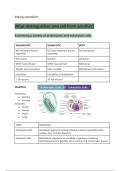
PROKARYOTIC EUKARYOTIC BOTH
NO membrane bound DO have membrane bound Cell membrane
organelles organelles
NO nucleus Nucleus Cytoplasm
MOST have cell wall SOME have cell wall Ribosomes
Simpler (more primitive) More complex DNA/Genetic information
Unicellular Unicellular or Multicellular
1-10 microns 10-100 microns
EXAMPLES:
Prokaryotic:
● Bacteria
● Archaea
Eukaryotic:
● Protist
● Animal
● Plants
● Fungi
TERM DEFINITION
Prokaryotic cells Unicellular organisms lacking membrane bound organelles and a
nucleus, (E.g- Archaea, Bacteria)
Eukaryotic cells Multicellular organisms or unicellular organisms containing
membrane bound organelles and a nucleus, (E.g- Protist cells, Animal
, cells, Plant cells, Fungus cells)
Cell membrane The cell membrane is a barrier which controls the substances that are
transported into and out of the cell
Organelles Subcellular structure that has a specific role within the cell
Unicellular An organism that is made up of one cell
Multicellular An organism that is made up of multiple cells
Cell wall A rigid external layer that provides structure and integrity to the cell
(MOST PROkaryotes have a cell wall and SOME EUkaryotes have cell
wall)
Nucleus The structure within a cell that contains DNA organised into
chromosomes
Ribosomes Collect amino acids and create proteins through the joining of the
amino acids by peptide bonds, creating polypeptide chains (proteins)
Amino acids Molecules that combine to form proteins- 20 amino acids
DNA Deoxyribonucleic acid is a molecule that carries genetic information
for the growth and functioning or an organism
Genetic material Material that carriers genetic information from generation to
generation
Membrane bound A structure within a cell that is bound in the membrane of the cell
organelles (E.g- Eukaryotic cells have these Prokaryotic cells do not)
Cytoplasm The jelly like fluid that fills the inside of a cell
Describe a range of technologies that are used to determine a
cell’s structure and function
MICROSCOPES
● Light
○ Can view living and non living specimens
○ Magnify up to 1500X
○ Coloured image
● Fluorescent
, ○ A fluorescent substance is added to the specimen that attaches to certain
structures that scientists want to observe
○ Undergoes intense illumination and the substances that the fluorescent
substance attached to illuminate making them visible
● Electron (SEM)
○ 3D image created
○ Electron beam bombards specimen
○ Black and white image
○ Can view non living only
● Electron (TEM)
○ 2D image created
○ Electron beam passes through specimen
○ Black and white image
○ Can view non living only
Investigate a variety of prokaryotic and eukaryotic cell
structures, including but not limited to:
Drawing scaled diagrams of a variety of cells
Comparing and contrasting different cell organelles an
arrangements
ORGANELLE ROLE
Vesicle Membrane sac- Transports material such as food
Vacuole Membrane sac- Stores nutrients such as water in plant
, cells and food in animals but can also store waste, often
plant cells have a central vacuole and animal cells have
multiple
Lysosomes Membrane sac of digestive organisms- Digest food, digest
broken organelles and other foreign bodies, contains
enzymes switch aid with their digestion of foreign bodies
Mitochondria Double membrane- Makes ATP (Oxygen+Sugar) from
cellular respiration, fuels cells through ATP it has a highly
folded inner membrane to increase surface area for more
area for cellular respiration to take place within
Chloroplasts (Plant cells Makes energy and sugars from sunlight through
only) photosynthesis to fuel the cell, plant cells get their colour
from chloroplasts as they use the sugars created to build
roots and fruit
Nucleus Nuclear membrane and Nucleolus- Protects DNA which
has instruction for building proteins and hold
chromosomes in DNA, proteins are excreted by nuclear
pores- The nucleolus produces ribosomes through the
genes ‘coding’
Ribosomes Some in cytoplasm some on rough ER- Build proteins from
amino acids, get instructions to build proteins from DNA
Endoplasmic Reticulum (ER) Smooth ER is smooth, Rough ER has ribosomes attached-
Rough ER helps to complete proteins after the ribosomes
build them and transport them, Smooth ER can make
lipids and hormones
Golgi Apparatus Membrane sacs- Finishes, sorts, labels and transports
proteins, transports proteins in vesicles
Centrioles (Animal cells One pair in each cell- Help coordinate cell division
only)
Modelling the structure and function of the fluid mosaic model of
the cell membrane