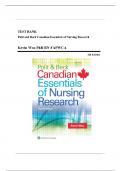
,TableofContents
Chapter 1.Introductionto NursingResearch inanEvidence-Based PracticeEnvironmentChapter 2.
.z .z
Fundamentals ofEvidence-Based Nursing Practice
Chapter3. KeyConcepts and Stepsin Quantitative and QualitativeResearchChapter
.z
4. Reading and Critiquing Research
ArticlesChapter 5.Ethics in Research
.z
Chapter 6. Research Problems, Research Questions, and
HypothesesChapter 7. Finding and Reviewing Research Evidence in
the LiteratureChapter 8. Theoretical and Conceptual Frameworks
Chapter 9. Quantitative Research Design
.z
Chapter 10. Sampling and Data Collection in Quantitative
StudiesChapter 11. Qualitative Designs and Approaches
Chapter 12. Sampling and Data Collection in Qualitative
StudiesChapter 13. Mixed Methods and Other Special Types of
.z
ResearchChapter 14. StatisticalAnalysis ofQuantitative Data
Chapter15.InterpretationandClinicalSignificance
.z
inQuantitativeResearchChapter 16. Analysis ofQualitative Data
.z
Chapter 17. Trustworthiness and Integrity in Qualitative Research
Chapter18. SystematicReviews:Meta-AnalysisandMetasynthesis
,Polit & Beck Canadian Essentials of Nursing Research 4th Edition Woo
TestBank
Chapter 1. Introduction to Nursing Research in an Evidence-Based Practice
Environment
What is the highest priority for the
1.
importance
of research in the nursing profession?
Research findings provide evidence for
A)
informing nurses' decisions and actions.
Conduct research to better understand the
B)
context of nursing practice.
Document the role that nurses serve in
C)
society.
D) Establish nursing research areas of study.
Which group would be best served by clinical
2.
nursing research?
A) Nursing administrators
B) Practicing nurses
C) Nurses' clients
D) Healthcare policymakers
3. In the United States, in what area does
research play an important role in nursing?
A) Chronic illness
B) Credentialing and status
C) Nurses' personalities
D) Nurses' education
What is the role of a consumer of
4.
nursingresearch?
.z
A) Read research reports for relevant findings.
Participate in generating evidence by doing
B)
research.
Participate in journal club in a practice
C)
setting.
D) Solve clinical problems and make clinical
decisions.
5. What was the concern of most nursing
studiesin the early 1900s?
, A) Client satisfaction
B) Clinical problems
C) Health promotion
D) Nursing education
Which topic most closely conforms to
6. thepriorities that have been suggested
.z
for
futurenursing research?
A) Attitudes of nursing students toward smoking.
B) Promotion of excellence in nursing science.
C) Nursing staff morale and turnover.
Number of doctorate prepared nurses in
D)
various clinical specialties.
7. What is the process of deductive reasoning?
Verifying assumptions that are part of our
A)
heritage.
Developing specific predictions from general
B)
principles.
Empirically testing observations that are
C)
made
known through our senses.
D) Forming generalizations from specific
observations.
What is the ontological assumption of those
8.
espousing a naturalistic paradigm?
A) Objective reality and those natural
phenomena are regular and orderly.
Phenomena are not haphazard and result
B)
from
prior causes.
Reality is multiply constructed and multiply
C)
interpreted by humans.
Reality is not fixed, but is rather a
D)
construction of human minds.
What is the epistemological assumption of
9.
those espousing a positivist paradigm?
A) The researcher is objective and independent
of those being studied.
Phenomena are not haphazard, but rather
B)
have
antecedent causes.
Chapter 1.Introductionto NursingResearch inanEvidence-Based PracticeEnvironmentChapter 2.
.z .z
Fundamentals ofEvidence-Based Nursing Practice
Chapter3. KeyConcepts and Stepsin Quantitative and QualitativeResearchChapter
.z
4. Reading and Critiquing Research
ArticlesChapter 5.Ethics in Research
.z
Chapter 6. Research Problems, Research Questions, and
HypothesesChapter 7. Finding and Reviewing Research Evidence in
the LiteratureChapter 8. Theoretical and Conceptual Frameworks
Chapter 9. Quantitative Research Design
.z
Chapter 10. Sampling and Data Collection in Quantitative
StudiesChapter 11. Qualitative Designs and Approaches
Chapter 12. Sampling and Data Collection in Qualitative
StudiesChapter 13. Mixed Methods and Other Special Types of
.z
ResearchChapter 14. StatisticalAnalysis ofQuantitative Data
Chapter15.InterpretationandClinicalSignificance
.z
inQuantitativeResearchChapter 16. Analysis ofQualitative Data
.z
Chapter 17. Trustworthiness and Integrity in Qualitative Research
Chapter18. SystematicReviews:Meta-AnalysisandMetasynthesis
,Polit & Beck Canadian Essentials of Nursing Research 4th Edition Woo
TestBank
Chapter 1. Introduction to Nursing Research in an Evidence-Based Practice
Environment
What is the highest priority for the
1.
importance
of research in the nursing profession?
Research findings provide evidence for
A)
informing nurses' decisions and actions.
Conduct research to better understand the
B)
context of nursing practice.
Document the role that nurses serve in
C)
society.
D) Establish nursing research areas of study.
Which group would be best served by clinical
2.
nursing research?
A) Nursing administrators
B) Practicing nurses
C) Nurses' clients
D) Healthcare policymakers
3. In the United States, in what area does
research play an important role in nursing?
A) Chronic illness
B) Credentialing and status
C) Nurses' personalities
D) Nurses' education
What is the role of a consumer of
4.
nursingresearch?
.z
A) Read research reports for relevant findings.
Participate in generating evidence by doing
B)
research.
Participate in journal club in a practice
C)
setting.
D) Solve clinical problems and make clinical
decisions.
5. What was the concern of most nursing
studiesin the early 1900s?
, A) Client satisfaction
B) Clinical problems
C) Health promotion
D) Nursing education
Which topic most closely conforms to
6. thepriorities that have been suggested
.z
for
futurenursing research?
A) Attitudes of nursing students toward smoking.
B) Promotion of excellence in nursing science.
C) Nursing staff morale and turnover.
Number of doctorate prepared nurses in
D)
various clinical specialties.
7. What is the process of deductive reasoning?
Verifying assumptions that are part of our
A)
heritage.
Developing specific predictions from general
B)
principles.
Empirically testing observations that are
C)
made
known through our senses.
D) Forming generalizations from specific
observations.
What is the ontological assumption of those
8.
espousing a naturalistic paradigm?
A) Objective reality and those natural
phenomena are regular and orderly.
Phenomena are not haphazard and result
B)
from
prior causes.
Reality is multiply constructed and multiply
C)
interpreted by humans.
Reality is not fixed, but is rather a
D)
construction of human minds.
What is the epistemological assumption of
9.
those espousing a positivist paradigm?
A) The researcher is objective and independent
of those being studied.
Phenomena are not haphazard, but rather
B)
have
antecedent causes.