

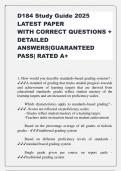
D184 Study Guide 2025
LATEST PAPER
WITH CORRECT QUESTIONS +
DETAILED
ANSWERS|GUARANTEED
PASS| RATED A+
1. How would you describe standards-based grading systems? -
✔✔✔A standard of grading that tracks student progress towards
and achievement of learning targets that are derived from
educational standards; grades reflect student mastery of the
learning targets and are measured on proficiency scales.
Which characteristics apply to standards-based grading? -
✔✔✔- Scores are reflected on proficiency scales
- Grades reflect student mastery of a learning target.
-Teachers tailor instruction based on student achievement
Based on the percentage average of all grades or holistic
grades - ✔✔✔traditional grading system
Based on different proficiency levels of standards -
✔✔✔standard based grading system
Single grade given per course on report cards -
✔✔✔traditional grading system
, Grade based on most recent evidence - ✔✔✔traditional
grading system
what are the defining characteristics of a standards-based
grading system? - ✔✔✔Standards-based grading is built around
achievement level goals that are based on content-specific
benchmarks within academic subjects. A standards-based
approach differs from traditional approaches that are built around
an average percentage of assignments, letter grades, or students'
rank of performance against the rest of the class. A standards-
based system is highly beneficial to the student because teaching
and learning can be fine-tuned to the needs of each student rather
than only a portion of students in any given classroom.
Which explanation applies to the type of assessments used
in a standards-based grading system? - ✔✔✔Criterion-based
assessments are used because students are measured against a
learning target (criterion) derived from an academic standard.
Which teacher approach would be most appropriate in a
standards-based grading system?
A. The teacher notes that the student is proficient by marking
a "3" on the four-point proficiency scale for the assessment,
noting that not all fractions have unlike denominators.
B. The teacher notes that the student is not proficient by
marking the assessment a "2" on the four-point proficiency scale
and provides support to the student to help her learn how to find
least common denominators.
C. The teacher encourages the student to complete an extra-
credit assignment by making a video about why math can be fun
to offset the poor grade earned on the assessment.
D. The teacher scores the assessment and gives the student a
grade of 34 percent and urges the student to reread the chapter in
, the textbook about adding and subtracting fractions. - ✔✔✔B.
The teacher notes that the student is not proficient by marking the
assessment a "2" on the four-point proficiency scale and provides
support to the student to help her learn how to find least common
denominators.
With a clear understanding of student knowledge and next
steps for progress, this stakeholder is empowered to support the
student in attaining goals and gaining confidence through
encouragement and guidance. - ✔✔✔Stakeholder
Unequivocal knowledge of instructional needs and useful
interventions for each student will guide this stakeholder's future
instruction. - ✔✔✔Teacher
Knowing their expectations and level of proficiency allows
this stakeholder to set personal goals, make improvements with
practice, demonstrate knowledge by meeting expectations, and
persevere through challenges by continued effort. - ✔✔✔Student
Stakeholders need letter grades to understand a student's
academic performance. True of false? - ✔✔✔False
Which teacher response would help the parent understand
standards-based grading report cards?
A. Sympathize with the parent and share the challenges they
are having with standards-based grading so the parent knows it is
a difficult system for everyone
B. Review the report card and standards with the parent,
explaining how the standards are assessed and clarifying the
grading scale that is used
C. Provide the parent with a percentage and letter grade
equivalent for each subject area every nine weeks
LATEST PAPER
WITH CORRECT QUESTIONS +
DETAILED
ANSWERS|GUARANTEED
PASS| RATED A+
1. How would you describe standards-based grading systems? -
✔✔✔A standard of grading that tracks student progress towards
and achievement of learning targets that are derived from
educational standards; grades reflect student mastery of the
learning targets and are measured on proficiency scales.
Which characteristics apply to standards-based grading? -
✔✔✔- Scores are reflected on proficiency scales
- Grades reflect student mastery of a learning target.
-Teachers tailor instruction based on student achievement
Based on the percentage average of all grades or holistic
grades - ✔✔✔traditional grading system
Based on different proficiency levels of standards -
✔✔✔standard based grading system
Single grade given per course on report cards -
✔✔✔traditional grading system
, Grade based on most recent evidence - ✔✔✔traditional
grading system
what are the defining characteristics of a standards-based
grading system? - ✔✔✔Standards-based grading is built around
achievement level goals that are based on content-specific
benchmarks within academic subjects. A standards-based
approach differs from traditional approaches that are built around
an average percentage of assignments, letter grades, or students'
rank of performance against the rest of the class. A standards-
based system is highly beneficial to the student because teaching
and learning can be fine-tuned to the needs of each student rather
than only a portion of students in any given classroom.
Which explanation applies to the type of assessments used
in a standards-based grading system? - ✔✔✔Criterion-based
assessments are used because students are measured against a
learning target (criterion) derived from an academic standard.
Which teacher approach would be most appropriate in a
standards-based grading system?
A. The teacher notes that the student is proficient by marking
a "3" on the four-point proficiency scale for the assessment,
noting that not all fractions have unlike denominators.
B. The teacher notes that the student is not proficient by
marking the assessment a "2" on the four-point proficiency scale
and provides support to the student to help her learn how to find
least common denominators.
C. The teacher encourages the student to complete an extra-
credit assignment by making a video about why math can be fun
to offset the poor grade earned on the assessment.
D. The teacher scores the assessment and gives the student a
grade of 34 percent and urges the student to reread the chapter in
, the textbook about adding and subtracting fractions. - ✔✔✔B.
The teacher notes that the student is not proficient by marking the
assessment a "2" on the four-point proficiency scale and provides
support to the student to help her learn how to find least common
denominators.
With a clear understanding of student knowledge and next
steps for progress, this stakeholder is empowered to support the
student in attaining goals and gaining confidence through
encouragement and guidance. - ✔✔✔Stakeholder
Unequivocal knowledge of instructional needs and useful
interventions for each student will guide this stakeholder's future
instruction. - ✔✔✔Teacher
Knowing their expectations and level of proficiency allows
this stakeholder to set personal goals, make improvements with
practice, demonstrate knowledge by meeting expectations, and
persevere through challenges by continued effort. - ✔✔✔Student
Stakeholders need letter grades to understand a student's
academic performance. True of false? - ✔✔✔False
Which teacher response would help the parent understand
standards-based grading report cards?
A. Sympathize with the parent and share the challenges they
are having with standards-based grading so the parent knows it is
a difficult system for everyone
B. Review the report card and standards with the parent,
explaining how the standards are assessed and clarifying the
grading scale that is used
C. Provide the parent with a percentage and letter grade
equivalent for each subject area every nine weeks


