
Maternity Exam 2 Study Guide
Chapter 15: Postpartum Adaptations
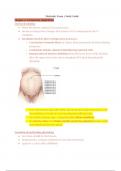
Uterine Involution
● When the uterus returns to its normal size.
● Involves retrogressive changes that return it to its nonpregnant size &
condition.
● Involution involves three retrogressive processes:
○ Contraction of muscle fibers to reduce those previously stretched during
pregnancy
○ Catabolism shrinks enlarged individual myometrial cells
○ Regeneration of uterine epithelium from the lower layer of the decidua
after the upper layers have been sloughed off & shed during lochial
discharge
○ Over the first few days after birth, the uterus descends from the level of
the umbilicus at a rate of 1 cm (one fingerbreadth) per day.
○ Gave birth 48 hours ago= 2 fingerbreadths below umbilicus
○ By end of 10 days, the fundus usually cannot be palpated because it has
descended into the true pelvis.
Lactation/breastfeeding physiology
● Secretion of milk by the breasts
● Progesterone, estrogen, prolactin & oxytocin interaction
● Appears 4-5 days after childbirth
, ● “Breast crawl” process:
○ Newborns will move on their mother’s abdomen up to her breast
instinctively.
● Oxytocin is responsible for milk let down
Suppressing lactation
● NOT breastfeeding:
○ Wear tight bra
○ Ice
○ Avoid breast stimulation
○ Cabbage leaves
Phases of Maternal Adaptation to Parenthood
● Reva Rubin’s 3 Phases:
○ Taking-in phase:
■ The time immediately after birth when the client needs others to
meet her needs & relives the birth process (24-48 hrs)
○ Taking-hold phase:
■ Characterized by dependent & independent maternal behavior.
○ Letting-go phase:
■ Woman reestablishes relationships with others.
● Four stages of becoming a mother:
○ Commitment, attachment to unborn baby, preparation for delivery &
motherhood during pregnancy.
○ Acquaintance/attachment to infant, learning to care for infant, & physical
restoration 2-6 weeks post birth.
, ○ Moving toward a new normal.
○ Achievement of maternal identity through redefining self to incorporate
motherhood (around 4 months).
Parental Attachment Behaviors
● Attachment: formation of a relationship between parent & his or her newborn
through a process of physical & emotional interactions
● Factors influencing attachment:
○ Environmental circumstances
○ Newborn health
○ Quality of nursing care
Lochia – types, amount
3 stages:
Rubra, serosa, alba. They should NOt be going backwards, bleeding should lessen.
Urinary & Endocrine System Adaptations
● URINARY ADAPTATIONS
Chapter 15: Postpartum Adaptations
Uterine Involution
● When the uterus returns to its normal size.
● Involves retrogressive changes that return it to its nonpregnant size &
condition.
● Involution involves three retrogressive processes:
○ Contraction of muscle fibers to reduce those previously stretched during
pregnancy
○ Catabolism shrinks enlarged individual myometrial cells
○ Regeneration of uterine epithelium from the lower layer of the decidua
after the upper layers have been sloughed off & shed during lochial
discharge
○ Over the first few days after birth, the uterus descends from the level of
the umbilicus at a rate of 1 cm (one fingerbreadth) per day.
○ Gave birth 48 hours ago= 2 fingerbreadths below umbilicus
○ By end of 10 days, the fundus usually cannot be palpated because it has
descended into the true pelvis.
Lactation/breastfeeding physiology
● Secretion of milk by the breasts
● Progesterone, estrogen, prolactin & oxytocin interaction
● Appears 4-5 days after childbirth
, ● “Breast crawl” process:
○ Newborns will move on their mother’s abdomen up to her breast
instinctively.
● Oxytocin is responsible for milk let down
Suppressing lactation
● NOT breastfeeding:
○ Wear tight bra
○ Ice
○ Avoid breast stimulation
○ Cabbage leaves
Phases of Maternal Adaptation to Parenthood
● Reva Rubin’s 3 Phases:
○ Taking-in phase:
■ The time immediately after birth when the client needs others to
meet her needs & relives the birth process (24-48 hrs)
○ Taking-hold phase:
■ Characterized by dependent & independent maternal behavior.
○ Letting-go phase:
■ Woman reestablishes relationships with others.
● Four stages of becoming a mother:
○ Commitment, attachment to unborn baby, preparation for delivery &
motherhood during pregnancy.
○ Acquaintance/attachment to infant, learning to care for infant, & physical
restoration 2-6 weeks post birth.
, ○ Moving toward a new normal.
○ Achievement of maternal identity through redefining self to incorporate
motherhood (around 4 months).
Parental Attachment Behaviors
● Attachment: formation of a relationship between parent & his or her newborn
through a process of physical & emotional interactions
● Factors influencing attachment:
○ Environmental circumstances
○ Newborn health
○ Quality of nursing care
Lochia – types, amount
3 stages:
Rubra, serosa, alba. They should NOt be going backwards, bleeding should lessen.
Urinary & Endocrine System Adaptations
● URINARY ADAPTATIONS


