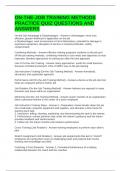
ON-THE-JOB TRAINING METHODS
PRACTICE QUIZ QUESTIONS AND
ANSWERS
On-the-Job Advantage & Disadvantages - Answer-o Advantages: more-cost
effective, greater likelihood of application on the job
o Disadvantages: work environment is full of distractions, potential for damage to
expensive equipment, disruption of service or slowed production, safety
compromised
Combining Methods - Answer-effective training programs combine on-the-job and
off-the-job training methods, combining methods to suit needs and objectives is most
important, blended approaches to training are often the best approach
Use of On-the-Job Training - Answer-many approaches, useful for small business
because of limited investment, 43% of SME's use on-the-job training
Job Instruction Training (On-the-Job Training Method) - Answer-formalized,
structured, and systematic approach
Performance Aid (On-the-Job Training Method) - Answer-a device at the job site that
helps an employee perform his/her job
Job Rotation (On-the-Job Training Method) - Answer-trainees are exposed to many
functions and areas within an organization
Mentoring (On-the-Job Training Method) - Answer-senior member of an organization
takes a personal interest in the career of a junior employee
Job Instruction Training Steps - Answer-1. Preparation: trainer breaks down the job
into small tasks, prepares equipment and supplies, and allocates a time frame for
learning each task
2. Instruction: telling, showing, explaining, and demonstrating the task to the trainee
3. Performance: trainee performs task under the trainer's guidance and the trainer
provides feedback and reinforcement
4. Follow-Up: the trainer monitors the trainee's performance
Cross-Training (Job Rotation) - Answer-training employees to perform each other's
jobs
Stretch Assignment (Job Rotation) - Answer-job assignments that aim to "stretch"
employees by having them work on challenging tasks and projects that involve
learning new knowledge and skills
Coaching 4 Core Elements - Answer-1. Formation/maintenance of a helping
relationship between the coach and the coachee
PRACTICE QUIZ QUESTIONS AND
ANSWERS
On-the-Job Advantage & Disadvantages - Answer-o Advantages: more-cost
effective, greater likelihood of application on the job
o Disadvantages: work environment is full of distractions, potential for damage to
expensive equipment, disruption of service or slowed production, safety
compromised
Combining Methods - Answer-effective training programs combine on-the-job and
off-the-job training methods, combining methods to suit needs and objectives is most
important, blended approaches to training are often the best approach
Use of On-the-Job Training - Answer-many approaches, useful for small business
because of limited investment, 43% of SME's use on-the-job training
Job Instruction Training (On-the-Job Training Method) - Answer-formalized,
structured, and systematic approach
Performance Aid (On-the-Job Training Method) - Answer-a device at the job site that
helps an employee perform his/her job
Job Rotation (On-the-Job Training Method) - Answer-trainees are exposed to many
functions and areas within an organization
Mentoring (On-the-Job Training Method) - Answer-senior member of an organization
takes a personal interest in the career of a junior employee
Job Instruction Training Steps - Answer-1. Preparation: trainer breaks down the job
into small tasks, prepares equipment and supplies, and allocates a time frame for
learning each task
2. Instruction: telling, showing, explaining, and demonstrating the task to the trainee
3. Performance: trainee performs task under the trainer's guidance and the trainer
provides feedback and reinforcement
4. Follow-Up: the trainer monitors the trainee's performance
Cross-Training (Job Rotation) - Answer-training employees to perform each other's
jobs
Stretch Assignment (Job Rotation) - Answer-job assignments that aim to "stretch"
employees by having them work on challenging tasks and projects that involve
learning new knowledge and skills
Coaching 4 Core Elements - Answer-1. Formation/maintenance of a helping
relationship between the coach and the coachee