
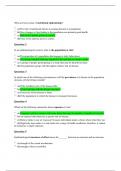
What are focus areas of nutritional epidemiology?
a) The role of nutritional factors in causing disease in a population.
b) How changes in food intake in the population can promote good health.
c) Both of the options given are correct.
d) None of the options given is correct.
Question 2
In an epidemiological context, what is the population at risk?
a) The proportion of a population that engage in risky behaviours.
b) The group of people that may experience the outcome we want to study.
c) A group of people participating in a study that may be harmful to them.
d) The population group with the highest relative risk of disease.
Question 3
In which one of the following circumstances will the prevalence of a disease in the population
increase, all else being constant?
a) If the incidence rate of the disease falls.
b) If survival time with the disease increases.
c) If recovery of the disease is faster.
d) If the population in which the disease is measured increases.
Question 4
Which of the following statements about exposures is true?
a) 'Exposure' refers to contact with some factor that may be harmful or beneficial to health.
b) An exposed individual has a greater risk of disease.
c) Dietary intake is not an 'exposure' because individuals make a choice about what they eat.
d) High body mass index is a risk factor for a range of health conditions, therefore, it cannot
be treated as a single exposure.
Question 5
Epidemiological measures of effect assess the _______ between an exposure and an outcome.
a) strength of the causal mechanisms
b) strength of the reversibility
, c) strength of the association
d) strength of a confounding factor
Question 6
It is possible to reduce (though not eliminate) information bias in assessment of dietary intake
by
a) gathering information about many different aspects of people's dietary habits.
b) collecting data about dietary intake at the onset of a study, before people have experienced
symptoms of disease.
c) collecting data on all possible confounders.
d) making sure that the study sample is representative of the population.
Question 7
In a cohort study, the risk ratio of developing diabetes was 0.86 when comparing consumers of
tea (the exposed) to those who did not drink tea (the unexposed). Which one statement is
correct?
a) The tea drinkers have lower risk of developing diabetes.
b) The tea drinkers have higher risk of developing diabetes.
c) Based on the information given we cannot tell if the observed difference in disease risk is
the result of chance.
d) The risk ratio is close to the value one, so there is no difference in disease risk between the
two groups.
Question 8
When epidemiologists judge the evidence to establish possible causes of a health outcome, they
consider
a) The estimated strength of the association between an exposure and the outcome.
b) Evidence that the exposure of interest has appeared before the outcome.
c) Evidence showing that reductions in the exposure level will reverse the risk of the
outcome.
d) All of the options given.
Question 9
Randomised, controlled trials provide strong evidence that an observed effect is due to the
intervention (the assigned exposure). One reason is because
a) The role of nutritional factors in causing disease in a population.
b) How changes in food intake in the population can promote good health.
c) Both of the options given are correct.
d) None of the options given is correct.
Question 2
In an epidemiological context, what is the population at risk?
a) The proportion of a population that engage in risky behaviours.
b) The group of people that may experience the outcome we want to study.
c) A group of people participating in a study that may be harmful to them.
d) The population group with the highest relative risk of disease.
Question 3
In which one of the following circumstances will the prevalence of a disease in the population
increase, all else being constant?
a) If the incidence rate of the disease falls.
b) If survival time with the disease increases.
c) If recovery of the disease is faster.
d) If the population in which the disease is measured increases.
Question 4
Which of the following statements about exposures is true?
a) 'Exposure' refers to contact with some factor that may be harmful or beneficial to health.
b) An exposed individual has a greater risk of disease.
c) Dietary intake is not an 'exposure' because individuals make a choice about what they eat.
d) High body mass index is a risk factor for a range of health conditions, therefore, it cannot
be treated as a single exposure.
Question 5
Epidemiological measures of effect assess the _______ between an exposure and an outcome.
a) strength of the causal mechanisms
b) strength of the reversibility
, c) strength of the association
d) strength of a confounding factor
Question 6
It is possible to reduce (though not eliminate) information bias in assessment of dietary intake
by
a) gathering information about many different aspects of people's dietary habits.
b) collecting data about dietary intake at the onset of a study, before people have experienced
symptoms of disease.
c) collecting data on all possible confounders.
d) making sure that the study sample is representative of the population.
Question 7
In a cohort study, the risk ratio of developing diabetes was 0.86 when comparing consumers of
tea (the exposed) to those who did not drink tea (the unexposed). Which one statement is
correct?
a) The tea drinkers have lower risk of developing diabetes.
b) The tea drinkers have higher risk of developing diabetes.
c) Based on the information given we cannot tell if the observed difference in disease risk is
the result of chance.
d) The risk ratio is close to the value one, so there is no difference in disease risk between the
two groups.
Question 8
When epidemiologists judge the evidence to establish possible causes of a health outcome, they
consider
a) The estimated strength of the association between an exposure and the outcome.
b) Evidence that the exposure of interest has appeared before the outcome.
c) Evidence showing that reductions in the exposure level will reverse the risk of the
outcome.
d) All of the options given.
Question 9
Randomised, controlled trials provide strong evidence that an observed effect is due to the
intervention (the assigned exposure). One reason is because


