

Human Breathing System
Significance
- Ensure continuous supply of O2 and removal of CO2 produced in respiration
- Chemical process that consumes O2 and produces CO2 as waste product
while releasing energy from food to carry out life processes
- Necessary for gas exchange between organism and external environment
- Takes place by diffusion across moist respiratory surface
- Unicellular orgs: large SA to volume ratio > body surface as
respiratory surface for efficient gas exchange
- Large multicellular organisms: smaller SA to volume ratio > body
surface as respiratory surface for gas exchange cannot satisfy needs
- Respiratory system: larger respiratory surface > allow
gases move in and out of body
- Transport system: carries gases between respiratory
surface and body cells
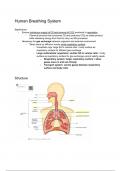
Structure
, Nostrils and nasal cavity
Hairs @nostrils
- Filter larger dust particles from the
inhaled air
Mucus-secreting cells @nasal cavity to
(larger) bronchioles
- Secrete mucus
- Traps dust particles and
microorganisms in inhaled
air
- Moistens inhaled air >
prevent moist respiratory
surface from drying out
Cilia of ciliated epithelial cells @nasal
cavity to (larger) bronchioles
- Beat/move to sweep the mucus
towards the pharynx
- Mucus coughed up or swallowed
into the stomach
- Most of trapped
microorganisms killed by HCl
Rich supply of blood in blood capillaries
@nasal cavity to bronchioles
- Warms the inhaled air > avoid
irritation of lungs
Olfactory cells @nasal cavity lining
- Detect chemicals in air
- Generate nerve impulses
which are transmitted to
brain (cerebrum) where it is
interpreted as smell
Pharynx and Larynx
Pharynx
- Common passage for food and air
- Leads to larynx and
oesophagus
- @swallowing: larynx raised, pressed
against epiglottis, covering opening
of larynx > prevent choking
Larynx/ voice box
- Boxlike, mainly made up of
cartilage
- Prevent larynx from
collapsing due to pressure
changes when breathing
- 2 vocal chords (folds of tissue,
Significance
- Ensure continuous supply of O2 and removal of CO2 produced in respiration
- Chemical process that consumes O2 and produces CO2 as waste product
while releasing energy from food to carry out life processes
- Necessary for gas exchange between organism and external environment
- Takes place by diffusion across moist respiratory surface
- Unicellular orgs: large SA to volume ratio > body surface as
respiratory surface for efficient gas exchange
- Large multicellular organisms: smaller SA to volume ratio > body
surface as respiratory surface for gas exchange cannot satisfy needs
- Respiratory system: larger respiratory surface > allow
gases move in and out of body
- Transport system: carries gases between respiratory
surface and body cells
Structure
, Nostrils and nasal cavity
Hairs @nostrils
- Filter larger dust particles from the
inhaled air
Mucus-secreting cells @nasal cavity to
(larger) bronchioles
- Secrete mucus
- Traps dust particles and
microorganisms in inhaled
air
- Moistens inhaled air >
prevent moist respiratory
surface from drying out
Cilia of ciliated epithelial cells @nasal
cavity to (larger) bronchioles
- Beat/move to sweep the mucus
towards the pharynx
- Mucus coughed up or swallowed
into the stomach
- Most of trapped
microorganisms killed by HCl
Rich supply of blood in blood capillaries
@nasal cavity to bronchioles
- Warms the inhaled air > avoid
irritation of lungs
Olfactory cells @nasal cavity lining
- Detect chemicals in air
- Generate nerve impulses
which are transmitted to
brain (cerebrum) where it is
interpreted as smell
Pharynx and Larynx
Pharynx
- Common passage for food and air
- Leads to larynx and
oesophagus
- @swallowing: larynx raised, pressed
against epiglottis, covering opening
of larynx > prevent choking
Larynx/ voice box
- Boxlike, mainly made up of
cartilage
- Prevent larynx from
collapsing due to pressure
changes when breathing
- 2 vocal chords (folds of tissue,


