

Metabolism
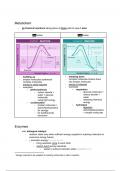
- all chemical reactions taking place in living cells to keep it alive
Anabolism Catabolism
- building up - breaking down
- simpler molecules synthesise - complex molecules broken down
complex molecules into simpler molecules
- energy is used/ required - energy is released
- examples - examples
- photosynthesis - respiration
- carbon dioxide + - glucose molecules >
water > glucose carbon dioxide +
molecules water
- using light energy - releasing chemical
- condensation energy
- simpler molecules > - hydrolysis
starch/lipids/proteins - digestion:
- for storage starch/lipids/proteins
- for building body > simpler molecules
structures
Enzymes
- role: biological catalyst
- reaction starts only when sufficient energy supplied to reacting molecules to
overcome energy barrier
- ↓ activation energy1 energy barrier
- bring reactants close to each other
- stretch bond among reactants
- easier to achieve transition state unstable bond
1
energy required to be supplied to reacting molecules to start a reaction
, - ↑ rate of chemical reactions at body temperature
- example: catalase
- hydrogen peroxide > oxygen + water
- H2O2: toxic byproduct of metabolic reactions in human body
14
- 10 times faster
- X accumulation of H2O2 > kill cell
3. Products leave 1. Substrate
active site molecules bind to
active site of
4. Enzyme enzyme molecule
molecule released to form
in original form and enzyme-substrate
can be reused and complex, lowering
bind to another EA of reaction
substrate molecule
2. Substrate
molecules are
converted into
products
- nature
- biological catalyst
- protein
- properties
- bc biological2 catalyst
- ↓ activation energy
- speed up metabolic reactions inside/outside living cells
- specific in action universal
- unique active site with specific shape
- 3D shape maintained by weak bonding
- only act on substrates with complementary shape that fit in
active site
- only catalyse one type of reaction
- many different enzymes needed for many different reactions in
body
- lock-and-key hypothesis
- lock: substrate
- changes
- complementary shape
- key: enzyme
- unchanged
- rigid active site
- complementary shape
- bc protein in nature
- structure and activity easily affected by temp and pH
- only work within particular range of temp and pH
2
made by living cells
- all chemical reactions taking place in living cells to keep it alive
Anabolism Catabolism
- building up - breaking down
- simpler molecules synthesise - complex molecules broken down
complex molecules into simpler molecules
- energy is used/ required - energy is released
- examples - examples
- photosynthesis - respiration
- carbon dioxide + - glucose molecules >
water > glucose carbon dioxide +
molecules water
- using light energy - releasing chemical
- condensation energy
- simpler molecules > - hydrolysis
starch/lipids/proteins - digestion:
- for storage starch/lipids/proteins
- for building body > simpler molecules
structures
Enzymes
- role: biological catalyst
- reaction starts only when sufficient energy supplied to reacting molecules to
overcome energy barrier
- ↓ activation energy1 energy barrier
- bring reactants close to each other
- stretch bond among reactants
- easier to achieve transition state unstable bond
1
energy required to be supplied to reacting molecules to start a reaction
, - ↑ rate of chemical reactions at body temperature
- example: catalase
- hydrogen peroxide > oxygen + water
- H2O2: toxic byproduct of metabolic reactions in human body
14
- 10 times faster
- X accumulation of H2O2 > kill cell
3. Products leave 1. Substrate
active site molecules bind to
active site of
4. Enzyme enzyme molecule
molecule released to form
in original form and enzyme-substrate
can be reused and complex, lowering
bind to another EA of reaction
substrate molecule
2. Substrate
molecules are
converted into
products
- nature
- biological catalyst
- protein
- properties
- bc biological2 catalyst
- ↓ activation energy
- speed up metabolic reactions inside/outside living cells
- specific in action universal
- unique active site with specific shape
- 3D shape maintained by weak bonding
- only act on substrates with complementary shape that fit in
active site
- only catalyse one type of reaction
- many different enzymes needed for many different reactions in
body
- lock-and-key hypothesis
- lock: substrate
- changes
- complementary shape
- key: enzyme
- unchanged
- rigid active site
- complementary shape
- bc protein in nature
- structure and activity easily affected by temp and pH
- only work within particular range of temp and pH
2
made by living cells


