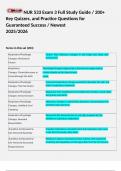
NUR 533 Exam 3 Full Study Guide / 200+
Key Quizzes, and Practice Questions for
Guaranteed Success / Newest
2025/2026
Terms in this set (203)
Respiratory Physiologic Factors that influence changes in the lungs and chest wall
Changes: Mechanical during birth.
Factors
Respiratory PhysiologicChanges triggered by a decrease in oxygen and an
Changes: Chemicalincrease in carbon dioxide as the infant travels
Factorsthrough the birth canal.
Respiratory Physiologic External temperature changes post-birth stimulate the skin and
Changes: Thermal Factors lead to respiratory responses.
Respiratory Physiologic Responses from handling by the healthcare provider, sound, light,
Changes: Sensory Factors and gravity post-birth.
Respiratory Physiologic Influences changes in blood flow dynamics and pressures that
Changes: Umbilical Cord facilitate lung expansion.
Clamping
Respiratory Physiologic Required if the above factors do not align properly for the
Changes: Neonatal newborn's respiratory adaptation.
Resuscitation
Transition to Extrauterine Irregular respirations, elevated heart and respiratory rate, seen
Life: Period of Reactivity in the first 30 minutes after birth.
Transition to Extrauterine Newborn's sleep or decreased motor activity, with unlabored
Life: Period of Decreased breathing and regulation of vital signs after the first 30 minutes.
Responsiveness
,Transition to Extrauterine Begins 2-8 hours after birth with a re-awakening of the newborn.
Life: Second Period of
Reactivity
Ideal Newborn Vital Signs: Normal range is 120-160 bpm.
Newborn Heart Rate
Ideal Newborn Vital Signs: Normal range is 97.7-99.5 F (36.5-37.5 C).
Newborn Temperature
Ideal Newborn Vital Signs: Normal rate is 30-60 breaths per minute.
Newborn Respirations
Signs of Respiratory Evident widening of nostrils, indicating difficulty breathing.
Distress: Nasal Flaring
Signs of Respiratory Noise made by the newborn when exhaling, signaling distress.
Distress: Grunting
Signs of Respiratory Use of intercostal or subcostal muscles, leading to the "drawing in"
Distress: Retractions of tissue between ribs.
Thermoregulation: Risk Larger surface area, blood vessels close to skin, little subcutaneous
Factors for Newborn Heat fat.
Loss
Thermoregulation: Neutral The goal temperature in which the newborn doesn't have to
Thermal Environment expend energy to maintain heat.
Thermoregulation: Newborns produce heat by metabolizing brown fat and
Nonshivering increasing metabolic activity, which can rapidly deplete with
cold stress.
Thermogenesis
Heat Loss Mechanisms: Heat flow from body surface to cooler surrounding air.
Convection
Heat Loss Mechanisms: Heat flow from body to a cooler surface in direct contact.
Conduction
Heat Loss Mechanisms: Heat loss when a liquid is converted to vapor.
Evaporation
, Heat Loss Mechanisms: Heat flow from body surface to a cooler solid surface nearby
Radiation without direct contact.
Increased physiological and metabolic demands on a newborn due
Cold Stress Definition
to hypothermia.
Cold Stress Symptoms Hypothermia, pale and mottled skin.
Complications of Cold Hypoglycemia, hyperbilirubinemia, respiratory distress.
Stress
GI and Renal Systems: Newborns excrete excess extracellular fluid, contributing to
Post-birth Diuresis expected weight loss of less than 10%.
GI and Renal Systems: I&Os and daily weights.
Indicators of Feeding
Success
GI and Renal Systems: Newborn's first bowel movement.
Meconium
GI and Renal Systems: Straw-colored and odorless.
Newborn Urine
Characteristics
Hepatic System: Newborn Liver is not fully developed at birth.
Hepatic Immaturity
Hepatic System: Red High concentrations with shorter life spans leading to increased
Blood Cells in Newborns bilirubin.
Hepatic System: Bilirubin Byproduct of RBC hemolysis leading to increased
Build-up unconjugated bilirubin to be broken down by the liver.
Integumentary System: Thick, white substance that covers the fetus and can be
Vernix present on the newborn.
Integumentary System: Fine, soft hair covering the fetus, may still be present on the
Lanugo newborn.
Integumentary System: Normal skin changes indicating the newborn's maturity.
Palms and Soles Creases
Key Quizzes, and Practice Questions for
Guaranteed Success / Newest
2025/2026
Terms in this set (203)
Respiratory Physiologic Factors that influence changes in the lungs and chest wall
Changes: Mechanical during birth.
Factors
Respiratory PhysiologicChanges triggered by a decrease in oxygen and an
Changes: Chemicalincrease in carbon dioxide as the infant travels
Factorsthrough the birth canal.
Respiratory Physiologic External temperature changes post-birth stimulate the skin and
Changes: Thermal Factors lead to respiratory responses.
Respiratory Physiologic Responses from handling by the healthcare provider, sound, light,
Changes: Sensory Factors and gravity post-birth.
Respiratory Physiologic Influences changes in blood flow dynamics and pressures that
Changes: Umbilical Cord facilitate lung expansion.
Clamping
Respiratory Physiologic Required if the above factors do not align properly for the
Changes: Neonatal newborn's respiratory adaptation.
Resuscitation
Transition to Extrauterine Irregular respirations, elevated heart and respiratory rate, seen
Life: Period of Reactivity in the first 30 minutes after birth.
Transition to Extrauterine Newborn's sleep or decreased motor activity, with unlabored
Life: Period of Decreased breathing and regulation of vital signs after the first 30 minutes.
Responsiveness
,Transition to Extrauterine Begins 2-8 hours after birth with a re-awakening of the newborn.
Life: Second Period of
Reactivity
Ideal Newborn Vital Signs: Normal range is 120-160 bpm.
Newborn Heart Rate
Ideal Newborn Vital Signs: Normal range is 97.7-99.5 F (36.5-37.5 C).
Newborn Temperature
Ideal Newborn Vital Signs: Normal rate is 30-60 breaths per minute.
Newborn Respirations
Signs of Respiratory Evident widening of nostrils, indicating difficulty breathing.
Distress: Nasal Flaring
Signs of Respiratory Noise made by the newborn when exhaling, signaling distress.
Distress: Grunting
Signs of Respiratory Use of intercostal or subcostal muscles, leading to the "drawing in"
Distress: Retractions of tissue between ribs.
Thermoregulation: Risk Larger surface area, blood vessels close to skin, little subcutaneous
Factors for Newborn Heat fat.
Loss
Thermoregulation: Neutral The goal temperature in which the newborn doesn't have to
Thermal Environment expend energy to maintain heat.
Thermoregulation: Newborns produce heat by metabolizing brown fat and
Nonshivering increasing metabolic activity, which can rapidly deplete with
cold stress.
Thermogenesis
Heat Loss Mechanisms: Heat flow from body surface to cooler surrounding air.
Convection
Heat Loss Mechanisms: Heat flow from body to a cooler surface in direct contact.
Conduction
Heat Loss Mechanisms: Heat loss when a liquid is converted to vapor.
Evaporation
, Heat Loss Mechanisms: Heat flow from body surface to a cooler solid surface nearby
Radiation without direct contact.
Increased physiological and metabolic demands on a newborn due
Cold Stress Definition
to hypothermia.
Cold Stress Symptoms Hypothermia, pale and mottled skin.
Complications of Cold Hypoglycemia, hyperbilirubinemia, respiratory distress.
Stress
GI and Renal Systems: Newborns excrete excess extracellular fluid, contributing to
Post-birth Diuresis expected weight loss of less than 10%.
GI and Renal Systems: I&Os and daily weights.
Indicators of Feeding
Success
GI and Renal Systems: Newborn's first bowel movement.
Meconium
GI and Renal Systems: Straw-colored and odorless.
Newborn Urine
Characteristics
Hepatic System: Newborn Liver is not fully developed at birth.
Hepatic Immaturity
Hepatic System: Red High concentrations with shorter life spans leading to increased
Blood Cells in Newborns bilirubin.
Hepatic System: Bilirubin Byproduct of RBC hemolysis leading to increased
Build-up unconjugated bilirubin to be broken down by the liver.
Integumentary System: Thick, white substance that covers the fetus and can be
Vernix present on the newborn.
Integumentary System: Fine, soft hair covering the fetus, may still be present on the
Lanugo newborn.
Integumentary System: Normal skin changes indicating the newborn's maturity.
Palms and Soles Creases