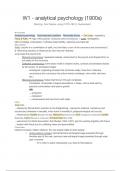
W1 - analytical psychology (1900s)
Starring: Carl Gustav Jung (1875-1961), Switzerland
Short overview
Analytical psychology - Psychodynamic systems - Personality theory → Carl Jung : inspired by
Freud & Adler. ⇒ map of the psyche: conscious and unconscious. + goals: reintegration,
self-knowledge, individuation, individual responsibility, replacing wounded self
Basic principles
Jung: “psyche is a combination of spirit, soul and idea; a sum of the conscious and unconscious.”
& “What they perceive is influenced by who they are” (frames)
Jung maps the psyche into:
- Personal unconscious: repressed material, unimportant to the psyche and dropped from or
not ready for the conscious
- Collective unconscious: same basic motifs in dreams myths, symbols and fantasies shared
by all humans ⇒ archetypal images
- Archetypes: organizing principle that structures reality, flows from collective
unconscious into conscious into actions (heroic archetype, inner child, wild man,
etc.)
- Personal unconscious: makes itself known through complexes
- Complexes: emotionally charged associations or ideas, can be dealt with by
personal confrontation and lead to growth.
OR
→ projection
→ repression
→ overpowered and lose touch with reality
History
Jung was…
…inspired by Romanticism (reaction to the Enlightening) : valuing the irrational, mysterious and
unconscious (interests in sexuality, inner world of mentally ill, parapsychological and occult).
…influenced by Goethe (Faustian Striving), Nietzsche (Übermensch), Kant (Categorische Imperatief), Schiller
(Spieltrieb), Carus (Bewust en onbewust), Schopenhauer (Der Wille)
…well-known for World Association Test Studies (1904-1907), got him working together with Freud
…broken with Freud due to conflicting views and personalities.
Current status
Interest increases: Object relations: the way people relate to other people
○ Anima-animus concept: (anima) feminine archetypal image presented through
feminine part of the man. (animus) male archetypal image presented through male
part of women
⇒ in order to reach individuation you need to find balance.
,Personality
→ dynamic unity of all parts of a person (conscious and unconscious & connected to collective
unconscious)
● Understanding of who we are:
○ Encounters with social reality;
○ What we deduce from our observations of others.
● The self: archetypal energy: personality ⇒ a wholeness out of which personality evolves.
The goal of personal evolvement. Infants start with a self; subsystems:
○ Ego (I): centre of consciousness: mediating between the outside world and world
and the unconscious realm
○ Personal shadow: balances the ego in the personal unconscious. Everything the
ego could or should have, but refuses to develop.
■ Positive or negative: appear in dreams // projections
● Facing evil is becoming conscious of your shadow.
○ Persona: public face, shields ego, reveals appropriate aspects of it.
⇒ first part of life = develop ego, take one’s place in the world
⇒ second part of life = reclaim undeveloped parts of oneself & fulfilling personality (individuation:
not perfect, but wholeness, also accepting the negative parts)
● Attitudes (typology): habitual ways people respond to the world:
○ Introversion (natural and basic, richer inner world, few strong relationships);
○ Extraversion (connects with reality through external objects, high social libido).
● Personality qualities (functions): differs in dominance
○ Thinking
○ Feeling
○ Sensation
○ Intuition
Main ideas
- Opposites: engage in an active struggle → personality
- Enantiodromia: sooner or later everything turns into opposites (human cycles)
- Compensation: opposites lay in dynamic balance. Everything in personality balanced its
opposite through self-regulation.
- The Transcendent function: bridge mediating opposites
- Mandala: symbol - wholeness & the centre of personality (dreams: compensation
stress/sign wholeness)
- Preoedipal development: importance of mother-child interaction
- Development of consciousness: first merged with mother, later splitting (seeing her as
sometimes good/bad) → self awareness: ego in place
- Psychopathology: conflicts early mother-child relationships, worsened by stressors →
frustrated urge for wholesome and healing
- Defense mechanisms: survive complexes (normal and destructive)
, Psychotherapy
Theory
Personality has the capacity to heal itself and become enlarged through experiences.
→ 4 tentans:
1. The psyche is a self-regulating system;
2. The unconscious has a creative and compensatory component;
3. Doctor-patient relationship;
4. Personal growth at many stages of lifespan.
Neurosis: symptom of disturbance in personal equilibrium → search for underlying complex (not
symptom) ⇒ what’s (not) normal? : degree of consciousness and amount of power complex.
Process
→ Fallible equals
→ 4 stages:
1. Confession (p.u): recountering personal history, sharing (c&u) secrets, binds through
transference;
2. Elucidation (p.u): relationships, dreams, fantasies: connect them to infantile origins.
3. Education (persona & ego): insight translated to responsible action;
Most people stop here
4. Transformation (personal archetype): self-actualization and wholeness.
In the final stages transference and countertransference +++
Mechanisms
Analysis of transference in 4 stages:
1. Projection of the therapist mirrors the history of the patient;
2. Discriminate personal (own psyche) & impersonal (collective realm) content;
3. Therapist becomes detached from healer image;
4. Truer evaluation of the therapist.
Active imagination: contact with unconscious → meditative imagery based on self-awareness:
intense concentration (today: focus on daily life).
Dream analysis: represent: fears, wishes, impulses, possible solutions, reveal changes psyche by
exposing inner life.
Type of dreams:
- Initial dreams: indicate path therapy/ type transference
- Recurrent dreams (esp. from childhood): problematic complexes or traumatic memory
events
- Dreams containing shadow material: rage, violence, immoral conduct
- About therapist/therapy: patient is unaware/ fearful and provides symbol for therapist and
client
Starring: Carl Gustav Jung (1875-1961), Switzerland
Short overview
Analytical psychology - Psychodynamic systems - Personality theory → Carl Jung : inspired by
Freud & Adler. ⇒ map of the psyche: conscious and unconscious. + goals: reintegration,
self-knowledge, individuation, individual responsibility, replacing wounded self
Basic principles
Jung: “psyche is a combination of spirit, soul and idea; a sum of the conscious and unconscious.”
& “What they perceive is influenced by who they are” (frames)
Jung maps the psyche into:
- Personal unconscious: repressed material, unimportant to the psyche and dropped from or
not ready for the conscious
- Collective unconscious: same basic motifs in dreams myths, symbols and fantasies shared
by all humans ⇒ archetypal images
- Archetypes: organizing principle that structures reality, flows from collective
unconscious into conscious into actions (heroic archetype, inner child, wild man,
etc.)
- Personal unconscious: makes itself known through complexes
- Complexes: emotionally charged associations or ideas, can be dealt with by
personal confrontation and lead to growth.
OR
→ projection
→ repression
→ overpowered and lose touch with reality
History
Jung was…
…inspired by Romanticism (reaction to the Enlightening) : valuing the irrational, mysterious and
unconscious (interests in sexuality, inner world of mentally ill, parapsychological and occult).
…influenced by Goethe (Faustian Striving), Nietzsche (Übermensch), Kant (Categorische Imperatief), Schiller
(Spieltrieb), Carus (Bewust en onbewust), Schopenhauer (Der Wille)
…well-known for World Association Test Studies (1904-1907), got him working together with Freud
…broken with Freud due to conflicting views and personalities.
Current status
Interest increases: Object relations: the way people relate to other people
○ Anima-animus concept: (anima) feminine archetypal image presented through
feminine part of the man. (animus) male archetypal image presented through male
part of women
⇒ in order to reach individuation you need to find balance.
,Personality
→ dynamic unity of all parts of a person (conscious and unconscious & connected to collective
unconscious)
● Understanding of who we are:
○ Encounters with social reality;
○ What we deduce from our observations of others.
● The self: archetypal energy: personality ⇒ a wholeness out of which personality evolves.
The goal of personal evolvement. Infants start with a self; subsystems:
○ Ego (I): centre of consciousness: mediating between the outside world and world
and the unconscious realm
○ Personal shadow: balances the ego in the personal unconscious. Everything the
ego could or should have, but refuses to develop.
■ Positive or negative: appear in dreams // projections
● Facing evil is becoming conscious of your shadow.
○ Persona: public face, shields ego, reveals appropriate aspects of it.
⇒ first part of life = develop ego, take one’s place in the world
⇒ second part of life = reclaim undeveloped parts of oneself & fulfilling personality (individuation:
not perfect, but wholeness, also accepting the negative parts)
● Attitudes (typology): habitual ways people respond to the world:
○ Introversion (natural and basic, richer inner world, few strong relationships);
○ Extraversion (connects with reality through external objects, high social libido).
● Personality qualities (functions): differs in dominance
○ Thinking
○ Feeling
○ Sensation
○ Intuition
Main ideas
- Opposites: engage in an active struggle → personality
- Enantiodromia: sooner or later everything turns into opposites (human cycles)
- Compensation: opposites lay in dynamic balance. Everything in personality balanced its
opposite through self-regulation.
- The Transcendent function: bridge mediating opposites
- Mandala: symbol - wholeness & the centre of personality (dreams: compensation
stress/sign wholeness)
- Preoedipal development: importance of mother-child interaction
- Development of consciousness: first merged with mother, later splitting (seeing her as
sometimes good/bad) → self awareness: ego in place
- Psychopathology: conflicts early mother-child relationships, worsened by stressors →
frustrated urge for wholesome and healing
- Defense mechanisms: survive complexes (normal and destructive)
, Psychotherapy
Theory
Personality has the capacity to heal itself and become enlarged through experiences.
→ 4 tentans:
1. The psyche is a self-regulating system;
2. The unconscious has a creative and compensatory component;
3. Doctor-patient relationship;
4. Personal growth at many stages of lifespan.
Neurosis: symptom of disturbance in personal equilibrium → search for underlying complex (not
symptom) ⇒ what’s (not) normal? : degree of consciousness and amount of power complex.
Process
→ Fallible equals
→ 4 stages:
1. Confession (p.u): recountering personal history, sharing (c&u) secrets, binds through
transference;
2. Elucidation (p.u): relationships, dreams, fantasies: connect them to infantile origins.
3. Education (persona & ego): insight translated to responsible action;
Most people stop here
4. Transformation (personal archetype): self-actualization and wholeness.
In the final stages transference and countertransference +++
Mechanisms
Analysis of transference in 4 stages:
1. Projection of the therapist mirrors the history of the patient;
2. Discriminate personal (own psyche) & impersonal (collective realm) content;
3. Therapist becomes detached from healer image;
4. Truer evaluation of the therapist.
Active imagination: contact with unconscious → meditative imagery based on self-awareness:
intense concentration (today: focus on daily life).
Dream analysis: represent: fears, wishes, impulses, possible solutions, reveal changes psyche by
exposing inner life.
Type of dreams:
- Initial dreams: indicate path therapy/ type transference
- Recurrent dreams (esp. from childhood): problematic complexes or traumatic memory
events
- Dreams containing shadow material: rage, violence, immoral conduct
- About therapist/therapy: patient is unaware/ fearful and provides symbol for therapist and
client