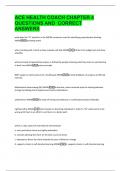
ACE HEALTH COACH CHAPTER 4
QUESTIONS AND CORRECT
ANSWERS
what does the "A" stand for in the ABCDE mnemonic used for identifying unproductive thinking
ANSW✅✅activating event
when working with a client as they evaluate self-talk ANSW✅✅refrain from judgement and show
empathy
which principle of appreciative inquiry is defined by people choosing what they work on and develop
in their lives ANSW✅✅poetic principle
BEST support a clients pursuit of a health goal ANSW✅✅provide feedback on progress at defined
intervals
Motivational Interviewing (MI) ANSW✅✅a directive, client-centered style for eliciting behavior
change by helping clients explore and resolve ambivalence
ambivalence ANSW✅✅the state of having contradictory or conflicting emotional attitudes
righting reflux ANSW✅✅relies heavily on directing individuals in order to "fix" what seems to be
wrong with them in an effort to set them on a better path
which is a key aspect of motivational interviewing?
a. only used when clients are highly ambivalent
b. includes advising the client on the best course of action
c. attempts to direct the client towards the pros of behavior change
d. supports clients in self-directed learning ANSW✅✅d. supports clients in self directed learning
, when a client asks for advice, what is the MOST appropriate response ANSW✅✅use open-ended
questions to find out what the client already knows
which process of motivational interviewing is also known as agenda mapping ANSW✅✅focusing
"i ate way too much on vacation so I might as well give up" is an example of what cognitive
distortion? ANSW✅✅all-or-none thinking
Four key interrelated elements that constitute the "spirit of MI" ANSW✅✅-collaboration
-acceptance
-compassion
-evocation
collaboration ANSW✅✅the client is the ultimate expert on their life
acceptance ANSW✅✅"unconditional positive regard" the client-coach relationship must be
rooted in respect, trust, and empathy in which the health coach genuinely and without judgement
understands the clients unique perspective
compassion ANSW✅✅MI should be practiced in the best interest and for the ultimate welfare of
the client not for some secondary gain or benefit to the coach
evocation ANSW✅✅calling upon the clients inner wisdom rather than telling the client what they
should or must do
OARS ANSW✅✅Open-ended questions
Affirmations
Reflective listening
Summaries
open-ended questions ANSW✅✅Questions for which the patient must provide detail to give an
answer.
affirmations ANSW✅✅statements that acknowledge a person's value and strengths
QUESTIONS AND CORRECT
ANSWERS
what does the "A" stand for in the ABCDE mnemonic used for identifying unproductive thinking
ANSW✅✅activating event
when working with a client as they evaluate self-talk ANSW✅✅refrain from judgement and show
empathy
which principle of appreciative inquiry is defined by people choosing what they work on and develop
in their lives ANSW✅✅poetic principle
BEST support a clients pursuit of a health goal ANSW✅✅provide feedback on progress at defined
intervals
Motivational Interviewing (MI) ANSW✅✅a directive, client-centered style for eliciting behavior
change by helping clients explore and resolve ambivalence
ambivalence ANSW✅✅the state of having contradictory or conflicting emotional attitudes
righting reflux ANSW✅✅relies heavily on directing individuals in order to "fix" what seems to be
wrong with them in an effort to set them on a better path
which is a key aspect of motivational interviewing?
a. only used when clients are highly ambivalent
b. includes advising the client on the best course of action
c. attempts to direct the client towards the pros of behavior change
d. supports clients in self-directed learning ANSW✅✅d. supports clients in self directed learning
, when a client asks for advice, what is the MOST appropriate response ANSW✅✅use open-ended
questions to find out what the client already knows
which process of motivational interviewing is also known as agenda mapping ANSW✅✅focusing
"i ate way too much on vacation so I might as well give up" is an example of what cognitive
distortion? ANSW✅✅all-or-none thinking
Four key interrelated elements that constitute the "spirit of MI" ANSW✅✅-collaboration
-acceptance
-compassion
-evocation
collaboration ANSW✅✅the client is the ultimate expert on their life
acceptance ANSW✅✅"unconditional positive regard" the client-coach relationship must be
rooted in respect, trust, and empathy in which the health coach genuinely and without judgement
understands the clients unique perspective
compassion ANSW✅✅MI should be practiced in the best interest and for the ultimate welfare of
the client not for some secondary gain or benefit to the coach
evocation ANSW✅✅calling upon the clients inner wisdom rather than telling the client what they
should or must do
OARS ANSW✅✅Open-ended questions
Affirmations
Reflective listening
Summaries
open-ended questions ANSW✅✅Questions for which the patient must provide detail to give an
answer.
affirmations ANSW✅✅statements that acknowledge a person's value and strengths