

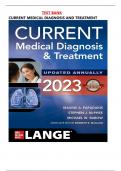
TEST BANK
CURRENT MEDICAL DIAGNOSIS AND TREATMENT
,Chapter`1.`Disease`Prevention`&`Health`Promotion
1.`Which`of`the`following`behaviors`indicates`the`highest`potential`for`spreading`infections`amo
ng`clients?`The`nurse:
1) disinfects`dirty`hands`with`antibacterial`soap.
2) allows`alcohol-based`rub`to`dry`for`10`seconds.
3) washes`hands`only`after`leaving`each`room.
4) uses`cold`water`for`medical`asepsis.
2.`What`is`the`most`frequent`cause`of`the`spread`of`infection`among`institutionalized
patients?
1) Airborne`microbes`from`other`patients
2) Contact`with`contaminated`equipment
3) Hands`of`healthcare`workers
4) Exposure`from`family`members
3.`Which`of`the`following`nursing`activities`is`of`highest`priority`for`maintaining`medical`
asepsis?
1) Washing`hands
2) Donning`gloves
3) Applying`sterile`drapes
4) Wearing`a`gown
4.`A`patient`infected`with`a`virus`but`who`does`not`have`any`outward`sign`of`the`disease`is`c
onsidered`a:
1) pathogen.
2) fomite.
3) vector.
4) carrier.
5.`A`patient`is`admitted`to`the`hospital`with`tuberculosis.`Which`precautions`must`the`nurse`i
nstitute`when`caring`for`this`patient?
1) Droplet`transmission
2) Airborne`transmission
3) Direct`contact
4) Indirect`contact
, 6.`A`patient`becomes`infected`with`oral`candidiasis`(thrush)`while`receiving`intravenous`
antibiotics`to`treat`a`systemic`infection.`Which`type`of`infection`has`the`patient`developed?
1) Endogenous`nosocomial
2) Exogenous`nosocomial
3) Latent
4) Primary
7.The`nurse`assists`a`surgeon`with`central`venous`catheter`insertion.`Which`action`is`
necessary`to`help`maintain`sterile`technique?
1) Closing`the`patients`door`to`limit`room`traffic`while`preparing`the`sterile`field
2) Using`clean`procedure`gloves`to`handle`sterile`equipment
3) Placing`the`nonsterile`syringes`containing`flush`solution`on`the`sterile`field
4) Remaining`6`inches`away`from`the`sterile`field`during`the`procedure
` ` 8.A`patient`admitted`to`the`hospital`with`pneumonia`has`been`receiving`antibiotics`for`2`da
ys.`His`condition`has`stabilized,`and`his`temperature`has`returned`to`normal.`Which`stage`of`inf
ection`is`the`patient`most`likely`experiencing?
1) Incubation
2) Prodromal
3) Decline
4) Convalescence
5) 8.
9.`A`patient`develops`localized`heat`and`erythema`over`an`area`on`the`lower`leg.`These`f
indings`are`indicative`of`which`secondary`defense`against`infection?
1) Phagocytosis
2) Complement`cascade
3) Inflammation
4) Immunity
10.`The`patient`suddenly`develops`hives,`shortness`of`breath,`and`wheezing`after`receiving`
an`antibiotic.`Which`antibody`is`primarily`responsible`for`this`patients`response?
1) IgA
2) IgE
3) IgG
4) IgM
11.`What`type`of`immunity`is`provided`by`intravenous`(IV)`administration`of`i
mmunoglobulin`G?
1) Cell-mediated
2) Passive
, 3) Humoral
4) Active
CURRENT MEDICAL DIAGNOSIS AND TREATMENT
,Chapter`1.`Disease`Prevention`&`Health`Promotion
1.`Which`of`the`following`behaviors`indicates`the`highest`potential`for`spreading`infections`amo
ng`clients?`The`nurse:
1) disinfects`dirty`hands`with`antibacterial`soap.
2) allows`alcohol-based`rub`to`dry`for`10`seconds.
3) washes`hands`only`after`leaving`each`room.
4) uses`cold`water`for`medical`asepsis.
2.`What`is`the`most`frequent`cause`of`the`spread`of`infection`among`institutionalized
patients?
1) Airborne`microbes`from`other`patients
2) Contact`with`contaminated`equipment
3) Hands`of`healthcare`workers
4) Exposure`from`family`members
3.`Which`of`the`following`nursing`activities`is`of`highest`priority`for`maintaining`medical`
asepsis?
1) Washing`hands
2) Donning`gloves
3) Applying`sterile`drapes
4) Wearing`a`gown
4.`A`patient`infected`with`a`virus`but`who`does`not`have`any`outward`sign`of`the`disease`is`c
onsidered`a:
1) pathogen.
2) fomite.
3) vector.
4) carrier.
5.`A`patient`is`admitted`to`the`hospital`with`tuberculosis.`Which`precautions`must`the`nurse`i
nstitute`when`caring`for`this`patient?
1) Droplet`transmission
2) Airborne`transmission
3) Direct`contact
4) Indirect`contact
, 6.`A`patient`becomes`infected`with`oral`candidiasis`(thrush)`while`receiving`intravenous`
antibiotics`to`treat`a`systemic`infection.`Which`type`of`infection`has`the`patient`developed?
1) Endogenous`nosocomial
2) Exogenous`nosocomial
3) Latent
4) Primary
7.The`nurse`assists`a`surgeon`with`central`venous`catheter`insertion.`Which`action`is`
necessary`to`help`maintain`sterile`technique?
1) Closing`the`patients`door`to`limit`room`traffic`while`preparing`the`sterile`field
2) Using`clean`procedure`gloves`to`handle`sterile`equipment
3) Placing`the`nonsterile`syringes`containing`flush`solution`on`the`sterile`field
4) Remaining`6`inches`away`from`the`sterile`field`during`the`procedure
` ` 8.A`patient`admitted`to`the`hospital`with`pneumonia`has`been`receiving`antibiotics`for`2`da
ys.`His`condition`has`stabilized,`and`his`temperature`has`returned`to`normal.`Which`stage`of`inf
ection`is`the`patient`most`likely`experiencing?
1) Incubation
2) Prodromal
3) Decline
4) Convalescence
5) 8.
9.`A`patient`develops`localized`heat`and`erythema`over`an`area`on`the`lower`leg.`These`f
indings`are`indicative`of`which`secondary`defense`against`infection?
1) Phagocytosis
2) Complement`cascade
3) Inflammation
4) Immunity
10.`The`patient`suddenly`develops`hives,`shortness`of`breath,`and`wheezing`after`receiving`
an`antibiotic.`Which`antibody`is`primarily`responsible`for`this`patients`response?
1) IgA
2) IgE
3) IgG
4) IgM
11.`What`type`of`immunity`is`provided`by`intravenous`(IV)`administration`of`i
mmunoglobulin`G?
1) Cell-mediated
2) Passive
, 3) Humoral
4) Active


