Supplement to Taxation For Decision Makers for Taxation for Decision Makers by Shirley Dennis-Escoffier, Karen A. Fortin
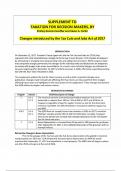
Supplement to Taxation For Decision Makers for Taxation for Decision Makers by Shirley Dennis-Escoffier, Karen A. Fortin-On December 22, 2017, President Trump signed into law the Tax Cuts and Jobs Act (TCJA) that represents the most comprehensive changes to the tax law in over 30 years. TCJA impacts all taxpayers by eliminating or changing many long-standing rules and adding new provisions. While Congress made most corporate changes permanent, the changes to the individual rates and deductions are temporary to comply with budget rules under reconciliation. As a result, most individual changes are effective for tax years beginning after December 31, 2017 and before January 1, 2026; effectively suspending existing law with the 2017 rules reinstated in 2026. This supplement updates the text for these revisions as well as other important changes since publication. Changes made retroactively affecting 2017 tax returns are discussed first; then changes affecting future years are highlighted in the next section of this supplement. These changes are keyed to the 2018 edition by chapter and section number. RETROACTIVE CHANGES Chapter Section Brief Description of Change 5 5.4.1 5.7.2 The minimum amount of unreimbursed medical expenses that are not deductible is reduced from 10% to 7.5% of AGI for 2017 and 2018 for all taxpayers (regardless of age) for regular income tax and for the alternative minimum tax (AMT). The 10% threshold is reinstated in 2019 for regular tax and AMT. 5 & 9 5.4.5 9.3.1 The $100 floor for casualty losses from disasters in 2016 or 2017 is raised to $500 per casualty and the 10%-of-AGI threshold does not apply. Taxpayers who do not itemize can increase their standard deduction by the net disaster loss for these two years. 7 7.3.2 Bonus Depreciation is increased from 50 percent to 100 percent for purchases after September 27, 2017. A more detailed discussion of this provision with an example follows. Retroactive Change to Bonus Depreciation Prior to the passage of the Tax Cuts and Jobs Act, bonus depreciation only applied to new (not used) property at a 50% rate. TCJA temporarily increased bonus depreciation to 100% for assets acquired after September 27, 2017 and extended it to used property. The 100% rate will begin to phase out after 2022 and expire at the end of 2026. SUPPLEMENT TO TAXATION FOR DECISION MAKERS, BY Shirley Dennis-Escoffier and Karen A. Fortin Changes introduced by the Tax Cuts and Jobs Act of 2017 Supplement to Taxation for Decision Makers, 2018 Edition 2 Example: On September 1, 2017, Molokai Corporation, a calendar-year corporation, purchased $1,810,000 of 5-year equipment and expensed $510,000 under Section 179. If this was used equipment, the maximum allowable first-year depreciation is $770,000: $510,000 Section 179 expensing and $260,000 *($1,810,000 − $510,000) × 20%+ regular MACRS depreciation. Its second-year depreciation is $416,000 *($1,810,000 − $510,000) × 32%+. If Molokai had purchased new equipment, its maximum allowable depreciation expense deduction for 2017 is $1,290,000, consisting of $510,000 Section 179 expense, $650,000 [($1,810,000 − $510,000) × 50%+ bonus depreciation and $130,000 *($1,810,000 − $510,000 − $650,000) × 20%] regular MACRS depreciation. Its 2018 depreciation deduction would be $208,000 *($1,810,000 − $510,000 − $650,000) × 32%+. If Molokai had instead purchased the equipment after September 27, 2017, it could deduct the entire $1,810,000 in the first year using the new 100% bonus depreciation. Property previously used by an unrelated taxpayer may qualify for bonus depreciation if purchased and placed in service after September 27, 2017 and the taxpayer had not used the property at any time before acquisition. Additionally, the property’s basis cannot be determined by reference to the adjusted basis of the taxpayer from whom it was acquired (carryover basis transactions). If there was a written binding contract to acquire property in effect prior to September 28, 2017, the property is deemed acquired the date the contract was entered into and is not eligible for the 100% bonus depreciation rate. Instead, the 50% bonus rate applies with only new property eligible. If the purchase of the property is completed before September 28, 2017 but it is not placed in service until 2018, the bonus depreciation rate is 40%; if placed in service in 2019, the bonus rate is only 30%. Bonus depreciation applies only to tangible personalty, software, and certain improvements. Any basis remaining after the reduction for the bonus depreciation is deducted is subject to regular MACRS depreciation. Realty and other assets with recovery periods greater than 20 years are not eligible for bonus depreciation. Bonus depreciation is not limited to small businesses, however; there is no phase-out provision (or taxable income limitation), unlike Section 179 expensing. When electing Section 179 expensing, the expensed amount is deducted first before computing bonus depreciation; thus, bonus depreciation is sandwiched between the Section 179 expensing and regular MACRS depreciation deductions.
Document information
- Uploaded on
- March 20, 2025
- Number of pages
- 9
- Written in
- 2024/2025
- Type
- Other
- Person
- Unknown