
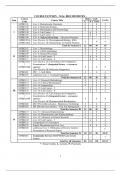
COURSE PATTERN – M.Sc. BIOCHEMISTRY -
Course Hours / week
Sem Course Title Credits
Code L P Total
16PBI1101 Core 1: Biomolecular Chemistry 6 - 6 5
16PBI1102 Core 2: Molecular biology 6 - 6 5
16PBI1103 Core 3: Bioenergetics and Enzymology 6 - 6 5
I 16PBI1104 Core 4: Lab Course – 1 - 4 4 4
16PBI1105 Core 5: Lab Course – 2 - 4 4 4
16PBI1106 Core 6: Self paced learning – Advanced Nutrition - - - 2
16PBI1201A Core Elective 1A: Developmental Biology (OR)
4 - 4 4
16PBI1201B Core Elective 1B: Biochemistry of Natural Products
Total for Semester I 22 08 30 30
16PBI2107 Core 7: Microbiology 4 - 4 4
16PBI2108 Core 8: r DNA technology 5 - 5 4
16PBI2109 Core 9: Human Physiology 5 - 5 4
II 16PBI2110 Core 10: Lab Course – 3 - 4 4 4
16PBI2111 Core 11: Lab Course – 4 - 4 4 4
16PBI2202A Core Elective 2A: Life Sciences for Competitive
/ Examinations-I (Integrated lecture – e-resource
16PBI2202B course) / 4 - 4 4
Core Elective 2B: Molecular Diagnostics
16PBI2401 IDC – 1- Soft Skills 4 - 4 4
16PBI2301 Additional Core 1: Training Programme - - - 3*
Total for Semester II 22 08 30 30
16PBI3112 Core 12: Research Methodology 4 - 4 4
16PBI3113 Core 13: Clinical Biochemistry 4 - 4 4
16PBI3114 Core 14: Immunology 4 - 4 4
16PBI3115 Core 15: Lab Course – 5 - 3 3 2
III 16PBI3116 Core 16: Lab Course – 6 - 3 3 2
16PBI3203A Core Elective 3A: Life Sciences for Competitive
/ Examinations-II (Integrated lecture – e-resource
16PBI3203B course) / 4 - 4 4
Core Elective 3B: Pharmaceutical Biochemistry
16PBI3402 IDC WS (within schools) – Bioprocess Technology 4 - 4 4
16PBI3403 IDC BS (between schools) – First Aid Management 4 - 4 4
Total for Semester III 24 06 30 28
16PBI4117 Core 17: Advanced Endocrinology 6 - 6 4
16PBI4118 Core 18: Pharmaceutics and Nanotechnology 6 - 6 4
16PBI4119 Core 19: Advances in Clinical Research 6 - 6 4
IV 16PBI4120 Core 20: Lab Course – 7 - 4 4 4
16PBI4121 Comprehensive Examination - - - 2
16PBI4122 Project Dissertation and Viva Voce - 8 8 4
16PBI4302 Additional Core 2: Publication of Review Articles / -
- - 5*
Presentation of Research Papers
Total for Semester IV 18 12 30 22+5*
16PBI4601 Community Service (SHEPHERD) and Gender
- - - 5
Studies
Total for all Semesters 86 34 120 112+8*
*- Extra Credits, L- Lecture, P- Practicals
1
, BIOMOLECULAR CHEMISTRY
SEM-I Hours/week: 6
16PBI1101 Credits: 5
Assurance of Learning:
The course assure to provide students with a basic understanding of:
the molecular makeup of living cells;
the chemical nature of biological macromolecules, their three-dimensional construction, and
the principles of molecular recognition;
the metabolism of dietary and endogenous carbohydrate, lipid, and protein.
At the end of the course, the students should be able to demonstrate the biomolecular
constitution and metabolic processes
Unit - I: The molecular logic of life:
The chemical unity of diverse living organisms, composition of living mater. Water - Physio-
chemical properties, biomolecular reactions. Macromolecules and their monomeric subunits,
Carbohydrates – classification, structure and isomerism. Monosaccharides, oligosaccharides
& polysaccharides – structure and properties. Amino acids - structures, classification and
properties. Proteins – classification, types, characteristics and structures, functions. Lipids –
classification, sources and biological functions. Nucleic acids- bases, nucleosides &
nucleotides.
Unit – II: Metabolism of Carbohydrates:
Glycolysis, Citric acid cycle, HMP shunt, Glucuronic acid pathway, Gluconeogenesis,
Glycogenesis, Glycogenolysis, Glyoxylate cycle. Regulations of Glycolysis and
Gluconeogenesis. Metabolism of Amino sugars - sialic acids, Mucopolysaccharides and
glycoproteins.
Unit – III: Metabolism of Proteins and Amino acids:
Biosynthesis of aspartate, pyruvate and aromatic amino acids families, Amphibolic activity of
amino acids. Methods for determining protein conformations, symmetry and functional
properties, protein folding, denaturation & renaturation, Ramachandran plot, solid state
synthesis of peptides, sequence determination. Degradation of proteins and aminoacids. Urea
cycle and its significance.
Unit – IV: Metabolism of lipids:
Biosynthesis of fatty acids and its regulation, hydroxy fatty acids, acylglycerols. Membrane
lipids- phospholipids, sphingolipids & eicosanoids. Cholesterol biosynthesis and its
regulation. Fatty acid degradation. Lipoproteins- types and functions. Methods of inter organ
transport of fatty acids. Formation of ketone bodies.
Unit – V: Metabolism of nucleic acids:
Structure of RNAs and DNA, forces stabilizing nucleic acid structures. Fractionation,
sequencing and chemical synthesis of oligonucleotides. Denaturation and hybridization.
Synthesis of purines and pyrimidines, synthesis of deoxy ribonucleotides. Biosynthesis of
nucleotide coenzymes, nucleotide degradation.
Text books for study
1. Robert K. Murray et al, 2000.Harper’s Biochemistry, Appleton and Lange Stainford Publishers, Connecticut.
2. Lehninger, A. L. et al., 1993. Principles of Biochemistry, Worth Publishers. Inc. USA.
References
1. Stryer, I., 1988. Biochemistry (2nd Edition), W.H. Freeman & Co., New York.
2. White, A. et al., 1959. Principles of Biochemistry, McGraw Hill Book Co., New York.
3. Donald Voet and Judith, G. Voet. 2011. Biochemistry. (4th Edition). John Wiley and Sons, New York.
2
, MOLECULAR BIOLOGY
SEM – I Hours/Week: 6
16PBI1102 Credits: 5
Assurance of Learning - The course assure to provide students with a basic understanding of:
the fundamentals of informational pathways;
the gene expression and regulations of cellular functions in cells;
the molecular machinery of informational pathways;
the errors and correction mechanisms of informational molecules.
Unit – I: Introduction:
Terms and definitions – DNA is the Genetic Material: Griffith’s Experiment, Avery, Hershey
& chase Experiment. RNA as the Genetic Material: Conrat& Singer Experiment with TMV –
Central Dogma. Viral genome – types of RNA and their role.
Organization of Chromosome:
Structural organization of eukaryotic chromosomes. Types and basic structure of
chromosomes. Chromosomal Proteins – Histones and Protamines – nucleosomes – levels in
the organization of Metaphase Chromosome. Organization of prokaryotic DNA. Special types
of Chromosome: Polytene and Lamp brush chromosomes. Duplication & segregation of
Chromosomes.
Unit – II: Transposons:
Discovery, IS elements, Transposons in Bacteria (Tn elements), Maize (Ac/Ds and Sp/Dsp
elements), Drosophila (P elements) and Yeast (Ty elements). Transposition, Genetic and
evolutionary significance of transposons.
Extra chromosomal DNA:
Maternal Inheritance, Structure, gene contents and functions of Chloroplast and Mitochondrial
DNA - Interaction between cpDNA and mDNA, theory of prokaryotic endosymbionts.
Plasmids: Definition, Types, Structure, Properties, gene content. Use in rDNA technology.
Unit – III: DNA replication:
Models – Messelson& Stahl Experimental proof for Semi-conservative replication - Rules,
requirements, problems and molecular mechanism of the replication of linear and circular
(Rolling circle Model) DNA. DNA polymerases – structure and function. Replication of
RNA – RNA and DNA mediated.
Recombination:
Homologous and non-homologous recombination- Site specific recombinations&
transposition of DNA.
Unit – IV: Transcription:
RNA types (tRNA, mRNA, rRNA, Ribozyme, snRNA, hnRNA ,RNAi ,RNA-P and micro
RNA), structure and functions. Transcription mechanism in prokaryotes and eukaryotes –
initiation, elongation and termination, Post transcriptional modifications. Antibiotic inhibitors
of transcription.
Translation:
Genetic code and features. Wobbling hypothesis. Machinery, initiation, elongation and
termination of translation in bacteria and eukaryotes. Translational proof reading, translational
inhibitors, post-translational modifications, chaperones and protein targeting- translocation,
heat shock proteins, glycosylation; SNAPs and SNAREs. Bacterial signal sequences.
Mitochondrial, chloroplast and nuclear protein transport. Endocytosis – viral entry. Ubiquitin
TAG protein destruction.
3
, Unit – V: Chromosomal changes and consequences:
Changes in the chromosome number: euploidy and aneuploidy and related genetic disorders.
Changes in the chromosome structure: addition, deletion, inversion and translocation and
related genetic disorders.
Mutation:
Definition, chemical basis and types. Mutagens: Physical and chemical. Mutant types– lethal,
conditional, biochemical, loss of function, gain of function, germinal verses somatic mutants,
insertional mutagenesis. DNA repair mechanism: thymine dimer, light activation, excision,
recombinational, SOS and mismatch repair.
Text books for study
1. David Freifelder, 2008. Molecular Biology. (Ed: 2). Narosa Publications. NewDelhi.
2. Jeoffrey M. Cooper & Rober E. Hausman. 2000. The Cell: A Molecular Approach ASM
Press, Washington D.C.
References
1. Ajoy Paul. 2007. Textbook of Cell and Molecular Biology. Books and Allied, Kolkata
2. De Robertis and De Robertis. 1990. Cell and Molecular Biology. Saunders, Philadelphia.
3. Gerald Karp. 2008. Cell and Molecular Biology. (Ed: 5). John Wiley and Sons, New
York.
4
Course Hours / week
Sem Course Title Credits
Code L P Total
16PBI1101 Core 1: Biomolecular Chemistry 6 - 6 5
16PBI1102 Core 2: Molecular biology 6 - 6 5
16PBI1103 Core 3: Bioenergetics and Enzymology 6 - 6 5
I 16PBI1104 Core 4: Lab Course – 1 - 4 4 4
16PBI1105 Core 5: Lab Course – 2 - 4 4 4
16PBI1106 Core 6: Self paced learning – Advanced Nutrition - - - 2
16PBI1201A Core Elective 1A: Developmental Biology (OR)
4 - 4 4
16PBI1201B Core Elective 1B: Biochemistry of Natural Products
Total for Semester I 22 08 30 30
16PBI2107 Core 7: Microbiology 4 - 4 4
16PBI2108 Core 8: r DNA technology 5 - 5 4
16PBI2109 Core 9: Human Physiology 5 - 5 4
II 16PBI2110 Core 10: Lab Course – 3 - 4 4 4
16PBI2111 Core 11: Lab Course – 4 - 4 4 4
16PBI2202A Core Elective 2A: Life Sciences for Competitive
/ Examinations-I (Integrated lecture – e-resource
16PBI2202B course) / 4 - 4 4
Core Elective 2B: Molecular Diagnostics
16PBI2401 IDC – 1- Soft Skills 4 - 4 4
16PBI2301 Additional Core 1: Training Programme - - - 3*
Total for Semester II 22 08 30 30
16PBI3112 Core 12: Research Methodology 4 - 4 4
16PBI3113 Core 13: Clinical Biochemistry 4 - 4 4
16PBI3114 Core 14: Immunology 4 - 4 4
16PBI3115 Core 15: Lab Course – 5 - 3 3 2
III 16PBI3116 Core 16: Lab Course – 6 - 3 3 2
16PBI3203A Core Elective 3A: Life Sciences for Competitive
/ Examinations-II (Integrated lecture – e-resource
16PBI3203B course) / 4 - 4 4
Core Elective 3B: Pharmaceutical Biochemistry
16PBI3402 IDC WS (within schools) – Bioprocess Technology 4 - 4 4
16PBI3403 IDC BS (between schools) – First Aid Management 4 - 4 4
Total for Semester III 24 06 30 28
16PBI4117 Core 17: Advanced Endocrinology 6 - 6 4
16PBI4118 Core 18: Pharmaceutics and Nanotechnology 6 - 6 4
16PBI4119 Core 19: Advances in Clinical Research 6 - 6 4
IV 16PBI4120 Core 20: Lab Course – 7 - 4 4 4
16PBI4121 Comprehensive Examination - - - 2
16PBI4122 Project Dissertation and Viva Voce - 8 8 4
16PBI4302 Additional Core 2: Publication of Review Articles / -
- - 5*
Presentation of Research Papers
Total for Semester IV 18 12 30 22+5*
16PBI4601 Community Service (SHEPHERD) and Gender
- - - 5
Studies
Total for all Semesters 86 34 120 112+8*
*- Extra Credits, L- Lecture, P- Practicals
1
, BIOMOLECULAR CHEMISTRY
SEM-I Hours/week: 6
16PBI1101 Credits: 5
Assurance of Learning:
The course assure to provide students with a basic understanding of:
the molecular makeup of living cells;
the chemical nature of biological macromolecules, their three-dimensional construction, and
the principles of molecular recognition;
the metabolism of dietary and endogenous carbohydrate, lipid, and protein.
At the end of the course, the students should be able to demonstrate the biomolecular
constitution and metabolic processes
Unit - I: The molecular logic of life:
The chemical unity of diverse living organisms, composition of living mater. Water - Physio-
chemical properties, biomolecular reactions. Macromolecules and their monomeric subunits,
Carbohydrates – classification, structure and isomerism. Monosaccharides, oligosaccharides
& polysaccharides – structure and properties. Amino acids - structures, classification and
properties. Proteins – classification, types, characteristics and structures, functions. Lipids –
classification, sources and biological functions. Nucleic acids- bases, nucleosides &
nucleotides.
Unit – II: Metabolism of Carbohydrates:
Glycolysis, Citric acid cycle, HMP shunt, Glucuronic acid pathway, Gluconeogenesis,
Glycogenesis, Glycogenolysis, Glyoxylate cycle. Regulations of Glycolysis and
Gluconeogenesis. Metabolism of Amino sugars - sialic acids, Mucopolysaccharides and
glycoproteins.
Unit – III: Metabolism of Proteins and Amino acids:
Biosynthesis of aspartate, pyruvate and aromatic amino acids families, Amphibolic activity of
amino acids. Methods for determining protein conformations, symmetry and functional
properties, protein folding, denaturation & renaturation, Ramachandran plot, solid state
synthesis of peptides, sequence determination. Degradation of proteins and aminoacids. Urea
cycle and its significance.
Unit – IV: Metabolism of lipids:
Biosynthesis of fatty acids and its regulation, hydroxy fatty acids, acylglycerols. Membrane
lipids- phospholipids, sphingolipids & eicosanoids. Cholesterol biosynthesis and its
regulation. Fatty acid degradation. Lipoproteins- types and functions. Methods of inter organ
transport of fatty acids. Formation of ketone bodies.
Unit – V: Metabolism of nucleic acids:
Structure of RNAs and DNA, forces stabilizing nucleic acid structures. Fractionation,
sequencing and chemical synthesis of oligonucleotides. Denaturation and hybridization.
Synthesis of purines and pyrimidines, synthesis of deoxy ribonucleotides. Biosynthesis of
nucleotide coenzymes, nucleotide degradation.
Text books for study
1. Robert K. Murray et al, 2000.Harper’s Biochemistry, Appleton and Lange Stainford Publishers, Connecticut.
2. Lehninger, A. L. et al., 1993. Principles of Biochemistry, Worth Publishers. Inc. USA.
References
1. Stryer, I., 1988. Biochemistry (2nd Edition), W.H. Freeman & Co., New York.
2. White, A. et al., 1959. Principles of Biochemistry, McGraw Hill Book Co., New York.
3. Donald Voet and Judith, G. Voet. 2011. Biochemistry. (4th Edition). John Wiley and Sons, New York.
2
, MOLECULAR BIOLOGY
SEM – I Hours/Week: 6
16PBI1102 Credits: 5
Assurance of Learning - The course assure to provide students with a basic understanding of:
the fundamentals of informational pathways;
the gene expression and regulations of cellular functions in cells;
the molecular machinery of informational pathways;
the errors and correction mechanisms of informational molecules.
Unit – I: Introduction:
Terms and definitions – DNA is the Genetic Material: Griffith’s Experiment, Avery, Hershey
& chase Experiment. RNA as the Genetic Material: Conrat& Singer Experiment with TMV –
Central Dogma. Viral genome – types of RNA and their role.
Organization of Chromosome:
Structural organization of eukaryotic chromosomes. Types and basic structure of
chromosomes. Chromosomal Proteins – Histones and Protamines – nucleosomes – levels in
the organization of Metaphase Chromosome. Organization of prokaryotic DNA. Special types
of Chromosome: Polytene and Lamp brush chromosomes. Duplication & segregation of
Chromosomes.
Unit – II: Transposons:
Discovery, IS elements, Transposons in Bacteria (Tn elements), Maize (Ac/Ds and Sp/Dsp
elements), Drosophila (P elements) and Yeast (Ty elements). Transposition, Genetic and
evolutionary significance of transposons.
Extra chromosomal DNA:
Maternal Inheritance, Structure, gene contents and functions of Chloroplast and Mitochondrial
DNA - Interaction between cpDNA and mDNA, theory of prokaryotic endosymbionts.
Plasmids: Definition, Types, Structure, Properties, gene content. Use in rDNA technology.
Unit – III: DNA replication:
Models – Messelson& Stahl Experimental proof for Semi-conservative replication - Rules,
requirements, problems and molecular mechanism of the replication of linear and circular
(Rolling circle Model) DNA. DNA polymerases – structure and function. Replication of
RNA – RNA and DNA mediated.
Recombination:
Homologous and non-homologous recombination- Site specific recombinations&
transposition of DNA.
Unit – IV: Transcription:
RNA types (tRNA, mRNA, rRNA, Ribozyme, snRNA, hnRNA ,RNAi ,RNA-P and micro
RNA), structure and functions. Transcription mechanism in prokaryotes and eukaryotes –
initiation, elongation and termination, Post transcriptional modifications. Antibiotic inhibitors
of transcription.
Translation:
Genetic code and features. Wobbling hypothesis. Machinery, initiation, elongation and
termination of translation in bacteria and eukaryotes. Translational proof reading, translational
inhibitors, post-translational modifications, chaperones and protein targeting- translocation,
heat shock proteins, glycosylation; SNAPs and SNAREs. Bacterial signal sequences.
Mitochondrial, chloroplast and nuclear protein transport. Endocytosis – viral entry. Ubiquitin
TAG protein destruction.
3
, Unit – V: Chromosomal changes and consequences:
Changes in the chromosome number: euploidy and aneuploidy and related genetic disorders.
Changes in the chromosome structure: addition, deletion, inversion and translocation and
related genetic disorders.
Mutation:
Definition, chemical basis and types. Mutagens: Physical and chemical. Mutant types– lethal,
conditional, biochemical, loss of function, gain of function, germinal verses somatic mutants,
insertional mutagenesis. DNA repair mechanism: thymine dimer, light activation, excision,
recombinational, SOS and mismatch repair.
Text books for study
1. David Freifelder, 2008. Molecular Biology. (Ed: 2). Narosa Publications. NewDelhi.
2. Jeoffrey M. Cooper & Rober E. Hausman. 2000. The Cell: A Molecular Approach ASM
Press, Washington D.C.
References
1. Ajoy Paul. 2007. Textbook of Cell and Molecular Biology. Books and Allied, Kolkata
2. De Robertis and De Robertis. 1990. Cell and Molecular Biology. Saunders, Philadelphia.
3. Gerald Karp. 2008. Cell and Molecular Biology. (Ed: 5). John Wiley and Sons, New
York.
4


