Pathophysiology Exam 1 Rasmussen
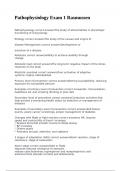
Pathophysiology correct answersThe study of abnormalities in physiologic
functioning of living beings
Etiology correct answersThe study of the causes and origins of
disease Pathogenesis correct answersDevelopment or
evolution of a disease
Allostasis correct answersAbility to achieve stability through
change
Allostatic load correct answersThe long-term negative impact of the stress
response on the body
Allostatic overload correct answersOver activation of adaptive
systems -Highly individualized
Primary level of prevention correct answersAltering susceptibility; reducing
exposure for susceptible persons
Examples of primary level of prevention correct answersEx- Immunization,
health/sex ed, quit smoking drinking or poor diet.
Secondary level of prevention correct answersConduction activities that
help prevent a worsening health status by detection or management of
diseases
Examples of secondary level of prevention correct answersSelf breast
exams, yearly cancer screenings, proper management of diabetes
Changes with flight or fight reaction correct answerso HR, impulse
speed and contractility of heart- increases
o Relaxes bronchial smooth muscle to dilate airway
o BP increases
o Dilates pupils
o Promotes arousal, attention, and vigilance
3 stages of adaptation (GAS) correct answersAlarm reaction, stage of
resistance, stage of exhaustion
Alarm stage correct answersfight or flight
response reduced resistance to stressors
release catecholamines (epinephrine and norepinephrine) and
adrenocortical steroids (cortisol and aldosterone)
, Resistance stage correct answerstrying to return to homeostasis
Exhaustion stage correct answerscannot return to homeostasis,
energy sources depleted, disease process sets in and permanent
symptoms show up.
Function of Mitochondria correct answerso Cellular respiration,
makes ATP. o Powerhouse of the cell
·Difference between Osmosis and Diffusion correct answersOne is the
diffusion of water and the other is the movement of any type of molecule
across the cell membrane from a high to low concentration.
·Isotonic Solution correct answersThe concentration of solutes is equal inside
and outside the cell so water moves across the membrane in both directions
maintaining cell size
Sensible water loss correct answerswater loss through typical routes like
urination or defecation
Insensible water loss correct answersLoss of water from the body that is not
noticeable such as from the skin or lungs
·Extracellular Fluid Deficit correct answersLoss of total body sodium-
Vomiting, diarrhea, excessive sweating, burns, diuretics or kidney failure.
Dehydration S/S correct answershard stools, sudden weight loss, rapid
pulse, oliguria, prolonged capillary refill time, decreased skin turgor, dry
mouth, absence of sweat and tears, confusion, lethargy, thirst
Hyponatremia S/S correct answersHyperactive bowel sounds, Weakness,
Lethargy, Confusion, Muscle cramps, Twitching, Seizures, Coma, Death
Hyperkalemia S/S correct answersMild cramping, hyperactive bowel sounds,
diarrhea, muscle weakness starting in lower extremities and ascends,
Bradycardia, Hypotension, Dysrhythmias, Tall T waves on ECG, Cardiac
arrest
Hypokalemia S/S correct answersAltered muscle function and weakness,
muscle cramping, Abdominal distention, bloating, diminished bowels sounds,
constipation, Dysrhythmias, Flat T waves on ECG, hyper polarization leads to
less reactive to stimuli, postural hypo tension
Electrolytes correct answersserves as bone reservoir
Potassium correct answersMaintain heart and muscle contraction
Pathophysiology correct answersThe study of abnormalities in physiologic
functioning of living beings
Etiology correct answersThe study of the causes and origins of
disease Pathogenesis correct answersDevelopment or
evolution of a disease
Allostasis correct answersAbility to achieve stability through
change
Allostatic load correct answersThe long-term negative impact of the stress
response on the body
Allostatic overload correct answersOver activation of adaptive
systems -Highly individualized
Primary level of prevention correct answersAltering susceptibility; reducing
exposure for susceptible persons
Examples of primary level of prevention correct answersEx- Immunization,
health/sex ed, quit smoking drinking or poor diet.
Secondary level of prevention correct answersConduction activities that
help prevent a worsening health status by detection or management of
diseases
Examples of secondary level of prevention correct answersSelf breast
exams, yearly cancer screenings, proper management of diabetes
Changes with flight or fight reaction correct answerso HR, impulse
speed and contractility of heart- increases
o Relaxes bronchial smooth muscle to dilate airway
o BP increases
o Dilates pupils
o Promotes arousal, attention, and vigilance
3 stages of adaptation (GAS) correct answersAlarm reaction, stage of
resistance, stage of exhaustion
Alarm stage correct answersfight or flight
response reduced resistance to stressors
release catecholamines (epinephrine and norepinephrine) and
adrenocortical steroids (cortisol and aldosterone)
, Resistance stage correct answerstrying to return to homeostasis
Exhaustion stage correct answerscannot return to homeostasis,
energy sources depleted, disease process sets in and permanent
symptoms show up.
Function of Mitochondria correct answerso Cellular respiration,
makes ATP. o Powerhouse of the cell
·Difference between Osmosis and Diffusion correct answersOne is the
diffusion of water and the other is the movement of any type of molecule
across the cell membrane from a high to low concentration.
·Isotonic Solution correct answersThe concentration of solutes is equal inside
and outside the cell so water moves across the membrane in both directions
maintaining cell size
Sensible water loss correct answerswater loss through typical routes like
urination or defecation
Insensible water loss correct answersLoss of water from the body that is not
noticeable such as from the skin or lungs
·Extracellular Fluid Deficit correct answersLoss of total body sodium-
Vomiting, diarrhea, excessive sweating, burns, diuretics or kidney failure.
Dehydration S/S correct answershard stools, sudden weight loss, rapid
pulse, oliguria, prolonged capillary refill time, decreased skin turgor, dry
mouth, absence of sweat and tears, confusion, lethargy, thirst
Hyponatremia S/S correct answersHyperactive bowel sounds, Weakness,
Lethargy, Confusion, Muscle cramps, Twitching, Seizures, Coma, Death
Hyperkalemia S/S correct answersMild cramping, hyperactive bowel sounds,
diarrhea, muscle weakness starting in lower extremities and ascends,
Bradycardia, Hypotension, Dysrhythmias, Tall T waves on ECG, Cardiac
arrest
Hypokalemia S/S correct answersAltered muscle function and weakness,
muscle cramping, Abdominal distention, bloating, diminished bowels sounds,
constipation, Dysrhythmias, Flat T waves on ECG, hyper polarization leads to
less reactive to stimuli, postural hypo tension
Electrolytes correct answersserves as bone reservoir
Potassium correct answersMaintain heart and muscle contraction