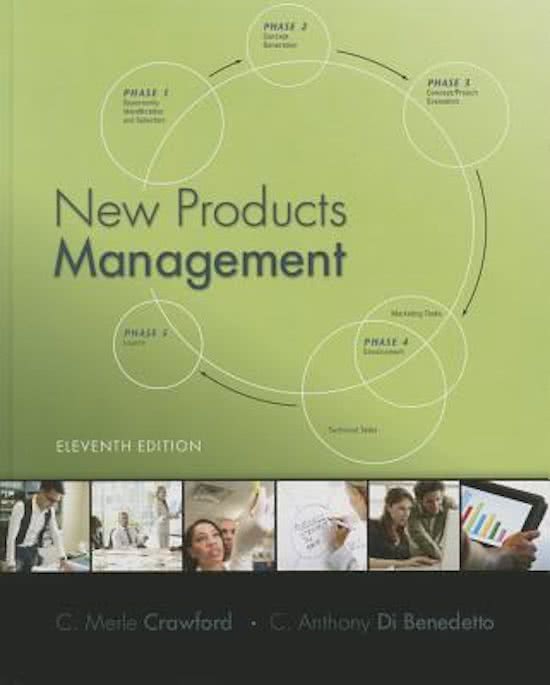
Summary 1ZV50 Book ‘New Products Management’
Chapter 1: The strategic elements of product development
New products: tangible goods/services, destined for the consumer market, B2B market, or both.
- Goods: products that are usually tangible (e.g. watch)
- Services: they are generally intangible (e.g. tinder)
- Mix good and service: mix of tangible and not tangible product (e.g. phone subscription)
Reasons for studying about new products:
1. New products hold the answer to most firms’ biggest problems.
2. New products process is exceedingly difficult.
The most important reasons why products fail:
The firm doesn’t understand customer, underfunds required research/development, doesn’t do
required homework before beginning development, doesn’t pay enough attention to quality, lacks
senior management support, chases a moving target.
➔ Goal: minimize dollar losses on failures and to learn from them.
Product development has become more challenging due to increased globalization.
Reasons for increasing global R&D efforts:
• Lower costs in foreign countries
• Increasing globalization of the innovating firms themselves
• Gaining competitive advantage by setting up global new product teams
Firms with a global innovation culture have the most effective global new product programs. Having a
global innovation culture means that a firm is open to global markets, mindful of differences in
customer needs and preferences, respectful of different national culture and business environments.
The new products team ideally is cross-functional, comprising personnel from marketing, R&D,
engineering, manufacturing, production, design, and other functional areas as well.
Process innovation usually applies to functions, especially the manufacturing or distribution process.
Product innovation applies to the total operation by which a new product is created and marketed.
Sometimes the new product process is accidental (serendipitous: not planned).
New products can be categorized as followed:
1. New-to-the-world products: revolutionize existing product categories or define new ones
2. New-to-the-firm products: new to the firm (new products process)
3. Additions to existing product lines: line extensions
4. Improvements and revisions to existing products: current products made better
5. Repositionings: products are retargeted for a new use
6. Cost reductions: new products that
simply replace existing products in the
line, by lower cost
,If a product is new to the world or to the firm, risks and uncertainties faced by firm are higher.
The number one reason for success is a unique superior product.
This field of activity has a unique vocabulary, because it is an expanding field (taking on new tasks)
and it is a melting pot field (different people, have to talk about the same event).
Specific jobs in the field of new products
• Functional representative: representatives on several teams or just one
• Project manager or team leader: leader of a team representing functions that will be required
• New products process manager: responsible for helping project managers develop and use
good new product processes
The three strategic elements are
1. New product process (procedure from concept evaluation to post-launch)
2. Product innovation charter (strategy for new products, in line with firm objectives)
3. Product portfolio (which new products would be best additions to existing product line)
The basic new products process
Phase 1 Opportunity identification and selection
Phase 2 Concept generation
Phase 3 Concept/Project evaluation
Phase 4 Development
Phase 5 Launch
No matter how many phases, there is underlying process of predevelopment, development, launch.
The phases of new products process represent activities that are conducted by the new product
team; between the phases are evaluation tasks, or decision points. There are periodic evaluations all
the way through the process. The activities are not sequential, but overlapping.
The goal of new products process is to manage down the amount of risk and uncertainty as one
passes from idea generation to launch.
Product development is truly multifunctional, where all functions work together on a cross-functional
team to accomplish the required tasks.
An evaluation task that includes conditional Go decisions is sometimes called a fuzzy gate.
➔ Fuzzy gates speed up the process, because time is not wasted in obtaining complete
information before the decision is made.
The new products process might look very different for new-to-the-world, breakthrough products, as
compared to more incremental new products.
Characteristics (overlapping phases, fuzzy gates, flexibility) are features of what is called the third-
generation new products process.
The PIC (product innovation charter) is developed by senior management and provides guidance to all
functional areas involved in innovation.
,Chapter 2: The new products process
PIC (product innovation charter) is a systematic way for managers to develop a new product strategy
that considers goals for product innovation efforts and how these efforts fit overall business strategy.
The new products process is the path new product takes from idea to the time of launch and beyond.
There needs to be assurance that firm develops right products with respect to its product portfolio
Phases in the New Products Process
1 Opportunity identification and selection: Generate new products opportunities as spinouts of
ongoing business operation, products suggestions, changes in marketing plan, resource changes and
new needs in marketplace.
• Three main streams of activity feed strategic planning for new products:
i. Ongoing marketing planning
ii. Ongoing corporate planning
iii. Special opportunity analysis (persons take an inventory of firms resources)
• From these activities, the opportunities identified can be sorted into categories:
i. Underutilized resource
ii. New resource
iii. External mandate
iv. Internal mandate (e.g. the product innovation (and/or acquisition) gap)
• The process of recognizing such opportunities is called opportunity identification.
2 Concept generation: Select a high potential/urgency opportunity, and begin customer involvement.
Collect available new product concepts that fit the opportunity and generate new ones as well.
• Creating viable product concepts is hard and sometimes frustrating work
• The problem find-solve approach involves identifying problems people/businesses have and
suggesting solutions to them.
3 Concept/project evaluation: Evaluate new products concepts on technical marketing, and financial
criteria. Rank them and select the best two/three. Request project proposal authorization.
• Before development work begins on new ideas, they are evaluated, screened, sorted out.
• This activity, called screening or pre-technical evaluation, varies tremendously.
• A concept test is used to see what potential consumers think about a concept.
These views come together in a full screen.
• If the decision is to go ahead, the evaluation turns into project evaluation.
• Product protocol means a kind of agreement between various groups what is wanted from
the new product (the benefits).
4 Development:
Technical tasks: specify full development process and its deliverables. Undertake to design
prototypes, test and validate prototypes against protocol, design production process, etc.
Marketing tasks: prepare strategy, tactics and launch details for marketing plan, prepare proposed
business plan and get approval for it, etc.
• Resource preparation: often overlooked by new products managers
• The major body of effort:
i. The item or service itself
ii. The marketing plan
iii. Business (or financial) plan
• If the product is real some firms make a comprehensive business analysis before moving into
launch (final Go/No Go)
, 5 Launch: Commercialize the plans and prototypes from development phase; begin distribution and
sale of new product and manage the launch program
• Launch: time or decision when the firm decides to market a product (the Go in Go/No Go)
• Thing that is often overlooked is the activity of planning for launch management.
Due to evaluation tasks in New Products Process, product comes
from a situation and turns into an end. We then have an evolving
product at end, if it is successful it becomes new product.
The Evolution from concept to new product (figure):
A complementary process to the phased new product
process is agile product development. Objective is: provide
customer satisfaction by continuous software improvement.
➔ “scrum” where team engages in series of sprints to continuously develop and deliver software
Accelerated Product Development: speeding product to market, which offers many benefits to firm.
Five sure methods to accelerate time to market:
1. Clear product innovation charter (product definition)
2. Overlapping phases or parallel processing
3. Portfolio management approach
4. Focus on quality at every phase complements the PIC
5. Empowered cross-functional team
Firms that strive for being first to mindshare think not about the speed of an individual product’s
development and launch, but rather about creating a dominant position in the mind of the customer.
Disadvantages of speeding to market: high costs, quality sacrifices, inadequate attention to key
marketing tasks in readying the product for launch
Services and goods are often arrayed on a scale of:
1. Pure service
2. Primarily service and partly a good
3. Primarily a good and partly service
4. Pure good
Services are individualized to the individual customer. Whereas goods are mass-produced, services
are provided through interaction between service provider and customer.
Chapter 1: The strategic elements of product development
New products: tangible goods/services, destined for the consumer market, B2B market, or both.
- Goods: products that are usually tangible (e.g. watch)
- Services: they are generally intangible (e.g. tinder)
- Mix good and service: mix of tangible and not tangible product (e.g. phone subscription)
Reasons for studying about new products:
1. New products hold the answer to most firms’ biggest problems.
2. New products process is exceedingly difficult.
The most important reasons why products fail:
The firm doesn’t understand customer, underfunds required research/development, doesn’t do
required homework before beginning development, doesn’t pay enough attention to quality, lacks
senior management support, chases a moving target.
➔ Goal: minimize dollar losses on failures and to learn from them.
Product development has become more challenging due to increased globalization.
Reasons for increasing global R&D efforts:
• Lower costs in foreign countries
• Increasing globalization of the innovating firms themselves
• Gaining competitive advantage by setting up global new product teams
Firms with a global innovation culture have the most effective global new product programs. Having a
global innovation culture means that a firm is open to global markets, mindful of differences in
customer needs and preferences, respectful of different national culture and business environments.
The new products team ideally is cross-functional, comprising personnel from marketing, R&D,
engineering, manufacturing, production, design, and other functional areas as well.
Process innovation usually applies to functions, especially the manufacturing or distribution process.
Product innovation applies to the total operation by which a new product is created and marketed.
Sometimes the new product process is accidental (serendipitous: not planned).
New products can be categorized as followed:
1. New-to-the-world products: revolutionize existing product categories or define new ones
2. New-to-the-firm products: new to the firm (new products process)
3. Additions to existing product lines: line extensions
4. Improvements and revisions to existing products: current products made better
5. Repositionings: products are retargeted for a new use
6. Cost reductions: new products that
simply replace existing products in the
line, by lower cost
,If a product is new to the world or to the firm, risks and uncertainties faced by firm are higher.
The number one reason for success is a unique superior product.
This field of activity has a unique vocabulary, because it is an expanding field (taking on new tasks)
and it is a melting pot field (different people, have to talk about the same event).
Specific jobs in the field of new products
• Functional representative: representatives on several teams or just one
• Project manager or team leader: leader of a team representing functions that will be required
• New products process manager: responsible for helping project managers develop and use
good new product processes
The three strategic elements are
1. New product process (procedure from concept evaluation to post-launch)
2. Product innovation charter (strategy for new products, in line with firm objectives)
3. Product portfolio (which new products would be best additions to existing product line)
The basic new products process
Phase 1 Opportunity identification and selection
Phase 2 Concept generation
Phase 3 Concept/Project evaluation
Phase 4 Development
Phase 5 Launch
No matter how many phases, there is underlying process of predevelopment, development, launch.
The phases of new products process represent activities that are conducted by the new product
team; between the phases are evaluation tasks, or decision points. There are periodic evaluations all
the way through the process. The activities are not sequential, but overlapping.
The goal of new products process is to manage down the amount of risk and uncertainty as one
passes from idea generation to launch.
Product development is truly multifunctional, where all functions work together on a cross-functional
team to accomplish the required tasks.
An evaluation task that includes conditional Go decisions is sometimes called a fuzzy gate.
➔ Fuzzy gates speed up the process, because time is not wasted in obtaining complete
information before the decision is made.
The new products process might look very different for new-to-the-world, breakthrough products, as
compared to more incremental new products.
Characteristics (overlapping phases, fuzzy gates, flexibility) are features of what is called the third-
generation new products process.
The PIC (product innovation charter) is developed by senior management and provides guidance to all
functional areas involved in innovation.
,Chapter 2: The new products process
PIC (product innovation charter) is a systematic way for managers to develop a new product strategy
that considers goals for product innovation efforts and how these efforts fit overall business strategy.
The new products process is the path new product takes from idea to the time of launch and beyond.
There needs to be assurance that firm develops right products with respect to its product portfolio
Phases in the New Products Process
1 Opportunity identification and selection: Generate new products opportunities as spinouts of
ongoing business operation, products suggestions, changes in marketing plan, resource changes and
new needs in marketplace.
• Three main streams of activity feed strategic planning for new products:
i. Ongoing marketing planning
ii. Ongoing corporate planning
iii. Special opportunity analysis (persons take an inventory of firms resources)
• From these activities, the opportunities identified can be sorted into categories:
i. Underutilized resource
ii. New resource
iii. External mandate
iv. Internal mandate (e.g. the product innovation (and/or acquisition) gap)
• The process of recognizing such opportunities is called opportunity identification.
2 Concept generation: Select a high potential/urgency opportunity, and begin customer involvement.
Collect available new product concepts that fit the opportunity and generate new ones as well.
• Creating viable product concepts is hard and sometimes frustrating work
• The problem find-solve approach involves identifying problems people/businesses have and
suggesting solutions to them.
3 Concept/project evaluation: Evaluate new products concepts on technical marketing, and financial
criteria. Rank them and select the best two/three. Request project proposal authorization.
• Before development work begins on new ideas, they are evaluated, screened, sorted out.
• This activity, called screening or pre-technical evaluation, varies tremendously.
• A concept test is used to see what potential consumers think about a concept.
These views come together in a full screen.
• If the decision is to go ahead, the evaluation turns into project evaluation.
• Product protocol means a kind of agreement between various groups what is wanted from
the new product (the benefits).
4 Development:
Technical tasks: specify full development process and its deliverables. Undertake to design
prototypes, test and validate prototypes against protocol, design production process, etc.
Marketing tasks: prepare strategy, tactics and launch details for marketing plan, prepare proposed
business plan and get approval for it, etc.
• Resource preparation: often overlooked by new products managers
• The major body of effort:
i. The item or service itself
ii. The marketing plan
iii. Business (or financial) plan
• If the product is real some firms make a comprehensive business analysis before moving into
launch (final Go/No Go)
, 5 Launch: Commercialize the plans and prototypes from development phase; begin distribution and
sale of new product and manage the launch program
• Launch: time or decision when the firm decides to market a product (the Go in Go/No Go)
• Thing that is often overlooked is the activity of planning for launch management.
Due to evaluation tasks in New Products Process, product comes
from a situation and turns into an end. We then have an evolving
product at end, if it is successful it becomes new product.
The Evolution from concept to new product (figure):
A complementary process to the phased new product
process is agile product development. Objective is: provide
customer satisfaction by continuous software improvement.
➔ “scrum” where team engages in series of sprints to continuously develop and deliver software
Accelerated Product Development: speeding product to market, which offers many benefits to firm.
Five sure methods to accelerate time to market:
1. Clear product innovation charter (product definition)
2. Overlapping phases or parallel processing
3. Portfolio management approach
4. Focus on quality at every phase complements the PIC
5. Empowered cross-functional team
Firms that strive for being first to mindshare think not about the speed of an individual product’s
development and launch, but rather about creating a dominant position in the mind of the customer.
Disadvantages of speeding to market: high costs, quality sacrifices, inadequate attention to key
marketing tasks in readying the product for launch
Services and goods are often arrayed on a scale of:
1. Pure service
2. Primarily service and partly a good
3. Primarily a good and partly service
4. Pure good
Services are individualized to the individual customer. Whereas goods are mass-produced, services
are provided through interaction between service provider and customer.