B.Com. III Year Subject- Income Tax Law And Practice
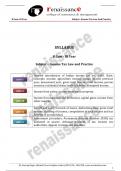
SYLLABUS
B.Com - III Year
Subject – Income Tax Law and Practice
General introduction of Indian income tax act, 1961. Basic
UNIT-I concepts: income, agriculture income, casual income previous
year, assessment year, gross total income, total income, person
assessee, residential status and tax liability, exempted income.
UNIT-II Income from salary, income from house property.
Income from business and profession, capital gains, income from
UNIT-III other sources.
Set off and carry forward of losses, deductions from gross total
UNIT-IV income, clubbing of income, computation of total income and tax
liability of an individual.
Assessment procedure, Permanent Account Number (PAN) tax
UNIT-V deducted at source. Advance payment of tax. Income tax
authorities. Appeal, revision and penalties.
45, Anurag Nagar, Behind Press Complex, Indore (M.P.) Ph.: 4262100, www.rccmindore.com
1
,B.Com. III Year Subject- Income Tax Law And Practice
UNIT-I
Basic concepts of Income Tax
Meaning of Income Tax
Income tax is a tax on year taxable income of a person levied by the Central Government at prescribed
rates. Tax payers include individual, firm, company, Hindu undivided family, association of persons, trust
etc. Taxable income means income calculated under the provisions of the Income Tax Act.1961
SALIENT FEATURES OF INCOME TAX –
1. Central Tax 8. Separate Administration
2. Direct Tax 9. Distribution of Tax between Central and
3. Tax on Taxable Income State Government.
4. Progressive rates of Tax 10. It is largest source of revenue.
5. Scope of Taxation not only with
11. Tax for country welfare
individual but also with firm, company,
12. History of income Tax in India is about
HUF, Trust & Co-Operative Societies
150 years old.
6. Tax Exemption limit
13. Control on Income by Income tax
7. Burden on Rich class persons
14. Beginning of Income Tax by sir James
Wilson in 1860 in India.
Income [Section 2(24)]
Though ‘Income’ is a very important word for the Income Tax Act but no precious definition of the word
“Income” is attempted under the Income Tax Act, 1961. The term “Income”, in the context of the Act, in
inclusive. The narration given in Sub-Section (24) of Section 2 of the Act enumerates certain items,
including those which cannot ordinarily be considered as income but are treated satutorily as such.
Definition of Income [Section 2(24)]
Income Includes:-
1. Profit and gains;
2. Dividend;
3. Voluntary contributions received by a trust.
4. The value of a perquisite o profit in lieu of salary.
5. Any special allowance or benefit other than perquisites included under 4.
6. Any allowance granted to the assessee either to meet his personal expenses at the place where the
duties of his office
7. The value of any benefit or perquisite obtained from a company.
8. Any compensation
9. Profit on sale of License
10. Cash assistance received
11. Any interest, salary, bonus, commission/remunerations
12. Profit/gain of mutual or co-operative insurance co.
13. Capital gain arising from transfer of capital gain
14. Any sum received under a key man insurance police.
45, Anurag Nagar, Behind Press Complex, Indore (M.P.) Ph.: 4262100, www.rccmindore.com
2
,B.Com. III Year Subject- Income Tax Law And Practice
Agricultural Income [Section 2 (1A)]
Definition of Agriculture Income
Sec. 2(1A) defines “agricultural income” to means –
(A) any rent or revenue derived from land which is situated in India and is used for agricultural
purposes,
(B) any income derived from such land by agriculture or by the process employed to render the
produce fit for the market or by sale of such produce by a cultivator or receiver of rent in kind,
(C) Any income derived from any building provided the following conditions are satisfied (i) The
Building is immediate vicinity of the agriculture land (ii) it is occupied by the cultivator or
received of rent or revenue (iii) It is used as a dwelling house or store house/out house. (iv)
The land is assessed to land revenue or a local rate.
(D) Any income derived from saplings/seedling grown in a nursery shall be deemed to be
agricultural income.
Partly Agricultural Income Shown by Chart
S.No. Partly Agricultural Income Agricultural Non Agricultural
Income Income
1 Growing & manufacturing tea in India 60% 40%
2 Growing & cured coffee in India by the 75% 25%
seller
3 Sale of Coffee grown, cured, roasted and 60% 40%
grounded
4 Sale of centrifuged latex or cenex 65% 35%
manufactured from rubber
5 Other Agricultural produce grown by the Market value of Remaining Business
manufacturer and used for own product. agricultural income will be taxable.
produce used in
production
INCOME CONNECTED WITH LAND BUT NOT AGRICULTURAL INCOME –
1. Profit earned on purchasing the 6. Income from land used for brick
standing crop. making
2. Income from mines 7. Income from supply of water for
3. Income from self grown grass, irrigation purposes.
trees/bamboos 8. Remuneration for managing
4. Divided from a company engaged in agricultural property.
Agricultural 9. Income from dairying.
5. Income from warehouses and 10. Interest accrued on promissory notes
godowns. executed for arrears of rent.
Agricultural Income and Tax Liability –
Though agricultural income is exempt and it is not included in computation of total income of an assessee
but from tax calculation point of view it is added to total income. The agricultural income is integrated
with non-agricultural income in those cases where assessee has both incomes. Such integration is done
only in the case of individual, HUF, AOP/BOI and Artificial juridical person.
45, Anurag Nagar, Behind Press Complex, Indore (M.P.) Ph.: 4262100, www.rccmindore.com
3
, B.Com. III Year Subject- Income Tax Law And Practice
Condition for Integration -
When the following two conditions are satisfied-
(i) Non agricultural income of the assessee exceeds the maximum exemption limit which for the
assessment year 2018-19 is Rs. 2.5 lakh in the case of an individual, Women and HUF in case of
Senior citizen it will be Rs. 3,00,000 and Super senior citizen Rs. 5,00,000 instead of Rs.
2,50,000/-.
(ii) Net agricultural income exceed Rs. 5,000
Procedure for computation of Tax-payable an non-agricultural income after Integration-
1. Aggregate the Agricultural income with non Agricultural income and determine the tax payable on
such amount.
2. Aggregate the Agricultural income with basis exemption limit and determine the tax payable on
such amount.
3. The difference between the tax computed in step (a) and step (b) will be the tax payable in respect
of non-agricultural income.
CASUAL INCOME
Causal Income means such income the receipt of which is accidental and without any stipulation. It is
the nature of an unexpected windfall.
Though causal income is fully taxable but it is necessary to clear this meaning from the following point
of view –
1. Causal income like lottery, race income are taxable at special rate of 30%
2. Causal income cannot be set off against other causal income as well as casual income cannot be
used for setting off loss of other head.
4. ASSESSMENT YEAR : (2018-2019) [Section 2 9)]
It means the period of twelve months commencing on 1st of April every year. In other words period of
12 months – 1st April to 31st March is called assessment year.
5. PREVIOUS YEAR (Section 3) (2017-2018) [Section3 ]
Previous year means the financial year immediately preceding the assessment year e.g. for the
assessment year 2018-2019 previous year will commence on 1st of April, 2017 and end on 31st March,
2018. Previous year for income tax purposes will be financial year which ends on 31st of March,
however the assessee can close his books of accounts on other date e.g. an assessee may maintain
books of accounts on calendar year basis but his previous year, for Income Tax purpose, will be
financial year and not the calendar year. This uniform previous year has to be followed for all sources
of income.
Important points in relation to previous year: Under the following situation the previous year would
be -
1. Where a different accounting year is followed
2. Previous year in case of newly set up business
3. In case of newly created source of income
Exception to the rule of Previous Year:
These exceptions are:
1. Shipping business income of non-resident ship-owners
2. In case of persons leaving India
3. In case of persons who are likely to transfer their assets to avoid tax
4. In case of discontinued business
45, Anurag Nagar, Behind Press Complex, Indore (M.P.) Ph.: 4262100, www.rccmindore.com
4
SYLLABUS
B.Com - III Year
Subject – Income Tax Law and Practice
General introduction of Indian income tax act, 1961. Basic
UNIT-I concepts: income, agriculture income, casual income previous
year, assessment year, gross total income, total income, person
assessee, residential status and tax liability, exempted income.
UNIT-II Income from salary, income from house property.
Income from business and profession, capital gains, income from
UNIT-III other sources.
Set off and carry forward of losses, deductions from gross total
UNIT-IV income, clubbing of income, computation of total income and tax
liability of an individual.
Assessment procedure, Permanent Account Number (PAN) tax
UNIT-V deducted at source. Advance payment of tax. Income tax
authorities. Appeal, revision and penalties.
45, Anurag Nagar, Behind Press Complex, Indore (M.P.) Ph.: 4262100, www.rccmindore.com
1
,B.Com. III Year Subject- Income Tax Law And Practice
UNIT-I
Basic concepts of Income Tax
Meaning of Income Tax
Income tax is a tax on year taxable income of a person levied by the Central Government at prescribed
rates. Tax payers include individual, firm, company, Hindu undivided family, association of persons, trust
etc. Taxable income means income calculated under the provisions of the Income Tax Act.1961
SALIENT FEATURES OF INCOME TAX –
1. Central Tax 8. Separate Administration
2. Direct Tax 9. Distribution of Tax between Central and
3. Tax on Taxable Income State Government.
4. Progressive rates of Tax 10. It is largest source of revenue.
5. Scope of Taxation not only with
11. Tax for country welfare
individual but also with firm, company,
12. History of income Tax in India is about
HUF, Trust & Co-Operative Societies
150 years old.
6. Tax Exemption limit
13. Control on Income by Income tax
7. Burden on Rich class persons
14. Beginning of Income Tax by sir James
Wilson in 1860 in India.
Income [Section 2(24)]
Though ‘Income’ is a very important word for the Income Tax Act but no precious definition of the word
“Income” is attempted under the Income Tax Act, 1961. The term “Income”, in the context of the Act, in
inclusive. The narration given in Sub-Section (24) of Section 2 of the Act enumerates certain items,
including those which cannot ordinarily be considered as income but are treated satutorily as such.
Definition of Income [Section 2(24)]
Income Includes:-
1. Profit and gains;
2. Dividend;
3. Voluntary contributions received by a trust.
4. The value of a perquisite o profit in lieu of salary.
5. Any special allowance or benefit other than perquisites included under 4.
6. Any allowance granted to the assessee either to meet his personal expenses at the place where the
duties of his office
7. The value of any benefit or perquisite obtained from a company.
8. Any compensation
9. Profit on sale of License
10. Cash assistance received
11. Any interest, salary, bonus, commission/remunerations
12. Profit/gain of mutual or co-operative insurance co.
13. Capital gain arising from transfer of capital gain
14. Any sum received under a key man insurance police.
45, Anurag Nagar, Behind Press Complex, Indore (M.P.) Ph.: 4262100, www.rccmindore.com
2
,B.Com. III Year Subject- Income Tax Law And Practice
Agricultural Income [Section 2 (1A)]
Definition of Agriculture Income
Sec. 2(1A) defines “agricultural income” to means –
(A) any rent or revenue derived from land which is situated in India and is used for agricultural
purposes,
(B) any income derived from such land by agriculture or by the process employed to render the
produce fit for the market or by sale of such produce by a cultivator or receiver of rent in kind,
(C) Any income derived from any building provided the following conditions are satisfied (i) The
Building is immediate vicinity of the agriculture land (ii) it is occupied by the cultivator or
received of rent or revenue (iii) It is used as a dwelling house or store house/out house. (iv)
The land is assessed to land revenue or a local rate.
(D) Any income derived from saplings/seedling grown in a nursery shall be deemed to be
agricultural income.
Partly Agricultural Income Shown by Chart
S.No. Partly Agricultural Income Agricultural Non Agricultural
Income Income
1 Growing & manufacturing tea in India 60% 40%
2 Growing & cured coffee in India by the 75% 25%
seller
3 Sale of Coffee grown, cured, roasted and 60% 40%
grounded
4 Sale of centrifuged latex or cenex 65% 35%
manufactured from rubber
5 Other Agricultural produce grown by the Market value of Remaining Business
manufacturer and used for own product. agricultural income will be taxable.
produce used in
production
INCOME CONNECTED WITH LAND BUT NOT AGRICULTURAL INCOME –
1. Profit earned on purchasing the 6. Income from land used for brick
standing crop. making
2. Income from mines 7. Income from supply of water for
3. Income from self grown grass, irrigation purposes.
trees/bamboos 8. Remuneration for managing
4. Divided from a company engaged in agricultural property.
Agricultural 9. Income from dairying.
5. Income from warehouses and 10. Interest accrued on promissory notes
godowns. executed for arrears of rent.
Agricultural Income and Tax Liability –
Though agricultural income is exempt and it is not included in computation of total income of an assessee
but from tax calculation point of view it is added to total income. The agricultural income is integrated
with non-agricultural income in those cases where assessee has both incomes. Such integration is done
only in the case of individual, HUF, AOP/BOI and Artificial juridical person.
45, Anurag Nagar, Behind Press Complex, Indore (M.P.) Ph.: 4262100, www.rccmindore.com
3
, B.Com. III Year Subject- Income Tax Law And Practice
Condition for Integration -
When the following two conditions are satisfied-
(i) Non agricultural income of the assessee exceeds the maximum exemption limit which for the
assessment year 2018-19 is Rs. 2.5 lakh in the case of an individual, Women and HUF in case of
Senior citizen it will be Rs. 3,00,000 and Super senior citizen Rs. 5,00,000 instead of Rs.
2,50,000/-.
(ii) Net agricultural income exceed Rs. 5,000
Procedure for computation of Tax-payable an non-agricultural income after Integration-
1. Aggregate the Agricultural income with non Agricultural income and determine the tax payable on
such amount.
2. Aggregate the Agricultural income with basis exemption limit and determine the tax payable on
such amount.
3. The difference between the tax computed in step (a) and step (b) will be the tax payable in respect
of non-agricultural income.
CASUAL INCOME
Causal Income means such income the receipt of which is accidental and without any stipulation. It is
the nature of an unexpected windfall.
Though causal income is fully taxable but it is necessary to clear this meaning from the following point
of view –
1. Causal income like lottery, race income are taxable at special rate of 30%
2. Causal income cannot be set off against other causal income as well as casual income cannot be
used for setting off loss of other head.
4. ASSESSMENT YEAR : (2018-2019) [Section 2 9)]
It means the period of twelve months commencing on 1st of April every year. In other words period of
12 months – 1st April to 31st March is called assessment year.
5. PREVIOUS YEAR (Section 3) (2017-2018) [Section3 ]
Previous year means the financial year immediately preceding the assessment year e.g. for the
assessment year 2018-2019 previous year will commence on 1st of April, 2017 and end on 31st March,
2018. Previous year for income tax purposes will be financial year which ends on 31st of March,
however the assessee can close his books of accounts on other date e.g. an assessee may maintain
books of accounts on calendar year basis but his previous year, for Income Tax purpose, will be
financial year and not the calendar year. This uniform previous year has to be followed for all sources
of income.
Important points in relation to previous year: Under the following situation the previous year would
be -
1. Where a different accounting year is followed
2. Previous year in case of newly set up business
3. In case of newly created source of income
Exception to the rule of Previous Year:
These exceptions are:
1. Shipping business income of non-resident ship-owners
2. In case of persons leaving India
3. In case of persons who are likely to transfer their assets to avoid tax
4. In case of discontinued business
45, Anurag Nagar, Behind Press Complex, Indore (M.P.) Ph.: 4262100, www.rccmindore.com
4