3/15/25, 3:33 PM PMHNP Comprehensive Exam / Exam Questions Study Guide / Actual Questions and Answers (A+ Guide Solution) Newest 2025/2…
PMHNP Comprehensive Exam / Exam Questions
Study Guide / Actual Questions and Answers (A+
Guide Solution) Newest 2025/2026
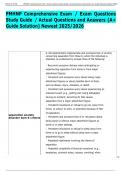
A. Developmentally inappropriate and excessive fear or anxiety
concerning separation from those to whom the individual is
attached, as evidenced by at least three of the following:
1. Recurrent excessive distress when anticipating or
experiencing separation from home or from major
attachment figures.
2. Persistent and excessive worry about losing major
attachment figures or about possible harm to them,
such as illness, injury, disasters, or death.
3. Persistent and excessive worry about experiencing an
untoward event (e.g., getting lost, being kidnapped,
having an accident, becoming ill) that causes
separation from a major attachment figure.
4. Persistent reluctance or refusal to go out, away from
home, to school, to work, or elsewhere because of fear
of separation.
separation anxiety
disorder dsm-5 criteria 5. Persistent and excessive fear of or reluctance about
being alone or without major attachment figures at
home or in other settings.
6. Persistent reluctance or refusal to sleep away from
home or to go to sleep without being near a major
attachment figure.
7. Repeated nightmares involving the theme of
separation.
8. Repeated complaints of physical symptoms (e.g.,
headaches, stomach aches, nausea, vomiting) when
… 1/52
,3/15/25, 3:33 PM PMHNP Comprehensive Exam / Exam Questions Study Guide / Actual Questions and Answers (A+ Guide Solution) Newest 2025/2…
separation from major attachment figures occurs or is
anticipated.
B. The fear, anxiety, or avoidance is persistent, lasting at least 4
weeks in children and adolescents and typically 6 months or more
in adults.
(Prochaska & DiClemente)
● Precontemplation—little to no awareness of the
problem or intent to change
● Contemplation—thinking about making a change in
Stages of Change the next 6 months, weigh pros and cons
(Transtheoretical Model) ● Preparation—prepare to make change within the
next month, start to make small changes
● Action—enacted the change for 1 day-6 months
● Maintenance—maintained behavior/change for 6
months or longer
● Physiological (food, water, shelter, warmth)
● Safety (security, stability, freedom from fear)
● Belonging/love (friends, family, spouse, lover)
Maslow's Hierarchy of
● Self-esteem (achievement, mastery, recognition,
Needs
respect)
● Self-actualization (pursue, inner talent, creativity,
fulfillment)
… 2/52
,3/15/25, 3:33 PM PMHNP Comprehensive Exam / Exam Questions Study Guide / Actual Questions and Answers (A+ Guide Solution) Newest 2025/2…
● Novice—unconscious incompetence, no
experience, governed by rules and regulations
● Advanced beginner—able to analyze and
Benner's Model deliberately act
● Competency/proficiency—2-5 yrs experience, able
to synthesize info/coordinate
● Expert—flexible, intuitive, efficient
○ 23-30 normal
MMSE Scoring ○ 19-23 borderline
○ <19 impaired
● Orientation
● Registration (repeat 3 words)
● Attention and Calculation (count backwards from
100 by 7, spell words backward)
MMSE components ● Recall (repeat the same 3 words from immediate
recall)
● Language (name an object, repeat a phrase, read a
sentence, write a sentence, copy intersecting
pentagons)
· Primary prevention—methods to avoid occurrence of
disease (most population-based health promotion
efforts)
· Secondary prevention—methods to diagnose and
treat existent disease in early stages before it causes
significant morbidity
Levels of Prevention
· Tertiary prevention—methods to reduce negative
impact of existent disease by restoring function and
reducing disease-related complications
· Quaternary prevention—methods to mitigate or avoid
results of unnecessary or excessive interventions in
the health system
A region of the cerebral cortex that has specialized
areas for movement, abstract thinking, planning,
frontal lobe
memory, and judgement
-prefrontal, motor strip, EPS, basal ganglia
… 3/52
, 3/15/25, 3:33 PM PMHNP Comprehensive Exam / Exam Questions Study Guide / Actual Questions and Answers (A+ Guide Solution) Newest 2025/2…
-nausea
-dry mouth
-insomnia
-somnolence
-headache
-nervousness
-anxiety
SSRI common adverse
-gastrointestinal (GI) disturbances
effects
-anorexia
-sexual dysfunction
-agitation
-dizziness
-fatigue
-jittery
-emotional flattening
Flu-like symptoms, fatigue, myalgia, decreased concentration, N/V,
impaired memory, paresthesia, shock like sensations, irritability,
SSRI discontinuation anxiety, insomnia, crying without provocation, dizziness, vertigo,
syndrome agitation
… 4/52
PMHNP Comprehensive Exam / Exam Questions
Study Guide / Actual Questions and Answers (A+
Guide Solution) Newest 2025/2026
A. Developmentally inappropriate and excessive fear or anxiety
concerning separation from those to whom the individual is
attached, as evidenced by at least three of the following:
1. Recurrent excessive distress when anticipating or
experiencing separation from home or from major
attachment figures.
2. Persistent and excessive worry about losing major
attachment figures or about possible harm to them,
such as illness, injury, disasters, or death.
3. Persistent and excessive worry about experiencing an
untoward event (e.g., getting lost, being kidnapped,
having an accident, becoming ill) that causes
separation from a major attachment figure.
4. Persistent reluctance or refusal to go out, away from
home, to school, to work, or elsewhere because of fear
of separation.
separation anxiety
disorder dsm-5 criteria 5. Persistent and excessive fear of or reluctance about
being alone or without major attachment figures at
home or in other settings.
6. Persistent reluctance or refusal to sleep away from
home or to go to sleep without being near a major
attachment figure.
7. Repeated nightmares involving the theme of
separation.
8. Repeated complaints of physical symptoms (e.g.,
headaches, stomach aches, nausea, vomiting) when
… 1/52
,3/15/25, 3:33 PM PMHNP Comprehensive Exam / Exam Questions Study Guide / Actual Questions and Answers (A+ Guide Solution) Newest 2025/2…
separation from major attachment figures occurs or is
anticipated.
B. The fear, anxiety, or avoidance is persistent, lasting at least 4
weeks in children and adolescents and typically 6 months or more
in adults.
(Prochaska & DiClemente)
● Precontemplation—little to no awareness of the
problem or intent to change
● Contemplation—thinking about making a change in
Stages of Change the next 6 months, weigh pros and cons
(Transtheoretical Model) ● Preparation—prepare to make change within the
next month, start to make small changes
● Action—enacted the change for 1 day-6 months
● Maintenance—maintained behavior/change for 6
months or longer
● Physiological (food, water, shelter, warmth)
● Safety (security, stability, freedom from fear)
● Belonging/love (friends, family, spouse, lover)
Maslow's Hierarchy of
● Self-esteem (achievement, mastery, recognition,
Needs
respect)
● Self-actualization (pursue, inner talent, creativity,
fulfillment)
… 2/52
,3/15/25, 3:33 PM PMHNP Comprehensive Exam / Exam Questions Study Guide / Actual Questions and Answers (A+ Guide Solution) Newest 2025/2…
● Novice—unconscious incompetence, no
experience, governed by rules and regulations
● Advanced beginner—able to analyze and
Benner's Model deliberately act
● Competency/proficiency—2-5 yrs experience, able
to synthesize info/coordinate
● Expert—flexible, intuitive, efficient
○ 23-30 normal
MMSE Scoring ○ 19-23 borderline
○ <19 impaired
● Orientation
● Registration (repeat 3 words)
● Attention and Calculation (count backwards from
100 by 7, spell words backward)
MMSE components ● Recall (repeat the same 3 words from immediate
recall)
● Language (name an object, repeat a phrase, read a
sentence, write a sentence, copy intersecting
pentagons)
· Primary prevention—methods to avoid occurrence of
disease (most population-based health promotion
efforts)
· Secondary prevention—methods to diagnose and
treat existent disease in early stages before it causes
significant morbidity
Levels of Prevention
· Tertiary prevention—methods to reduce negative
impact of existent disease by restoring function and
reducing disease-related complications
· Quaternary prevention—methods to mitigate or avoid
results of unnecessary or excessive interventions in
the health system
A region of the cerebral cortex that has specialized
areas for movement, abstract thinking, planning,
frontal lobe
memory, and judgement
-prefrontal, motor strip, EPS, basal ganglia
… 3/52
, 3/15/25, 3:33 PM PMHNP Comprehensive Exam / Exam Questions Study Guide / Actual Questions and Answers (A+ Guide Solution) Newest 2025/2…
-nausea
-dry mouth
-insomnia
-somnolence
-headache
-nervousness
-anxiety
SSRI common adverse
-gastrointestinal (GI) disturbances
effects
-anorexia
-sexual dysfunction
-agitation
-dizziness
-fatigue
-jittery
-emotional flattening
Flu-like symptoms, fatigue, myalgia, decreased concentration, N/V,
impaired memory, paresthesia, shock like sensations, irritability,
SSRI discontinuation anxiety, insomnia, crying without provocation, dizziness, vertigo,
syndrome agitation
… 4/52