

Week 1, additional reading 1
EXPLAINING DEVELOPMENT AND CHANGE IN ORGANIZATIONS
Van de Ven and Poole
We contend that such integration is possible if different perspectives are viewed as providing
alternative pictures of the same organizational processes without nullifying each other. This
can be achieved by identifying the viewpoints from which each theory applies and the
circumstances when these theories are interrelated. This approach preserves the authenticity of
distinct theories, and at the same time advances theory building, because it highlights
circumstances when interplays among the theories may provide stronger and broader
explanatory power of organizational change and development processes.
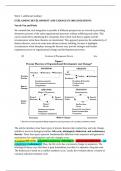
The article introduces four basic types of process theories that explain how and why change
unfolds in social or biological entities: life cycle, teleological, dialectical, and evolutionary
theories. These four types represent fundamentally different event sequences and generative
mechanisms for explaining how and why changes occur.
A program (life cycle), purposeful construction (teleological), confrontation (dialectical), and
competition (evolutionary). Thus, the life cycle has a necessary change in sequences. The
teleological theory says that there is goal formulation, but that it is adjusted a long the road.
The dialectical is based on a conflict-synthesis cycle. Lastly, the evolution theory is based on
variation-selection-retention cycle.
,The Four Ideal-Typical Development Theories:
Life Cycle Theory: This theory views development as a process that unfolds in a
prescribed sequence of stages. The underlying idea is that the entity has an internal
logic or program that governs change. This program guides the entity from a starting
point to a predetermined endpoint. External events influence the process but are
always mediated by the internal logic. This theory is often used to describe the
development of organizations, products, and careers. The typical progression of
change events in a life cycle model is a unidirectional sequence that is cumulative
(features acquired in earlier stages are retained in later stages) and conjunctive (stages
are related such that they arise from a common underlying process).
Teleological Theory: This theory explains development by referring to goals. Here, the entity
is goal-oriented and constructs a desired end state. It takes action to achieve this state and
monitors progress. Development is seen as a recurring sequence of goal formulation,
implementation, evaluation, and adjustment. Unlike life cycle theory, teleological theory
does not prescribe a necessary sequence of events. There is no predetermined rule or
logically necessary direction. This theory emphasizes the intentionality of the actor. It
recognizes that the environment and resources of the organization impose constraints on what
it can achieve.
Dialectical Theory: Dialectical theory posits that organizations exist in a pluralistic world of
conflicting events and contradictory values. Change occurs when opposing values or forces
gain enough power to confront the existing situation. This leads to a synthesis that is new
and different from the original thesis and antithesis. Stability is explained by the balance of
power between opposing entities. It can result in creative syntheses or the overthrow of the
status quo.
Evolutionary Theory: Evolutionary theory focuses on cumulative changes in structural
forms of populations of organizational entities. The process proceeds through a cycle of
variation, selection, and retention. Variations arise randomly, selection occurs through
competition for scarce resources, and retention sustains certain forms. The theory can be
applied at various levels, from populations to internal processes within organizations.
Most specific theories of organizational change and development are combinations of
two or more of these ideal-typical mechanisms. This is because the organizational context
of development and change spans across space and time, and no single mechanism is
complete on its own.
,Week 1, additional reading 2; Smith, Skinner & Read(2020) .ch.1,2&3,mIntroduction,theory
philosophy and rational change philosophy
Chapter 1; Introduction: ‘’changing philosophies’’
To make change happen successfully depends on a myriad of assumptions and variables;
- Readiness for change
- The political, institutional and technological context
- Human responses
- Commitments to change
- Resilience in the face of upheaval
Fast-transforming world. ‘’Information Age.’’
Success of change will depend on understanding and intersecting the different
philosophies. Philosophies are motors of change.
Change = continuity, not a single, momentary disturbance. No singular philosophy will have
more chance than a combination of them.
Change capacities need to be faster, not to be better, but to survive. (competition,
globalization, speed, change, complexity, technology)
Change context
A lot of scholars created pathways to change where it would be, unfreezing, moving,
refreezing. However, this is often not the case.
- Little evidence supports the supposition that organizations are ‘’as amenable to control
as a block of ice.’’
- Rational approaches ignore the human factor. Humans are treated as automatons rather
than active agents.
The Theories Philosophies;
- The rational philosophy; pursues an alignment between an organization’s structure, its
competencies and the environment. Assumes that a purposeful and adaptive logic
motivates organizational change. Assumes that change can be introduced at any pace
and on any scale deemed suitable.
- The biological philosophy; refers to adaptations experienced by ‘’species’’ (population
of organizations) over time. Focuses on incremental change in the industries rather
than one organization on its own. Evolving of industries. Life-cycle model, change
will then be relentless and inescapable.
- The models philosophy; leaders often employ consultants to leverage change efforts,
direct their implementation and take the blame for uncomfortable actions or failure.
The preferred change methods in this philosophy tend to import ready-made, one-size-
fits-all approaches that place an exclusive emphasis on one particular concept, idea or
framework.
, - The institutional philosophy; focuses on the way organizations change as a
consequence of environmental pressures. Contextual change. The institutional
environment overpowers strategy and the competition for resources. Other agents
pressure, organizations or social pressure, defy change. Isomorphism, similarity in
structures, causes inertia, pressure to conformity. (industry specific pressures)
- The resource philosophy; explains deviance. Proposes that any given organization
does not possess all the resources it needs to compete. The pursuit of resources drives
change as the critical activity for survival and prosperity. Criticality and scarcity
determine which resources constitute a priority. Resources converted into strategic
capabilities determine successful change. Do not fit the environment, dominate it.
- The psychological philosophy; personal responses to change govern organizational
success. Assumes that individual employees constitute the most important unit of
analyses in studying organizational change. Emotions are powerful change mediators,
but can be managed with careful attention. Psychological adjustment to change cannot
be enforced or accelerated.
- The systems philosophy; viewing organizations as complex machines, later as open
systems, and now as entities capable of self-organization. Treating organizations
holistically. Sum of their parts rather than as a collection of reducible units. Change
instigates numerous and sometimes multiplied effects across an organization.
Interconnected. Change succeeds only when interventions are levelled throughout the
entire system because every system is affected.
- The cultural philosophy; often employees, managers etc., construct set ways of
thinking about how things should be done. As a result, imposing change means
fighting entrenched sets of values and beliefs shared by organizational members.
Desired behaviors focuses this on, happens due to manipulation, facilitation, coercion.
Difficult to change because first you need to diagnose the values and second, change
them without undermining the tacit behavioral fabric holding the organization
together.
- The critical philosophy; views change as the clash of ideologies or belief systems.
Agenda vs agenda, challenging status quo e.g. influence, power, bargaining,
consciousness raising etc. Organizations work as political systems by formal and tacit
rules, and day to day activity necessitates ‘’wheeling and dealing.’’ Power forces
pressure internally, but they are also externally. Power is, postmodernist pov,
exploitative and manipulative, and can come in many, often concealed, forms.
- The innovation philosophy; due to rapid changes in globalization and technology that
have forced organizations to adapt to unprecedented competition. Assumes that the
long-term growth of organizations is directly tied to their continual production of
innovative products and services, at the same time as they deliver their existing
products and services smoothly. Flexible, agile, intuitive, imaginative.
- The dualities philosophy; organization and strategy transforms into organizing and
strategizing, where the latter two embrace dynamic change. They embody continuous
rather than static change processes. They abandon linear, sequential thinking about
change in exchange for iterative and reciprocal action. Diversity leads to flexibility.
EXPLAINING DEVELOPMENT AND CHANGE IN ORGANIZATIONS
Van de Ven and Poole
We contend that such integration is possible if different perspectives are viewed as providing
alternative pictures of the same organizational processes without nullifying each other. This
can be achieved by identifying the viewpoints from which each theory applies and the
circumstances when these theories are interrelated. This approach preserves the authenticity of
distinct theories, and at the same time advances theory building, because it highlights
circumstances when interplays among the theories may provide stronger and broader
explanatory power of organizational change and development processes.
The article introduces four basic types of process theories that explain how and why change
unfolds in social or biological entities: life cycle, teleological, dialectical, and evolutionary
theories. These four types represent fundamentally different event sequences and generative
mechanisms for explaining how and why changes occur.
A program (life cycle), purposeful construction (teleological), confrontation (dialectical), and
competition (evolutionary). Thus, the life cycle has a necessary change in sequences. The
teleological theory says that there is goal formulation, but that it is adjusted a long the road.
The dialectical is based on a conflict-synthesis cycle. Lastly, the evolution theory is based on
variation-selection-retention cycle.
,The Four Ideal-Typical Development Theories:
Life Cycle Theory: This theory views development as a process that unfolds in a
prescribed sequence of stages. The underlying idea is that the entity has an internal
logic or program that governs change. This program guides the entity from a starting
point to a predetermined endpoint. External events influence the process but are
always mediated by the internal logic. This theory is often used to describe the
development of organizations, products, and careers. The typical progression of
change events in a life cycle model is a unidirectional sequence that is cumulative
(features acquired in earlier stages are retained in later stages) and conjunctive (stages
are related such that they arise from a common underlying process).
Teleological Theory: This theory explains development by referring to goals. Here, the entity
is goal-oriented and constructs a desired end state. It takes action to achieve this state and
monitors progress. Development is seen as a recurring sequence of goal formulation,
implementation, evaluation, and adjustment. Unlike life cycle theory, teleological theory
does not prescribe a necessary sequence of events. There is no predetermined rule or
logically necessary direction. This theory emphasizes the intentionality of the actor. It
recognizes that the environment and resources of the organization impose constraints on what
it can achieve.
Dialectical Theory: Dialectical theory posits that organizations exist in a pluralistic world of
conflicting events and contradictory values. Change occurs when opposing values or forces
gain enough power to confront the existing situation. This leads to a synthesis that is new
and different from the original thesis and antithesis. Stability is explained by the balance of
power between opposing entities. It can result in creative syntheses or the overthrow of the
status quo.
Evolutionary Theory: Evolutionary theory focuses on cumulative changes in structural
forms of populations of organizational entities. The process proceeds through a cycle of
variation, selection, and retention. Variations arise randomly, selection occurs through
competition for scarce resources, and retention sustains certain forms. The theory can be
applied at various levels, from populations to internal processes within organizations.
Most specific theories of organizational change and development are combinations of
two or more of these ideal-typical mechanisms. This is because the organizational context
of development and change spans across space and time, and no single mechanism is
complete on its own.
,Week 1, additional reading 2; Smith, Skinner & Read(2020) .ch.1,2&3,mIntroduction,theory
philosophy and rational change philosophy
Chapter 1; Introduction: ‘’changing philosophies’’
To make change happen successfully depends on a myriad of assumptions and variables;
- Readiness for change
- The political, institutional and technological context
- Human responses
- Commitments to change
- Resilience in the face of upheaval
Fast-transforming world. ‘’Information Age.’’
Success of change will depend on understanding and intersecting the different
philosophies. Philosophies are motors of change.
Change = continuity, not a single, momentary disturbance. No singular philosophy will have
more chance than a combination of them.
Change capacities need to be faster, not to be better, but to survive. (competition,
globalization, speed, change, complexity, technology)
Change context
A lot of scholars created pathways to change where it would be, unfreezing, moving,
refreezing. However, this is often not the case.
- Little evidence supports the supposition that organizations are ‘’as amenable to control
as a block of ice.’’
- Rational approaches ignore the human factor. Humans are treated as automatons rather
than active agents.
The Theories Philosophies;
- The rational philosophy; pursues an alignment between an organization’s structure, its
competencies and the environment. Assumes that a purposeful and adaptive logic
motivates organizational change. Assumes that change can be introduced at any pace
and on any scale deemed suitable.
- The biological philosophy; refers to adaptations experienced by ‘’species’’ (population
of organizations) over time. Focuses on incremental change in the industries rather
than one organization on its own. Evolving of industries. Life-cycle model, change
will then be relentless and inescapable.
- The models philosophy; leaders often employ consultants to leverage change efforts,
direct their implementation and take the blame for uncomfortable actions or failure.
The preferred change methods in this philosophy tend to import ready-made, one-size-
fits-all approaches that place an exclusive emphasis on one particular concept, idea or
framework.
, - The institutional philosophy; focuses on the way organizations change as a
consequence of environmental pressures. Contextual change. The institutional
environment overpowers strategy and the competition for resources. Other agents
pressure, organizations or social pressure, defy change. Isomorphism, similarity in
structures, causes inertia, pressure to conformity. (industry specific pressures)
- The resource philosophy; explains deviance. Proposes that any given organization
does not possess all the resources it needs to compete. The pursuit of resources drives
change as the critical activity for survival and prosperity. Criticality and scarcity
determine which resources constitute a priority. Resources converted into strategic
capabilities determine successful change. Do not fit the environment, dominate it.
- The psychological philosophy; personal responses to change govern organizational
success. Assumes that individual employees constitute the most important unit of
analyses in studying organizational change. Emotions are powerful change mediators,
but can be managed with careful attention. Psychological adjustment to change cannot
be enforced or accelerated.
- The systems philosophy; viewing organizations as complex machines, later as open
systems, and now as entities capable of self-organization. Treating organizations
holistically. Sum of their parts rather than as a collection of reducible units. Change
instigates numerous and sometimes multiplied effects across an organization.
Interconnected. Change succeeds only when interventions are levelled throughout the
entire system because every system is affected.
- The cultural philosophy; often employees, managers etc., construct set ways of
thinking about how things should be done. As a result, imposing change means
fighting entrenched sets of values and beliefs shared by organizational members.
Desired behaviors focuses this on, happens due to manipulation, facilitation, coercion.
Difficult to change because first you need to diagnose the values and second, change
them without undermining the tacit behavioral fabric holding the organization
together.
- The critical philosophy; views change as the clash of ideologies or belief systems.
Agenda vs agenda, challenging status quo e.g. influence, power, bargaining,
consciousness raising etc. Organizations work as political systems by formal and tacit
rules, and day to day activity necessitates ‘’wheeling and dealing.’’ Power forces
pressure internally, but they are also externally. Power is, postmodernist pov,
exploitative and manipulative, and can come in many, often concealed, forms.
- The innovation philosophy; due to rapid changes in globalization and technology that
have forced organizations to adapt to unprecedented competition. Assumes that the
long-term growth of organizations is directly tied to their continual production of
innovative products and services, at the same time as they deliver their existing
products and services smoothly. Flexible, agile, intuitive, imaginative.
- The dualities philosophy; organization and strategy transforms into organizing and
strategizing, where the latter two embrace dynamic change. They embody continuous
rather than static change processes. They abandon linear, sequential thinking about
change in exchange for iterative and reciprocal action. Diversity leads to flexibility.


