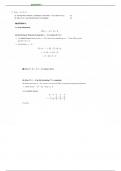
QUESTION 1
1.1 P (x) = −x 3 + 7x + 6
(a) Use the Factor Theorem, or otherwise, to show that x + 2 is a factor of P (x) . (2)
(b) Solve P (x) = 0 by first factorising P (x) completely. (3)
QUESTION 1:
1.1 Given Polynomial:
P() = -+7+6
(a) Use the Factor Theorem to show that r + 2 is a factor of P(x ).
The Factor Theorem states that if ar + 2is a factor, then substituting z = -2 into P(a) should
give P(-2) = 0.
Substituting a = -2:
P(--2) = -(--2) +7(--2) + 6
=-(-8)+ (-14) +6
= 8- 14 +6= 0
E since P(--2) = 0,r + 2is indeed a factor
(b) Solve P(r) =0 by first factorizing P() completely.
We already know that + 2is a factor. Let's factorize P(r) completely using polynomial division:
a
1. Divide P(r) = --r + 7r +6byz +2
Using synthetic division:
This gives:
·: -1 2
-4
7
3
6
6
0
, This gives:
P() = (z +2)(--r +2r +3)
2. Factorize -r + 2r + 3:
-+2r+3=-(-2±-3)
=-( -3)(r +1)
Thus, the full factorization is:
P() = -(z +2)( -3)(r + 1)
3. Solving for P(r) = 0:
(z +2)(z -3)( +1) =0
r+2=0=z=-2
r -3=0=z=3
ar+I=0=zr=-I
E solutions:r = -2,3, -1.
1.1 P (x) = −x 3 + 7x + 6
(a) Use the Factor Theorem, or otherwise, to show that x + 2 is a factor of P (x) . (2)
(b) Solve P (x) = 0 by first factorising P (x) completely. (3)
QUESTION 1:
1.1 Given Polynomial:
P() = -+7+6
(a) Use the Factor Theorem to show that r + 2 is a factor of P(x ).
The Factor Theorem states that if ar + 2is a factor, then substituting z = -2 into P(a) should
give P(-2) = 0.
Substituting a = -2:
P(--2) = -(--2) +7(--2) + 6
=-(-8)+ (-14) +6
= 8- 14 +6= 0
E since P(--2) = 0,r + 2is indeed a factor
(b) Solve P(r) =0 by first factorizing P() completely.
We already know that + 2is a factor. Let's factorize P(r) completely using polynomial division:
a
1. Divide P(r) = --r + 7r +6byz +2
Using synthetic division:
This gives:
·: -1 2
-4
7
3
6
6
0
, This gives:
P() = (z +2)(--r +2r +3)
2. Factorize -r + 2r + 3:
-+2r+3=-(-2±-3)
=-( -3)(r +1)
Thus, the full factorization is:
P() = -(z +2)( -3)(r + 1)
3. Solving for P(r) = 0:
(z +2)(z -3)( +1) =0
r+2=0=z=-2
r -3=0=z=3
ar+I=0=zr=-I
E solutions:r = -2,3, -1.