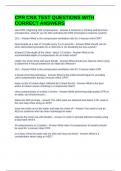
CPR CNA TEST QUESTIONS WITH
CORRECT ANSWERS
start CPR, beginning with compressions - Answer-if someone is choking and becomes
unresponsive, what do you do after activating the ERS (emergency response system)
15:2 - Answer-What is the compression-ventilation ratio for 2-rescuer child CPR?
Give breaths at a rate of 1 breath every 3 to 5 seconds - Answer-What should you do
when administering breaths for a child who is not breathing but has a pulse?
at least 1/3 the depth of the chest - about 1.5 inches - Answer-What is the
recommended depth of compressions for an infant victim?
visible rise of the chest with each breath - Answer-What should you observe when trying
to determine if rescue breaths for an infant are effective?
15:2 - Answer-What is the compression-ventilation ratio for 2 rescuer infant CPR
2 thumb-encircling technique - Answer-What is the preferred technique for providing
chest compressions during 2-rescuer infant CPR?
begin cycles of 5 back slaps, followed by 5 chest thrusts - Answer-What is the best
action to relieve severe chocking in a responsive infant?
chest compressions of at least 2 inches - Answer-While performing high-quality CPR on
an adult, you should ensure...
follow the AED prompts - Answer-The AED pads are attached and detect V-fib, what is
the next step when using an AED?
move the victim out of the water and wipe the chest off - Answer-You need to use an
AED on someone who has been submerged in water
observe the chest rise with breaths - Answer-In order to provide effective breaths using
a bag-mask device
30 compressions to 2 breaths - Answer-What ratio of compressions to breaths should
be used for 1-rescuer infant CPR
on a hairy chest the pads may not stick and may not shock - Answer-What is a
consideration when using an AED?
CORRECT ANSWERS
start CPR, beginning with compressions - Answer-if someone is choking and becomes
unresponsive, what do you do after activating the ERS (emergency response system)
15:2 - Answer-What is the compression-ventilation ratio for 2-rescuer child CPR?
Give breaths at a rate of 1 breath every 3 to 5 seconds - Answer-What should you do
when administering breaths for a child who is not breathing but has a pulse?
at least 1/3 the depth of the chest - about 1.5 inches - Answer-What is the
recommended depth of compressions for an infant victim?
visible rise of the chest with each breath - Answer-What should you observe when trying
to determine if rescue breaths for an infant are effective?
15:2 - Answer-What is the compression-ventilation ratio for 2 rescuer infant CPR
2 thumb-encircling technique - Answer-What is the preferred technique for providing
chest compressions during 2-rescuer infant CPR?
begin cycles of 5 back slaps, followed by 5 chest thrusts - Answer-What is the best
action to relieve severe chocking in a responsive infant?
chest compressions of at least 2 inches - Answer-While performing high-quality CPR on
an adult, you should ensure...
follow the AED prompts - Answer-The AED pads are attached and detect V-fib, what is
the next step when using an AED?
move the victim out of the water and wipe the chest off - Answer-You need to use an
AED on someone who has been submerged in water
observe the chest rise with breaths - Answer-In order to provide effective breaths using
a bag-mask device
30 compressions to 2 breaths - Answer-What ratio of compressions to breaths should
be used for 1-rescuer infant CPR
on a hairy chest the pads may not stick and may not shock - Answer-What is a
consideration when using an AED?