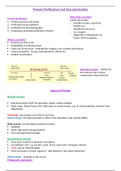
Protein Purification and Characterisation
Why purify a protein?
Protein Purification Isolate the protein
1. Protein sources & extraction identify function, specificity,
2. Purification by precipitation kinetics etc.
3. Purification by Chromatography identify the structure
4. Designing & assessing purification schemes as a reagent
diagnostic or therapeutic e.g.
Factor VIII from plasma
What is a protein?
Proteins are vital to life
Polypeptide, functional groups
Folds into 3D structure - Hydrophobic collapse, non-covalent interactions
Unique properties - Charge, hydrophobicity, affinity etc.
Exploit in purification
How pure is pure? – defined by
the end use (only remove
contaminates that interfere)
Source of Protein
Natural sources
Required protein MUST be abundant, stable, readily available
Wide range - blood (Factor VIII), milk, plant or animal tissues. e.g. 10-15mg hydrolytic enzymes from
200g kidney
Advantage: the proteins are in the in vivo form
Disadvantages: the desired protein is often in low abundance and reproducibility
Plant sources: low abundance (polysaccharides)
oxidation
seeds: high levels storage proteins
fruit: developmental changes
Recombinant sources
clone gene, transfer to plasmid, overexpress
recombinant cells. e.g. bacteria, yeast, insect, plant cells, transgenic animals
yields may be 100-fold higher
Most successful in similar organism - with deleted or low native expression
Disadvantage – depends on the source
Prokaryotic expression
,• under control of strong promoter
• expression induced
• insolubility - necessitates solubilisation and refolding - not always successful, but purification method
e.g. E.Coli
Eukaryotic expression
Yeast (S. cerevisiae)
Pichia pastoris - higher cell density, grows on methanol, still misfolds
Insect cells - baculovirus driven expression
A d v a n ta g e s D is a d v a n ta g e s
G o o d .g ro w th .ra te s m is f o ld i n g
s im p l e . ( c h e a p ) . m e d ia h y p e r g ly c o s y l a t i o n
g e n e t ic s . u n d e r s t o o d n o t . h ig h . c e l l. d e n s i t y
mammalian recombinant expression - mammalian transgenic expression (milk)
Extraction of protein
Homogenisation
Cell lysis - Physical methods, Non-mechanical methods
Subcellular fractionation
Homogenisation (natural sources)
Mammalian tissue
cut into small pieces, then blender - isotonic buffer e.g. 0.3M sucrose
ease dependent on tissue connectivity - e.g. lung more difficult than brain, kidney
Plant tissue
blender for fragile tissues, e.g. leaf,
grinding with sand for fibrous sources e.g. stems,
e.g. dry grind first (freeze in N2(liq)) if protein stable
Cell Lysis - Physical or non-mechanical methods
Breaking of plasma membrane (cell death):
Easiest for eukaryotic cells
Releases cell contents
Proteins AND proteases, nucleic acids
Physical cell disruption
Mechanical Sonication:
high frequency sound waves
oscillating metal probe
, rotating blades e.g. Waring blender
grinding in pestle & mortar
vortexing with glass beads
Liquid shear
e.g. French Press homogenizer
suspension forced through narrow space
Pressure release bursts cells
only small volumes, difficult to clean
Non-mechanical lysis
osmotic lysis - hypotonic solution, insect, mammalian cells
freeze/thaw - ice crystals disrupt cells
detergent solubilisation e.g. BugBuster® - non-ionic (ionic e.g. SDS denature)
Lytic enzymes damage cell walls - Followed by osmotic shock, application specific e.g. lipases, proteases
May be combined
Need to preserve activity
Medium: buffer, salts, EDTA, protease inhibitors, detergents, etc.
Needs optimisation
Chill to 4°C
Subcellular Fractionation
eukaryotic cells
gentle disruption retains compartments
differential centrifugation (size)
o components retain activity
o cytosol (soluble small proteins)
Protein produced from native or recombinant sources
as in last lecture. Cells lysed, proteins removed from cell debris by centrifugation, now need to
separate protein of interest from host cell proteins, nucleic acids and other biomolecules. Protein
purification is the removal of contaminants.
, Clarification
Remove cell debris, other particulates
Filtration - Can lower protein yield
Sedimentation - Centrifugation (CRP lectures), large or small scale
Supernatant: soluble proteins
Pellet: Membrane fraction, organelles….
Contaminants – particulates, aggregates, nucleic acids, small molecules, proteins
Removal of nucleic acids
Filtration - Gelatinous/fibrous so clog
Precipitate with 1% protamine sulphate (+ve) - Simple, rapid, add contaminant, poor reproducibility
Incubate with DNase, (30 min, 25-37°C) - Simple, reproducible, Slow, proteases may degrade target
Extract with sonication (shears chromosomes)
Removal of small molecules
(buffer exchange)
Ultrafiltration - Semi-permeable membranes - define MW cutoff
Dialysis
Proteins
general host proteins
variants of target protein
Polymer of amino acids
Exploit chemical and physical properties
Charge (isoelectric point, surface charge)
Hydrophobicity
Affinity (activity, metal ions) interactions and binding
Solubility/Stability
Molecular weight
Purification by exploiting solubility - Protein or contaminants
Purification by precipitation
Hydrophobic regions interact with water – no H bonds formed. An
order around the molecule.
Solubility: polar (solvent), ionic (salts), repulsive
Reduce solubility, selective precipitation
Precipitation by changes in ionic strength – differential
solubilisation
1. ionic strength
Increase from 0M - Differential solubilisation, ‘salting in’ to solution.
Why purify a protein?
Protein Purification Isolate the protein
1. Protein sources & extraction identify function, specificity,
2. Purification by precipitation kinetics etc.
3. Purification by Chromatography identify the structure
4. Designing & assessing purification schemes as a reagent
diagnostic or therapeutic e.g.
Factor VIII from plasma
What is a protein?
Proteins are vital to life
Polypeptide, functional groups
Folds into 3D structure - Hydrophobic collapse, non-covalent interactions
Unique properties - Charge, hydrophobicity, affinity etc.
Exploit in purification
How pure is pure? – defined by
the end use (only remove
contaminates that interfere)
Source of Protein
Natural sources
Required protein MUST be abundant, stable, readily available
Wide range - blood (Factor VIII), milk, plant or animal tissues. e.g. 10-15mg hydrolytic enzymes from
200g kidney
Advantage: the proteins are in the in vivo form
Disadvantages: the desired protein is often in low abundance and reproducibility
Plant sources: low abundance (polysaccharides)
oxidation
seeds: high levels storage proteins
fruit: developmental changes
Recombinant sources
clone gene, transfer to plasmid, overexpress
recombinant cells. e.g. bacteria, yeast, insect, plant cells, transgenic animals
yields may be 100-fold higher
Most successful in similar organism - with deleted or low native expression
Disadvantage – depends on the source
Prokaryotic expression
,• under control of strong promoter
• expression induced
• insolubility - necessitates solubilisation and refolding - not always successful, but purification method
e.g. E.Coli
Eukaryotic expression
Yeast (S. cerevisiae)
Pichia pastoris - higher cell density, grows on methanol, still misfolds
Insect cells - baculovirus driven expression
A d v a n ta g e s D is a d v a n ta g e s
G o o d .g ro w th .ra te s m is f o ld i n g
s im p l e . ( c h e a p ) . m e d ia h y p e r g ly c o s y l a t i o n
g e n e t ic s . u n d e r s t o o d n o t . h ig h . c e l l. d e n s i t y
mammalian recombinant expression - mammalian transgenic expression (milk)
Extraction of protein
Homogenisation
Cell lysis - Physical methods, Non-mechanical methods
Subcellular fractionation
Homogenisation (natural sources)
Mammalian tissue
cut into small pieces, then blender - isotonic buffer e.g. 0.3M sucrose
ease dependent on tissue connectivity - e.g. lung more difficult than brain, kidney
Plant tissue
blender for fragile tissues, e.g. leaf,
grinding with sand for fibrous sources e.g. stems,
e.g. dry grind first (freeze in N2(liq)) if protein stable
Cell Lysis - Physical or non-mechanical methods
Breaking of plasma membrane (cell death):
Easiest for eukaryotic cells
Releases cell contents
Proteins AND proteases, nucleic acids
Physical cell disruption
Mechanical Sonication:
high frequency sound waves
oscillating metal probe
, rotating blades e.g. Waring blender
grinding in pestle & mortar
vortexing with glass beads
Liquid shear
e.g. French Press homogenizer
suspension forced through narrow space
Pressure release bursts cells
only small volumes, difficult to clean
Non-mechanical lysis
osmotic lysis - hypotonic solution, insect, mammalian cells
freeze/thaw - ice crystals disrupt cells
detergent solubilisation e.g. BugBuster® - non-ionic (ionic e.g. SDS denature)
Lytic enzymes damage cell walls - Followed by osmotic shock, application specific e.g. lipases, proteases
May be combined
Need to preserve activity
Medium: buffer, salts, EDTA, protease inhibitors, detergents, etc.
Needs optimisation
Chill to 4°C
Subcellular Fractionation
eukaryotic cells
gentle disruption retains compartments
differential centrifugation (size)
o components retain activity
o cytosol (soluble small proteins)
Protein produced from native or recombinant sources
as in last lecture. Cells lysed, proteins removed from cell debris by centrifugation, now need to
separate protein of interest from host cell proteins, nucleic acids and other biomolecules. Protein
purification is the removal of contaminants.
, Clarification
Remove cell debris, other particulates
Filtration - Can lower protein yield
Sedimentation - Centrifugation (CRP lectures), large or small scale
Supernatant: soluble proteins
Pellet: Membrane fraction, organelles….
Contaminants – particulates, aggregates, nucleic acids, small molecules, proteins
Removal of nucleic acids
Filtration - Gelatinous/fibrous so clog
Precipitate with 1% protamine sulphate (+ve) - Simple, rapid, add contaminant, poor reproducibility
Incubate with DNase, (30 min, 25-37°C) - Simple, reproducible, Slow, proteases may degrade target
Extract with sonication (shears chromosomes)
Removal of small molecules
(buffer exchange)
Ultrafiltration - Semi-permeable membranes - define MW cutoff
Dialysis
Proteins
general host proteins
variants of target protein
Polymer of amino acids
Exploit chemical and physical properties
Charge (isoelectric point, surface charge)
Hydrophobicity
Affinity (activity, metal ions) interactions and binding
Solubility/Stability
Molecular weight
Purification by exploiting solubility - Protein or contaminants
Purification by precipitation
Hydrophobic regions interact with water – no H bonds formed. An
order around the molecule.
Solubility: polar (solvent), ionic (salts), repulsive
Reduce solubility, selective precipitation
Precipitation by changes in ionic strength – differential
solubilisation
1. ionic strength
Increase from 0M - Differential solubilisation, ‘salting in’ to solution.