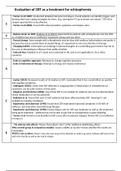
Evaluation of CBT as a treatment for schizophrenia
- Tarrier et al (1987): Conducted detailed interview techniques. Found patients can identify triggers and
develop their own coping strategies for them. (E.g. turning the TV up to drown out voices). 73% of his
sample reported this to be effective.
S - Tarrier et al (2006): Found CBT reduced positive symptoms and relapse rates
- Reduce strain on NHS: Andrews et al (2012): Reported that patients with schizophrenia cost the NHS
P £11.8 billion/year due to ineffective treatments being used too often.
- Forced change: Some people with schizophrenia may be okay with auditory hallucinations and prefer it
because the voices remind them of menial things. It’s important to not cross this line in therapy.
- Changing beliefs: A therapist can challenge irrational thoughts of a controlling government, but not at
I the cost of attempting to influence their political beliefs.
- Cultural bias: Haddock et al’s study was conducted in UK, and is not applicable to US or other
countries.
- Links to cognitive approach: Attempts to change cognitive processes
- Links to behavioural therapy: Attempt to change and measure behaviour
A
- Jauhar (2014): Reviewed results of 34 studies to CBT. Concluded that it has a small effect on positive
and negative symptoms
- Addington (2005): Claims that self-reflection is inappropriate in initial phase of schizophrenia as
symptoms can be quite intense at that point
- Kingdom and Kirshchen (2006): Found that CBT is not suitable for patients who are too disorientated,
refuse medication or are too paranoid
- Haddock et al: Found that only 13/187 patients had been offered private CBT, showing it’s not
C available to majority of patients
- Kopelowicz and Liberman (1998): Found that CBT moderately improved symptoms in 50-60% of
sufferers, but only when used with drug therapy
- Kopelowicz and Liberman (1998): Found relapse rate for CBT was moderate as well as the treatment
being quite expensive – patients may not be able to pay that as schizophrenia is quite disabling.
- Tarrier et al: Found no real benefits to CBT a year after treatment stopped. Shows CBT is not effective
in long run
✔No adverse side effects: Means that patients don’t suffer additional debilitating effects
✘No control group in comparison studies: Lowers validity as we don’t know whether the results are
meaningful.
E ✘CBT is not curative: Doesn’t treat the root cause of the disorder or make it go away. Patients still have to live
with it for the life as well as the risk of relapse
- Tarrier et al (1987): Conducted detailed interview techniques. Found patients can identify triggers and
develop their own coping strategies for them. (E.g. turning the TV up to drown out voices). 73% of his
sample reported this to be effective.
S - Tarrier et al (2006): Found CBT reduced positive symptoms and relapse rates
- Reduce strain on NHS: Andrews et al (2012): Reported that patients with schizophrenia cost the NHS
P £11.8 billion/year due to ineffective treatments being used too often.
- Forced change: Some people with schizophrenia may be okay with auditory hallucinations and prefer it
because the voices remind them of menial things. It’s important to not cross this line in therapy.
- Changing beliefs: A therapist can challenge irrational thoughts of a controlling government, but not at
I the cost of attempting to influence their political beliefs.
- Cultural bias: Haddock et al’s study was conducted in UK, and is not applicable to US or other
countries.
- Links to cognitive approach: Attempts to change cognitive processes
- Links to behavioural therapy: Attempt to change and measure behaviour
A
- Jauhar (2014): Reviewed results of 34 studies to CBT. Concluded that it has a small effect on positive
and negative symptoms
- Addington (2005): Claims that self-reflection is inappropriate in initial phase of schizophrenia as
symptoms can be quite intense at that point
- Kingdom and Kirshchen (2006): Found that CBT is not suitable for patients who are too disorientated,
refuse medication or are too paranoid
- Haddock et al: Found that only 13/187 patients had been offered private CBT, showing it’s not
C available to majority of patients
- Kopelowicz and Liberman (1998): Found that CBT moderately improved symptoms in 50-60% of
sufferers, but only when used with drug therapy
- Kopelowicz and Liberman (1998): Found relapse rate for CBT was moderate as well as the treatment
being quite expensive – patients may not be able to pay that as schizophrenia is quite disabling.
- Tarrier et al: Found no real benefits to CBT a year after treatment stopped. Shows CBT is not effective
in long run
✔No adverse side effects: Means that patients don’t suffer additional debilitating effects
✘No control group in comparison studies: Lowers validity as we don’t know whether the results are
meaningful.
E ✘CBT is not curative: Doesn’t treat the root cause of the disorder or make it go away. Patients still have to live
with it for the life as well as the risk of relapse