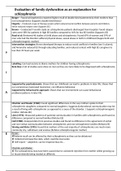
Evaluation of family dysfunction as an explanation for
schizophrenia
Berger – Found schizophrenics reported higher recall of double bind statements by their mothers than
non-schizophrenics (Supports double bind theory)
Hogarty – Produced a type of therapy session which reduced social conflicts between parents and children,
which reduced relapse rates (Supports EE)
S Brown – Conducted 9 month study on schizophrenia patients discharged from hospital. Found relapse
rates were 58% for patients in high EE families compared to 10% for low EE families (Supports EE)
Read et al: Reviewed 46 studies of child abuse and schizophrenia. Found 69% of women and 59% of
men who had the disorder suffered physical abuse, sexual abuse or both in childhood (Supports EE and
schizophrenogenic mother)
Intervention strategies: Brown developed therapy to reduce social conflicts in families (see S column),
and Amaresha reduced EE through educating families, and reduced contact with high EE caregivers to
less than 35 hours per week
P
Labelling: Can lead society to blame mothers for children having schizophrenia
Beta bias: A lot of studies were done on men as they are more likely to be diagnosed with schizophrenia
I
Supported by psychodynamic: Shows that our childhood can lead to problems in later life. Shows that
our unconscious (repressed memories), can influence behaviour
Supported by behaviourist approach: Shows that our environment can cause behavioural
A problems/patterns in later life
Mischler and Waxler (1968): Found significant differences in the way mothers spoke to their
schizophrenic daughters compared to normal daughters. Suggests dysfunctional communication may be
a result of living with schizophrenic as opposed to a cause of the disorder. ( Supports schizophrenogenic
mother. Refutes EE)
Liem (1974): Measured patterns of parental communication in families with schizophrenia and found no
C difference compared to normal families (Refutes EE)
Hall (1980): Analysed data from previous studies and found no difference in the agreement of verbal
and non-verbal communication between schizophrenic and non-schizophrenic families (Refutes EE)
Waring and Ricks (1995): Found that mothers of the vast majority of schizophrenics are much more
commonly shy, withdrawn and anxious (Refutes schizophrenogenic mother)
E Berger:
✘Patients recall can be affected by their schizophrenia as they can be delusional
✘ Collected retrospective data, which could be inaccurate
✘ Self report – subjective, can be response bias etc…
Mischler and Waxler:
✘ The schizophrenia may have been caused due to consistent rejection from mother whilst growing up
or by persistently being treated as different.
schizophrenia
Berger – Found schizophrenics reported higher recall of double bind statements by their mothers than
non-schizophrenics (Supports double bind theory)
Hogarty – Produced a type of therapy session which reduced social conflicts between parents and children,
which reduced relapse rates (Supports EE)
S Brown – Conducted 9 month study on schizophrenia patients discharged from hospital. Found relapse
rates were 58% for patients in high EE families compared to 10% for low EE families (Supports EE)
Read et al: Reviewed 46 studies of child abuse and schizophrenia. Found 69% of women and 59% of
men who had the disorder suffered physical abuse, sexual abuse or both in childhood (Supports EE and
schizophrenogenic mother)
Intervention strategies: Brown developed therapy to reduce social conflicts in families (see S column),
and Amaresha reduced EE through educating families, and reduced contact with high EE caregivers to
less than 35 hours per week
P
Labelling: Can lead society to blame mothers for children having schizophrenia
Beta bias: A lot of studies were done on men as they are more likely to be diagnosed with schizophrenia
I
Supported by psychodynamic: Shows that our childhood can lead to problems in later life. Shows that
our unconscious (repressed memories), can influence behaviour
Supported by behaviourist approach: Shows that our environment can cause behavioural
A problems/patterns in later life
Mischler and Waxler (1968): Found significant differences in the way mothers spoke to their
schizophrenic daughters compared to normal daughters. Suggests dysfunctional communication may be
a result of living with schizophrenic as opposed to a cause of the disorder. ( Supports schizophrenogenic
mother. Refutes EE)
Liem (1974): Measured patterns of parental communication in families with schizophrenia and found no
C difference compared to normal families (Refutes EE)
Hall (1980): Analysed data from previous studies and found no difference in the agreement of verbal
and non-verbal communication between schizophrenic and non-schizophrenic families (Refutes EE)
Waring and Ricks (1995): Found that mothers of the vast majority of schizophrenics are much more
commonly shy, withdrawn and anxious (Refutes schizophrenogenic mother)
E Berger:
✘Patients recall can be affected by their schizophrenia as they can be delusional
✘ Collected retrospective data, which could be inaccurate
✘ Self report – subjective, can be response bias etc…
Mischler and Waxler:
✘ The schizophrenia may have been caused due to consistent rejection from mother whilst growing up
or by persistently being treated as different.