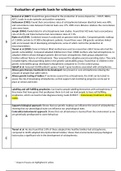
Evaluation of genetic basis for schizophrenia
Benzel et al (2007): Found three genes linked to the production of excess dopamine – COMT, DRD4,
AKT1. Leads to acute episodes and positive symptoms.
Gottesman (1981): Found that concordance rates of schizophrenia between identical twins was 48%,
and concordance rates between fraternal twins was 17%. With more distance relatives the concordance
rates were lower.
Joseph (2004): Pooled data for all schizophrenia twin studies. Found that MZ twins had a concordance
rate of 40.4% and fraternal twins had concordance rates of 7.4%.
Ripke et al (2014): Combined research conducted on genome-wide studies. Compared genetic makeup
of 113000 controls to 37,000 schizophrenic patients. Found there were 108 genetic variations linked
S with an increased risk of developing schizophrenia, some of which control the production of
neurotransmitters.
Tienari et al (2004): Done in Finland. Blind method was used (so researchers didn’t know who had the
genetic vulnerability). Compared adopted children born from 19000 mothers who had schizophrenia, to
adopted children whose biological parents did not have schizophrenia. Both groups adopted into
families without history of schizophrenia. They assessed the adoptive parents parenting styles. They only
included highly critical parenting styles in the genetic vulnerability group. Found that 11 children in the
genetic vulnerability group developed schizophrenia compared to 3 in the control group.
Ophoff et al: Assessed 50,000 patient’s genes. Found 7 gene locations associated with schizophrenia.
Allows gene therapy treatments to be developed: Can prevent or cure schizophrenia relieving the
amount of people that suffer with it.
Allows genetic testing of babies: If we know a parent has schizophrenia, the child can be tested to
P assess the risk of developing schizophrenia, so that support and monitoring programs can be put in
place at school and home.
Labelling and self-fulfilling prophecies: Can lead to people labelling themselves with schizophrenia, if
they know that have genes that predispose them to it and can lead people to have self-fulfilling
I prophecies, which can lead to false diagnoses being made (IMPACT = Unnecessary treatment, strong
meds).
Supports biological approach: Shows that our genetic makeup can influence the onset of schizophrenia,
showing that our physiological state can influence our psychological state.
Contradicts behaviourist approach: Shows that not all behaviour is learned from the environment as we
are genetically predisposed to some behaviour.
A
Tienari et al: He also found that 5.8% of those adopted into healthy families had schizophrenia,
compared to 36.8% adopted into dysfunctional families. Shows that environmental and psychological
factors play a significant role in the development of schizophrenia.
C
* Impact of issues are highlighted in yellow
Benzel et al (2007): Found three genes linked to the production of excess dopamine – COMT, DRD4,
AKT1. Leads to acute episodes and positive symptoms.
Gottesman (1981): Found that concordance rates of schizophrenia between identical twins was 48%,
and concordance rates between fraternal twins was 17%. With more distance relatives the concordance
rates were lower.
Joseph (2004): Pooled data for all schizophrenia twin studies. Found that MZ twins had a concordance
rate of 40.4% and fraternal twins had concordance rates of 7.4%.
Ripke et al (2014): Combined research conducted on genome-wide studies. Compared genetic makeup
of 113000 controls to 37,000 schizophrenic patients. Found there were 108 genetic variations linked
S with an increased risk of developing schizophrenia, some of which control the production of
neurotransmitters.
Tienari et al (2004): Done in Finland. Blind method was used (so researchers didn’t know who had the
genetic vulnerability). Compared adopted children born from 19000 mothers who had schizophrenia, to
adopted children whose biological parents did not have schizophrenia. Both groups adopted into
families without history of schizophrenia. They assessed the adoptive parents parenting styles. They only
included highly critical parenting styles in the genetic vulnerability group. Found that 11 children in the
genetic vulnerability group developed schizophrenia compared to 3 in the control group.
Ophoff et al: Assessed 50,000 patient’s genes. Found 7 gene locations associated with schizophrenia.
Allows gene therapy treatments to be developed: Can prevent or cure schizophrenia relieving the
amount of people that suffer with it.
Allows genetic testing of babies: If we know a parent has schizophrenia, the child can be tested to
P assess the risk of developing schizophrenia, so that support and monitoring programs can be put in
place at school and home.
Labelling and self-fulfilling prophecies: Can lead to people labelling themselves with schizophrenia, if
they know that have genes that predispose them to it and can lead people to have self-fulfilling
I prophecies, which can lead to false diagnoses being made (IMPACT = Unnecessary treatment, strong
meds).
Supports biological approach: Shows that our genetic makeup can influence the onset of schizophrenia,
showing that our physiological state can influence our psychological state.
Contradicts behaviourist approach: Shows that not all behaviour is learned from the environment as we
are genetically predisposed to some behaviour.
A
Tienari et al: He also found that 5.8% of those adopted into healthy families had schizophrenia,
compared to 36.8% adopted into dysfunctional families. Shows that environmental and psychological
factors play a significant role in the development of schizophrenia.
C
* Impact of issues are highlighted in yellow