

WGU D293 - Assessment and Learning Analytics - Section 1: Evaluating
Assessment Alignment Q/A
Study online at https://quizlet.com/_gsaebk
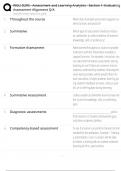
1. Throughout the course When does formative assessment support stu-
dents to learn and practice?
2. Summative Which type of assessment should an instruc-
tor administer to collect evidence of learners'
knowledge, skill, or proficiency?
3. Formative Assessment Administered throughout a course to provide
instructors with the information needed to
support learners. For example, instructors can
use data from formative assessments during
learning to see if there are common miscon-
ceptions, evidenced by students choosing the
same wrong answer, which would inform fu-
ture instruction. It helps students learn by giv-
ing students feedback to revise, refocus stud-
ies, or to self-regulate during learning.
4. Summative Assessment Gathers evidence of whether learners have met
the course's knowledge, skill, or proficiency
goal.
5. Diagnostic assessments ______________________________will in-
form teachers of student achievement gaps
and other academic abilities.
6. Competency-based assessment To see if a learner can perform the kind of skill
needed for the workplace. Example - Creating
a presentation. Goal - Learners will be able
to deliver a training talk on student-centered
learning for first- year teachers.
, WGU D293 - Assessment and Learning Analytics - Section 1: Evaluating
Assessment Alignment Q/A
Study online at https://quizlet.com/_gsaebk
7. Criterion-Referenced assessment To see if a learner has met predetermined
milestones and requirements. Example - Ad-
vanced Placement Test. Goal - Learners will be
able to apply the basics of calculus.
8. Ipsative assessment To see if a learner has improved based on
previous knowledge. This assessment can help
motivate learners by showing the distance pro-
gressed and awards said progress. Example -
Compare previous work and progress to cur-
rent work. Think about writing in a journal.
Goal - Learners will increase their reading and
comprehension skills.
9. Traditional assessment To see if a learner can meet the requirements
based on memorization of data and facts. Ex-
ample - Multiple Choice True/False. Goal -
Learners will be able to describe and identify
parts of the human nervous system.
10. Norm-referenced assessment To see how a learner's work compares to the
average work completed by a similar group of
learners. Example - Test graded on a curve.
Goal - Learners will be able to identify and
solve engineering problems that may occur in
the field.
11. Standards-based assessment To see if a learner can meet requirements
and have a mastery of knowledge based on
a predetermined standard. Example - State
Standardized Test. Goal - Learners will master
grade-level mathematics.
Assessment Alignment Q/A
Study online at https://quizlet.com/_gsaebk
1. Throughout the course When does formative assessment support stu-
dents to learn and practice?
2. Summative Which type of assessment should an instruc-
tor administer to collect evidence of learners'
knowledge, skill, or proficiency?
3. Formative Assessment Administered throughout a course to provide
instructors with the information needed to
support learners. For example, instructors can
use data from formative assessments during
learning to see if there are common miscon-
ceptions, evidenced by students choosing the
same wrong answer, which would inform fu-
ture instruction. It helps students learn by giv-
ing students feedback to revise, refocus stud-
ies, or to self-regulate during learning.
4. Summative Assessment Gathers evidence of whether learners have met
the course's knowledge, skill, or proficiency
goal.
5. Diagnostic assessments ______________________________will in-
form teachers of student achievement gaps
and other academic abilities.
6. Competency-based assessment To see if a learner can perform the kind of skill
needed for the workplace. Example - Creating
a presentation. Goal - Learners will be able
to deliver a training talk on student-centered
learning for first- year teachers.
, WGU D293 - Assessment and Learning Analytics - Section 1: Evaluating
Assessment Alignment Q/A
Study online at https://quizlet.com/_gsaebk
7. Criterion-Referenced assessment To see if a learner has met predetermined
milestones and requirements. Example - Ad-
vanced Placement Test. Goal - Learners will be
able to apply the basics of calculus.
8. Ipsative assessment To see if a learner has improved based on
previous knowledge. This assessment can help
motivate learners by showing the distance pro-
gressed and awards said progress. Example -
Compare previous work and progress to cur-
rent work. Think about writing in a journal.
Goal - Learners will increase their reading and
comprehension skills.
9. Traditional assessment To see if a learner can meet the requirements
based on memorization of data and facts. Ex-
ample - Multiple Choice True/False. Goal -
Learners will be able to describe and identify
parts of the human nervous system.
10. Norm-referenced assessment To see how a learner's work compares to the
average work completed by a similar group of
learners. Example - Test graded on a curve.
Goal - Learners will be able to identify and
solve engineering problems that may occur in
the field.
11. Standards-based assessment To see if a learner can meet requirements
and have a mastery of knowledge based on
a predetermined standard. Example - State
Standardized Test. Goal - Learners will master
grade-level mathematics.


