

ATI Pharmacology Study Guide(Etsy).pdf!!!!!!!!!!!!!!!!!!!~~~~~~~~~~~~~~~~~~~~~~~~~%%%%%%%%%%%%
ATI Pharmacology Study Guide(Etsy).pdf
ATI Pharmacology Study Guide(Etsy).pdf
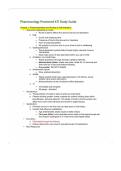
Pharmacology Proctored ATI Study Guide
Chapter 1: Pharmacokinetics and Routes of Administration
• Absorption (depends on route)
▪ Route of admin affects the rate and amount of absorption
o Oral:
▪ GI pH and emptying time
▪ Presence of food in the stomach or intestines
▪ Form of meds (liquid/XR)
▪ Sit upright or put your chin to your chest to aid in swallowing
o Sublingual/buccal
▪ Quick absorption systemically through highly vascular mucous
membranes
▪ Must make sure it is fully absorbed before you eat or drink
o Inhalation via mouth/nose
▪ Rapid absorption through alveolar capillary networks
▪ Metered-dose inhaler: shake and press, inhale for 3-5 seconds and
then hold for 10 seconds before exhaling
▪ Dry powder: DO NOT SHAKE
o Intradermal, topical
▪ Slow, gradual absorption
o SQ/IM
▪ Highly soluble meds have rapid absorption (10-30min), poorly
soluble have slower absorption
▪ Blood perfusion at site of injection affect absorption
o IV
▪ Immediate and complete
▪ 20 gauge – standard
• Distribution
o Transportation of meds to sites of action by body fluids
o Plasma binding protein: meds compete for protein binding sites within
bloodstream, primarily albumin. The ability of med to bind to protein can
affect how much med will leave and travel to target tissues.
• Metabolism
o Primarily occurs in the liver but can take place in the kidney
o Factors that influence metabolism:
▪ Age (infants/older adults require smaller doses)
▪ First pass effect: liver inactivates some meds on first pass through and
thus require sublingual or IV route (may need higher dose)
• Excretion
o Eliminated through the kidneys
o Kidney dysfunction can result in elevated levels of medications.
• Med Response
de(Etsy).pdf~~~~~~~~~~~~~~~~~~~~~~~~~~~~~~~~~~~~~~~~~~~~~!!!!!!!!!!!!!!!!!!!!!!!!^^^^^^^^^^^^^^^^^^^^^^
ATI Pharmacology Study Guide(Etsy).pdf
ATI Pharmacology Study Guide(Etsy).pdf
, ATI Pharmacology Study Guide(Etsy).pdf!!!!!!!!!!!!!!!!!!!~~~~~~~~~~~~~~~~~~~~~~~~~%%%%%%%%%%%%
ATI Pharmacology Study Guide(Etsy).pdf
ATI Pharmacology Study Guide(Etsy).pdf
o Maintain plasma levels between minimum effective concentration and the
toxic concentration:
• Therapeutic index (TI)
o High TI has a wide safety margin.
o Low TI requires monitoring of serum levels; higher risk of toxicity
o Tough levels: obtain immediately before next dose.
• Half-life
o Time it takes a medication level to drop in the body by 50%.
o Short vs long half-life: long half-life has greater risk for med accumulation in
body.
• Agonist: enhance/produces an action
• Antagonist: blocks the action
• Routes of admin:
o Oral/Enteral:
▪ 90 degrees upright
▪ do not mix with large amounts of food
▪ lean chin in to help facilitate swallowing
o Sublingual/buccal
▪ Keep med in place until completely dissolved
o Transdermal
▪ Wash skin with soap and water then dry it thoroughly before placing
patch. Place patch on hairless area and rotate sites to prevent
irritation.
o Drops:
▪ Place drop in center of sac.
▪ Avoid placing directly on cornea.
▪ If blink repeat process.
▪ Apply gentle pressure with finger and a clean facial tissue on the
nasolacrimal duct for 30-60 seconds to prevent systemic absorption.
o Ears:
▪ Have client lay on unaffected side.
▪ Up and out for adults
▪ Down and back for children
o Inhalation:
▪ MDI
• Shake vigorously 5-6 times
• Take a deep breath and then exhale
• Slow deep breath for 3-5 seconds from MDI
• Hold breath for 10 seconds after
▪ DPI
• DO NOT SHAKE DEVICE
• Place mouthpiece between lips and take a deep breath
• Hold breath for 5-10 seconds
de(Etsy).pdf~~~~~~~~~~~~~~~~~~~~~~~~~~~~~~~~~~~~~~~~~~~~~!!!!!!!!!!!!!!!!!!!!!!!!^^^^^^^^^^^^^^^^^^^^^^
ATI Pharmacology Study Guide(Etsy).pdf
ATI Pharmacology Study Guide(Etsy).pdf
, ATI Pharmacology Study Guide(Etsy).pdf!!!!!!!!!!!!!!!!!!!~~~~~~~~~~~~~~~~~~~~~~~~~%%%%%%%%%%%%
ATI Pharmacology Study Guide(Etsy).pdf
ATI Pharmacology Study Guide(Etsy).pdf
de(Etsy).pdf~~~~~~~~~~~~~~~~~~~~~~~~~~~~~~~~~~~~~~~~~~~~~!!!!!!!!!!!!!!!!!!!!!!!!^^^^^^^^^^^^^^^^^^^^^^
ATI Pharmacology Study Guide(Etsy).pdf
ATI Pharmacology Study Guide(Etsy).pdf
, ATI Pharmacology Study Guide(Etsy).pdf!!!!!!!!!!!!!!!!!!!~~~~~~~~~~~~~~~~~~~~~~~~~%%%%%%%%%%%%
ATI Pharmacology Study Guide(Etsy).pdf
ATI Pharmacology Study Guide(Etsy).pdf
Chapter 3: Dosage Calculation
• 1kg=1000mg
• 1oz=30mL
• 1L=1000mL
Chapter 4: IV Therapy
• Rapid and precise
• Circulatory overload is possible if too large or too rapid of an infusion
• Admin can irritate vein
• Can lead to sepsis if aseptic technique is broken
• Distal veins on nondominant hand first
• Write date/time, document size/site/appearance
• Flush every 8-12 hours when not in use
• Avoid tourniquets in older adults
• Hold hand below heart
• Change every 72 hours
• Change tubing every 24 hours
• Changes fluids every 24 hours
• Wipe all ports with alcohol before using or inserting a syringe
• Complications
o Infiltration
▪ Findings: pallor, local swelling at site, decreased skin temp around
site, damp dressing
▪ Treatment: stop infusion and remove catheter, elevate extremity,
encourage active range of motion, apply a cold or warm compress
depending on type of solution that infiltrated, check with provider to
determine whether the IV is still needed.
o Extravasation
▪ Findings: pain, burning, redness, and swelling.
▪ Treatment: stop infusion, place antidote before removing catheter if
there is one, notify provider.
o Hematoma
▪ Elevate extremity, use warm compress
o Catheter embolus
▪ Missing catheter tip after discontinuation. Place tourniquet high on
extremity, surgical removal.
o Phlebitis/thrombophlebitis
▪ Red line up the arm with palpable band at vein site
▪ Symptoms - edema, throbbing, paining, burning, increased skin temp
de(Etsy).pdf~~~~~~~~~~~~~~~~~~~~~~~~~~~~~~~~~~~~~~~~~~~~~!!!!!!!!!!!!!!!!!!!!!!!!^^^^^^^^^^^^^^^^^^^^^^
ATI Pharmacology Study Guide(Etsy).pdf
ATI Pharmacology Study Guide(Etsy).pdf
ATI Pharmacology Study Guide(Etsy).pdf
ATI Pharmacology Study Guide(Etsy).pdf
Pharmacology Proctored ATI Study Guide
Chapter 1: Pharmacokinetics and Routes of Administration
• Absorption (depends on route)
▪ Route of admin affects the rate and amount of absorption
o Oral:
▪ GI pH and emptying time
▪ Presence of food in the stomach or intestines
▪ Form of meds (liquid/XR)
▪ Sit upright or put your chin to your chest to aid in swallowing
o Sublingual/buccal
▪ Quick absorption systemically through highly vascular mucous
membranes
▪ Must make sure it is fully absorbed before you eat or drink
o Inhalation via mouth/nose
▪ Rapid absorption through alveolar capillary networks
▪ Metered-dose inhaler: shake and press, inhale for 3-5 seconds and
then hold for 10 seconds before exhaling
▪ Dry powder: DO NOT SHAKE
o Intradermal, topical
▪ Slow, gradual absorption
o SQ/IM
▪ Highly soluble meds have rapid absorption (10-30min), poorly
soluble have slower absorption
▪ Blood perfusion at site of injection affect absorption
o IV
▪ Immediate and complete
▪ 20 gauge – standard
• Distribution
o Transportation of meds to sites of action by body fluids
o Plasma binding protein: meds compete for protein binding sites within
bloodstream, primarily albumin. The ability of med to bind to protein can
affect how much med will leave and travel to target tissues.
• Metabolism
o Primarily occurs in the liver but can take place in the kidney
o Factors that influence metabolism:
▪ Age (infants/older adults require smaller doses)
▪ First pass effect: liver inactivates some meds on first pass through and
thus require sublingual or IV route (may need higher dose)
• Excretion
o Eliminated through the kidneys
o Kidney dysfunction can result in elevated levels of medications.
• Med Response
de(Etsy).pdf~~~~~~~~~~~~~~~~~~~~~~~~~~~~~~~~~~~~~~~~~~~~~!!!!!!!!!!!!!!!!!!!!!!!!^^^^^^^^^^^^^^^^^^^^^^
ATI Pharmacology Study Guide(Etsy).pdf
ATI Pharmacology Study Guide(Etsy).pdf
, ATI Pharmacology Study Guide(Etsy).pdf!!!!!!!!!!!!!!!!!!!~~~~~~~~~~~~~~~~~~~~~~~~~%%%%%%%%%%%%
ATI Pharmacology Study Guide(Etsy).pdf
ATI Pharmacology Study Guide(Etsy).pdf
o Maintain plasma levels between minimum effective concentration and the
toxic concentration:
• Therapeutic index (TI)
o High TI has a wide safety margin.
o Low TI requires monitoring of serum levels; higher risk of toxicity
o Tough levels: obtain immediately before next dose.
• Half-life
o Time it takes a medication level to drop in the body by 50%.
o Short vs long half-life: long half-life has greater risk for med accumulation in
body.
• Agonist: enhance/produces an action
• Antagonist: blocks the action
• Routes of admin:
o Oral/Enteral:
▪ 90 degrees upright
▪ do not mix with large amounts of food
▪ lean chin in to help facilitate swallowing
o Sublingual/buccal
▪ Keep med in place until completely dissolved
o Transdermal
▪ Wash skin with soap and water then dry it thoroughly before placing
patch. Place patch on hairless area and rotate sites to prevent
irritation.
o Drops:
▪ Place drop in center of sac.
▪ Avoid placing directly on cornea.
▪ If blink repeat process.
▪ Apply gentle pressure with finger and a clean facial tissue on the
nasolacrimal duct for 30-60 seconds to prevent systemic absorption.
o Ears:
▪ Have client lay on unaffected side.
▪ Up and out for adults
▪ Down and back for children
o Inhalation:
▪ MDI
• Shake vigorously 5-6 times
• Take a deep breath and then exhale
• Slow deep breath for 3-5 seconds from MDI
• Hold breath for 10 seconds after
▪ DPI
• DO NOT SHAKE DEVICE
• Place mouthpiece between lips and take a deep breath
• Hold breath for 5-10 seconds
de(Etsy).pdf~~~~~~~~~~~~~~~~~~~~~~~~~~~~~~~~~~~~~~~~~~~~~!!!!!!!!!!!!!!!!!!!!!!!!^^^^^^^^^^^^^^^^^^^^^^
ATI Pharmacology Study Guide(Etsy).pdf
ATI Pharmacology Study Guide(Etsy).pdf
, ATI Pharmacology Study Guide(Etsy).pdf!!!!!!!!!!!!!!!!!!!~~~~~~~~~~~~~~~~~~~~~~~~~%%%%%%%%%%%%
ATI Pharmacology Study Guide(Etsy).pdf
ATI Pharmacology Study Guide(Etsy).pdf
de(Etsy).pdf~~~~~~~~~~~~~~~~~~~~~~~~~~~~~~~~~~~~~~~~~~~~~!!!!!!!!!!!!!!!!!!!!!!!!^^^^^^^^^^^^^^^^^^^^^^
ATI Pharmacology Study Guide(Etsy).pdf
ATI Pharmacology Study Guide(Etsy).pdf
, ATI Pharmacology Study Guide(Etsy).pdf!!!!!!!!!!!!!!!!!!!~~~~~~~~~~~~~~~~~~~~~~~~~%%%%%%%%%%%%
ATI Pharmacology Study Guide(Etsy).pdf
ATI Pharmacology Study Guide(Etsy).pdf
Chapter 3: Dosage Calculation
• 1kg=1000mg
• 1oz=30mL
• 1L=1000mL
Chapter 4: IV Therapy
• Rapid and precise
• Circulatory overload is possible if too large or too rapid of an infusion
• Admin can irritate vein
• Can lead to sepsis if aseptic technique is broken
• Distal veins on nondominant hand first
• Write date/time, document size/site/appearance
• Flush every 8-12 hours when not in use
• Avoid tourniquets in older adults
• Hold hand below heart
• Change every 72 hours
• Change tubing every 24 hours
• Changes fluids every 24 hours
• Wipe all ports with alcohol before using or inserting a syringe
• Complications
o Infiltration
▪ Findings: pallor, local swelling at site, decreased skin temp around
site, damp dressing
▪ Treatment: stop infusion and remove catheter, elevate extremity,
encourage active range of motion, apply a cold or warm compress
depending on type of solution that infiltrated, check with provider to
determine whether the IV is still needed.
o Extravasation
▪ Findings: pain, burning, redness, and swelling.
▪ Treatment: stop infusion, place antidote before removing catheter if
there is one, notify provider.
o Hematoma
▪ Elevate extremity, use warm compress
o Catheter embolus
▪ Missing catheter tip after discontinuation. Place tourniquet high on
extremity, surgical removal.
o Phlebitis/thrombophlebitis
▪ Red line up the arm with palpable band at vein site
▪ Symptoms - edema, throbbing, paining, burning, increased skin temp
de(Etsy).pdf~~~~~~~~~~~~~~~~~~~~~~~~~~~~~~~~~~~~~~~~~~~~~!!!!!!!!!!!!!!!!!!!!!!!!^^^^^^^^^^^^^^^^^^^^^^
ATI Pharmacology Study Guide(Etsy).pdf
ATI Pharmacology Study Guide(Etsy).pdf


