
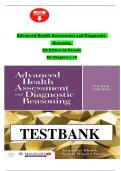
Advanced Health Assessment and Diagnostic
Reasoning,
4th Edition by Rhoads
All Chapters 1-18
TEST BANK W1
,TABLE OF CONTENT W1 W1
Chapter 1 Interview and History- W 1 W 1 W1 W1
Taking Strategies Chapter 2 Physical Examination Strate
W1 W 1 W 1 W 1 W1 W1
gies Chapter 3 Documentation Strategies
W 1 W 1 W 1 W1
Chapter 4 Cultural and Spiritual Assessment Chapter 5
W 1 W 1 W1 W1 W1 W 1 W 1 W 1
Nutritional Assessment W1
Chapter 6 Mental Health Disorders Chapter W 1 W 1 W1 W1 W 1
W 1 7 Integumentary Disorders Chapter 8 Ey
W 1 W1 W 1 W 1 W 1
e Disorders
W1
Chapter 9 Ear Disorders W 1 W 1 W1
Chapter 10 Nose, Sinus, Mouth, and Throat Disorders Chapter 11
W 1 W 1 W1 W1 W1 W1 W1 W 1 W 1
W 1 Respiratory Disorders W1
Chapter 12 Cardiovascular Disorders Chapt W 1 W 1 W1 W 1
er 13 Endocrine Disorders Chapter 14 Gas
W 1 W 1 W1 W 1 W 1 W 1
trointestinal Disorders Chapter 15 Neurolog W1 W 1 W 1 W 1
ical Disorders W1
Chapter 16 Male Genitourinary Disorders W 1 W 1 W1 W1
Chapter 17 Female Genitourinary and Breast Disorders Chapter 1
W 1 W 1 W1 W1 W1 W1 W 1 W 1
8 Musculoskeletal Disorder
W 1 W1
,Chapter 1 Interview and History Taking Strategies W
1 W
1 W1 W1 W1 W1
MULTIPLE CHOICE W 1
1. The nurse is conducting an interview with a woman who has recently learned that she is preg
W1 W1 W1 W1 W1 W1 W1 W1 W1 W1 W1 W1 W1 W 1 W1 W1
nant and who has come to the clinic today to begin prenatal care. The woman states that she and
W1 W1 W1 W1 W1 W1 W1 W1 W1 W1 W1 W1 W1 W 1 W1 W1 W1 W1 W1
her husband are excited about the pregnancy but have a few questions. She looks nervously at h
W1 W1 W1 W1 W1 W1 W1 W1 W1 W 1 W1 W1 W1 W1 W1 W1
er hands during the interview and sighs loudly. Considering the concept of communication, wh
W1 W1 W1 W1 W1 W1 W 1 W1 W1 W1 W1 W1 W1
ich statement does the nurse know to be most accurate? The woman is:
W1 W1 W1 W1 W 1 W1 W1 W1 W1 W1 W1 W1
a. Excited about her pregnancy but nervous about the labor. W1 W1 W1 W1 W1 W1 W1 W1
b. Exhibiting verbal and nonverbal behaviors that do not match. W1 W1 W1 W1 W1 W1 W1 W1
c. Excited about her pregnancy, but her husband is not and this is upsetting t
W1 W1 W1 W1 W1 W1 W1 W1 W1 W1 W1 W 1 W1
o her. d. W1 W1
Not excited about her pregnancy but believes the nurse will negatively respo
W1 W
1 W
1 W1 W1 W1 W1 W1 W1 W 1 W1
nd to her if she states this.
W1 W1 W1 W1 W1 W1
ANS: B W1
Communication is all behaviors, conscious and unconscious, verbal and nonverbal. All behaviors W1 W1 W1 W1 W1 W1 W1 W1 W1 W 1 W1 W1
have meaning. Her behavior does not imply that she is nervous about labor, upset by her husband
W1 W1 W1 W1 W1 W1 W1 W1 W1 W1 W1 W 1 W1 W1 W1 W1
, or worried about the nurses response.
W1 W1 W1 W1 W1 W1
2. Receiving is a part of the communication process. Which receiver is most likely to W1 W1 W1 W1 W1 W1 W1 W1 W1 W1 W 1 W1 W1
misinterpret a message sent by a health care professional?
W1 W1 W1 W1 W1 W1 W1 W1 W1
a. Well-adjusted adolescent who came in for a sports physical W1 W1 W1 W1 W1 W1 W1 W1
b. Recovering alcoholic who came in for a basic physical examination W1 W1 W1 W1 W1 W1 W1 W1 W1
c. Man whose wife has just been diagnosed with lung cancer
W1 W1 W1 W1 W1 W1 W1 W1 W 1 W1
d.
Man with a hearing impairment who uses sign language to communicate and who has an interpre
W1 W1 W1 W1 W1 W1 W1 W1 W1 W1 W1 W1 W 1 W1 W1
ter with him W1 W1
ANS: C W1
The receiver attaches meaning determined by his or her experiences, culture, self-
W1 W1 W1 W1 W1 W1 W1 W1 W1 W1 W1
W concept, and current physical and emotional states. The man whose wife has just been diagno
1 W1 W1 W1 W1 W1 W1 W1 W1 W1 W1 W1 W1 W 1 W1
sed with lung cancer may be experiencing emotions that affect his receiving.
W1 W1 W1 W1 W1 W1 W1 W1 W1 W1 W 1
3. The nurse makes which adjustment in the physical environment to promote the success ofa
W1 W1 W1 W1 W1 W1 W1 W1 W1 W1 W1 W 1 W1 W
1
n interview?
W1
a. Reduces noise by turning off televisions and radios W1 W1 W1 W1 W1 W1 W1
b. Reduces the distance between the interviewer and the patient to 2 feet or lessW1 W1 W1 W1 W1 W1 W1 W1 W1 W1 W1 W1 W1
c. Provides a dim light that makes the room cozy and helps the patient relax W1 W1 W1 W1 W1 W1 W1 W1 W1 W1 W1 W1 W1
d. Arranges seating across a desk or table to allow the patient some personal s W1 W1 W1 W1 W1 W1 W1 W1 W1 W1 W1 W 1 W1
pace
ANS: A W1
The nurse should reduce noise by turning off the television, radio, and other unnecessary equip
W1 W1 W1 W1 W1 W1 W1 W1 W1 W1 W1 W1 W 1 W1
ment, because multiple stimuli are confusing. The interviewer and patient should be approximat
W1 W1 W1 W1 W1 W1 W1 W 1 W1 W1 W1 W1
ely 4 to 5 feet apart; the room should be well-
W1 W1 W1 W1 W1 W1 W1 W1 W1 W1
lit, enabling the interviewer and patient to see each other clearly. Having a table or desk in betw
W 1 W1 W1 W1 W1 W1 W1 W1 W1 W1 W1 W1 W1 W1 W 1 W1 W1
een the two people creates the idea of a barrier; equal-status seating, at eye level, is better.
W1 W1 W1 W1 W1 W1 W1 W1 W1 W1 W1 W 1 W1 W1 W1 W1
, 4. In an interview, the nurse may find it necessary to take notes to aid his or her memory lat
W1 W1 W1 W1 W1 W1 W1 W1 W1 W1 W1 W1 W1 W1 W1 W1 W 1 W1
er. Which statement is trueregarding note-taking?
W1 W1 W1 W1 W1
a. Note-
taking may impede the nurses observation of the patients nonverbal behavi
W1 W1 W1 W1 W1 W1 W1 W1 W 1 W1
ors. b. W1
Note-
taking allows the patient to continue at his or her own pace as the nurse records
W1 W1 W1 W1 W1 W1 W
1 W1 W1 W1 W1 W1 W 1 W1 W1
what is said.
W1 W1 W1
c.
Note-
taking allows the nurse to shift attention away from the patient, resulting in an
W1 W1 W1 W1 W1 W1 W1 W1 W1 W1 W 1 W1 W1 W1
increased comfort level. W1 W1
d.
Note-
taking allows the nurse to break eye contact with the patient, which may increa
W1 W1 W1 W1 W1 W1 W1 W1 W1 W1 W 1 W1 W1
se his or her level of comfort.
W1 W1 W1 W1 W1 W1
ANS: A W1
The use of history forms and note-
W 1 W 1 W 1 W 1 W 1 W 1
taking may be unavoidable. However, the nurse must be aware that note-
W 1 W 1 W 1 W 1 W 1 W 1 W 1 W 1 W 1 W 1 W 1
taking during the interview has disadvantages. It breaks eye contact too often and shifts the a
W 1 W 1 W 1 W 1 W 1 W 1 W 1 W 1 W1 W1 W1 W1 W1 W1 W1
ttention away from the patient, which diminishes his or her sense of importance. Notetaking ma
W1 W1 W1 W1 W1 W1 W 1 W1 W1 W1 W1 W1 W1 W1
y also interrupt the patients narrative flow, and it impedes the observation of the
W1 W1 W 1 W1 W1 W 1 W1 W1 W1 W1 W1 W1 W1
patients nonverbal behavior. W1 W1
5. The nurse asks, I would like to ask you some questions about your health and your usual daily a
W1 W1 W1 W1 W1 W1 W1 W1 W1 W1 W1 W1 W1 W1 W1 W 1 W1 W1
ctivities so that we can better plan your stay here. This question is found at the
W1 W1 W1 W1 W1 W1 W1 W1 W1 W1 W1 W1 W 1 W1 W1 W1W1
phase of the interview process.
W 1 W 1 W1 W1 W1
a. Summary
b. Closing
c. Body
d. Opening or i W
1 W 1
ntroduction A W1W1
NS: D W1
When gathering a complete history, the nurse should give the reason for the interview during the
W1 W1 W1 W1 W1 W1 W1 W1 W1 W1 W1 W1 W 1 W1 W1 W1
opening or introduction phase of the interview, not during or at the end of the interview.
W1 W1 W1 W1 W1 W1 W1 W1 W1 W1 W 1 W1 W1 W1 W1
6. A woman has just entered the emergency department after being battered by her husband. The
W1 W1 W1 W1 W1 W1 W1 W1 W1 W1 W1 W1 W 1 W1
nurse needs to get some information from her to begin treatment. What is the best choice for a
W1 W1 W1 W1 W1 W1 W1 W1 W1 W1 W1 W 1 W1 W1 W1 W1 W1 W1
n opening phase of the interview with this patient?
W1 W1 W1 W1 W1 W1 W1 W1
a. Hello, Nancy, my name is Mrs. C. W1 W1 W1 W1 W1 W1
b. Hello, Mrs. H., my name is Mrs. C. It sure is cold today!
W1 W1 W1 W1 W1 W1 W1 W1 W1 W1 W1 W1
c. Mrs. H., my name is Mrs. C. How are you?
W1 W1 W1 W1 W1 W1 W1 W1 W1
d. Mrs. H., my name is Mrs. C. Ill need to ask you a few questions about what happened
W1 W1 W1 W1 W1 W1 W1 W1 W1 W1 W1 W1 W1 W1 W1 W1 W 1
.
ANS: D W1
Address the person by using his or her surname. The nurse should introduce him or herself and gi
W1 W1 W1 W1 W1 W1 W1 W1 W1 W1 W1 W1 W1 W1 W 1 W1 W1
ve the reason for the interview. Friendly small talk is not needed to build rapport.
W1 W1 W1 W1 W1 W1 W1 W1 W1 W1 W1 W1 W 1 W1
7. During an interview, the nurse states, You mentioned having shortness of breath. Tell me
W1 W1 W1 W1 W1 W1 W1 W1 W1 W1 W 1 W1 W1 W1
more about that. Which verbal skill is used with this statement?
W1 W1 W1 W1 W1 W1 W1 W1 W1 W1
a. Reflection
Reasoning,
4th Edition by Rhoads
All Chapters 1-18
TEST BANK W1
,TABLE OF CONTENT W1 W1
Chapter 1 Interview and History- W 1 W 1 W1 W1
Taking Strategies Chapter 2 Physical Examination Strate
W1 W 1 W 1 W 1 W1 W1
gies Chapter 3 Documentation Strategies
W 1 W 1 W 1 W1
Chapter 4 Cultural and Spiritual Assessment Chapter 5
W 1 W 1 W1 W1 W1 W 1 W 1 W 1
Nutritional Assessment W1
Chapter 6 Mental Health Disorders Chapter W 1 W 1 W1 W1 W 1
W 1 7 Integumentary Disorders Chapter 8 Ey
W 1 W1 W 1 W 1 W 1
e Disorders
W1
Chapter 9 Ear Disorders W 1 W 1 W1
Chapter 10 Nose, Sinus, Mouth, and Throat Disorders Chapter 11
W 1 W 1 W1 W1 W1 W1 W1 W 1 W 1
W 1 Respiratory Disorders W1
Chapter 12 Cardiovascular Disorders Chapt W 1 W 1 W1 W 1
er 13 Endocrine Disorders Chapter 14 Gas
W 1 W 1 W1 W 1 W 1 W 1
trointestinal Disorders Chapter 15 Neurolog W1 W 1 W 1 W 1
ical Disorders W1
Chapter 16 Male Genitourinary Disorders W 1 W 1 W1 W1
Chapter 17 Female Genitourinary and Breast Disorders Chapter 1
W 1 W 1 W1 W1 W1 W1 W 1 W 1
8 Musculoskeletal Disorder
W 1 W1
,Chapter 1 Interview and History Taking Strategies W
1 W
1 W1 W1 W1 W1
MULTIPLE CHOICE W 1
1. The nurse is conducting an interview with a woman who has recently learned that she is preg
W1 W1 W1 W1 W1 W1 W1 W1 W1 W1 W1 W1 W1 W 1 W1 W1
nant and who has come to the clinic today to begin prenatal care. The woman states that she and
W1 W1 W1 W1 W1 W1 W1 W1 W1 W1 W1 W1 W1 W 1 W1 W1 W1 W1 W1
her husband are excited about the pregnancy but have a few questions. She looks nervously at h
W1 W1 W1 W1 W1 W1 W1 W1 W1 W 1 W1 W1 W1 W1 W1 W1
er hands during the interview and sighs loudly. Considering the concept of communication, wh
W1 W1 W1 W1 W1 W1 W 1 W1 W1 W1 W1 W1 W1
ich statement does the nurse know to be most accurate? The woman is:
W1 W1 W1 W1 W 1 W1 W1 W1 W1 W1 W1 W1
a. Excited about her pregnancy but nervous about the labor. W1 W1 W1 W1 W1 W1 W1 W1
b. Exhibiting verbal and nonverbal behaviors that do not match. W1 W1 W1 W1 W1 W1 W1 W1
c. Excited about her pregnancy, but her husband is not and this is upsetting t
W1 W1 W1 W1 W1 W1 W1 W1 W1 W1 W1 W 1 W1
o her. d. W1 W1
Not excited about her pregnancy but believes the nurse will negatively respo
W1 W
1 W
1 W1 W1 W1 W1 W1 W1 W 1 W1
nd to her if she states this.
W1 W1 W1 W1 W1 W1
ANS: B W1
Communication is all behaviors, conscious and unconscious, verbal and nonverbal. All behaviors W1 W1 W1 W1 W1 W1 W1 W1 W1 W 1 W1 W1
have meaning. Her behavior does not imply that she is nervous about labor, upset by her husband
W1 W1 W1 W1 W1 W1 W1 W1 W1 W1 W1 W 1 W1 W1 W1 W1
, or worried about the nurses response.
W1 W1 W1 W1 W1 W1
2. Receiving is a part of the communication process. Which receiver is most likely to W1 W1 W1 W1 W1 W1 W1 W1 W1 W1 W 1 W1 W1
misinterpret a message sent by a health care professional?
W1 W1 W1 W1 W1 W1 W1 W1 W1
a. Well-adjusted adolescent who came in for a sports physical W1 W1 W1 W1 W1 W1 W1 W1
b. Recovering alcoholic who came in for a basic physical examination W1 W1 W1 W1 W1 W1 W1 W1 W1
c. Man whose wife has just been diagnosed with lung cancer
W1 W1 W1 W1 W1 W1 W1 W1 W 1 W1
d.
Man with a hearing impairment who uses sign language to communicate and who has an interpre
W1 W1 W1 W1 W1 W1 W1 W1 W1 W1 W1 W1 W 1 W1 W1
ter with him W1 W1
ANS: C W1
The receiver attaches meaning determined by his or her experiences, culture, self-
W1 W1 W1 W1 W1 W1 W1 W1 W1 W1 W1
W concept, and current physical and emotional states. The man whose wife has just been diagno
1 W1 W1 W1 W1 W1 W1 W1 W1 W1 W1 W1 W1 W 1 W1
sed with lung cancer may be experiencing emotions that affect his receiving.
W1 W1 W1 W1 W1 W1 W1 W1 W1 W1 W 1
3. The nurse makes which adjustment in the physical environment to promote the success ofa
W1 W1 W1 W1 W1 W1 W1 W1 W1 W1 W1 W 1 W1 W
1
n interview?
W1
a. Reduces noise by turning off televisions and radios W1 W1 W1 W1 W1 W1 W1
b. Reduces the distance between the interviewer and the patient to 2 feet or lessW1 W1 W1 W1 W1 W1 W1 W1 W1 W1 W1 W1 W1
c. Provides a dim light that makes the room cozy and helps the patient relax W1 W1 W1 W1 W1 W1 W1 W1 W1 W1 W1 W1 W1
d. Arranges seating across a desk or table to allow the patient some personal s W1 W1 W1 W1 W1 W1 W1 W1 W1 W1 W1 W 1 W1
pace
ANS: A W1
The nurse should reduce noise by turning off the television, radio, and other unnecessary equip
W1 W1 W1 W1 W1 W1 W1 W1 W1 W1 W1 W1 W 1 W1
ment, because multiple stimuli are confusing. The interviewer and patient should be approximat
W1 W1 W1 W1 W1 W1 W1 W 1 W1 W1 W1 W1
ely 4 to 5 feet apart; the room should be well-
W1 W1 W1 W1 W1 W1 W1 W1 W1 W1
lit, enabling the interviewer and patient to see each other clearly. Having a table or desk in betw
W 1 W1 W1 W1 W1 W1 W1 W1 W1 W1 W1 W1 W1 W1 W 1 W1 W1
een the two people creates the idea of a barrier; equal-status seating, at eye level, is better.
W1 W1 W1 W1 W1 W1 W1 W1 W1 W1 W1 W 1 W1 W1 W1 W1
, 4. In an interview, the nurse may find it necessary to take notes to aid his or her memory lat
W1 W1 W1 W1 W1 W1 W1 W1 W1 W1 W1 W1 W1 W1 W1 W1 W 1 W1
er. Which statement is trueregarding note-taking?
W1 W1 W1 W1 W1
a. Note-
taking may impede the nurses observation of the patients nonverbal behavi
W1 W1 W1 W1 W1 W1 W1 W1 W 1 W1
ors. b. W1
Note-
taking allows the patient to continue at his or her own pace as the nurse records
W1 W1 W1 W1 W1 W1 W
1 W1 W1 W1 W1 W1 W 1 W1 W1
what is said.
W1 W1 W1
c.
Note-
taking allows the nurse to shift attention away from the patient, resulting in an
W1 W1 W1 W1 W1 W1 W1 W1 W1 W1 W 1 W1 W1 W1
increased comfort level. W1 W1
d.
Note-
taking allows the nurse to break eye contact with the patient, which may increa
W1 W1 W1 W1 W1 W1 W1 W1 W1 W1 W 1 W1 W1
se his or her level of comfort.
W1 W1 W1 W1 W1 W1
ANS: A W1
The use of history forms and note-
W 1 W 1 W 1 W 1 W 1 W 1
taking may be unavoidable. However, the nurse must be aware that note-
W 1 W 1 W 1 W 1 W 1 W 1 W 1 W 1 W 1 W 1 W 1
taking during the interview has disadvantages. It breaks eye contact too often and shifts the a
W 1 W 1 W 1 W 1 W 1 W 1 W 1 W 1 W1 W1 W1 W1 W1 W1 W1
ttention away from the patient, which diminishes his or her sense of importance. Notetaking ma
W1 W1 W1 W1 W1 W1 W 1 W1 W1 W1 W1 W1 W1 W1
y also interrupt the patients narrative flow, and it impedes the observation of the
W1 W1 W 1 W1 W1 W 1 W1 W1 W1 W1 W1 W1 W1
patients nonverbal behavior. W1 W1
5. The nurse asks, I would like to ask you some questions about your health and your usual daily a
W1 W1 W1 W1 W1 W1 W1 W1 W1 W1 W1 W1 W1 W1 W1 W 1 W1 W1
ctivities so that we can better plan your stay here. This question is found at the
W1 W1 W1 W1 W1 W1 W1 W1 W1 W1 W1 W1 W 1 W1 W1 W1W1
phase of the interview process.
W 1 W 1 W1 W1 W1
a. Summary
b. Closing
c. Body
d. Opening or i W
1 W 1
ntroduction A W1W1
NS: D W1
When gathering a complete history, the nurse should give the reason for the interview during the
W1 W1 W1 W1 W1 W1 W1 W1 W1 W1 W1 W1 W 1 W1 W1 W1
opening or introduction phase of the interview, not during or at the end of the interview.
W1 W1 W1 W1 W1 W1 W1 W1 W1 W1 W 1 W1 W1 W1 W1
6. A woman has just entered the emergency department after being battered by her husband. The
W1 W1 W1 W1 W1 W1 W1 W1 W1 W1 W1 W1 W 1 W1
nurse needs to get some information from her to begin treatment. What is the best choice for a
W1 W1 W1 W1 W1 W1 W1 W1 W1 W1 W1 W 1 W1 W1 W1 W1 W1 W1
n opening phase of the interview with this patient?
W1 W1 W1 W1 W1 W1 W1 W1
a. Hello, Nancy, my name is Mrs. C. W1 W1 W1 W1 W1 W1
b. Hello, Mrs. H., my name is Mrs. C. It sure is cold today!
W1 W1 W1 W1 W1 W1 W1 W1 W1 W1 W1 W1
c. Mrs. H., my name is Mrs. C. How are you?
W1 W1 W1 W1 W1 W1 W1 W1 W1
d. Mrs. H., my name is Mrs. C. Ill need to ask you a few questions about what happened
W1 W1 W1 W1 W1 W1 W1 W1 W1 W1 W1 W1 W1 W1 W1 W1 W 1
.
ANS: D W1
Address the person by using his or her surname. The nurse should introduce him or herself and gi
W1 W1 W1 W1 W1 W1 W1 W1 W1 W1 W1 W1 W1 W1 W 1 W1 W1
ve the reason for the interview. Friendly small talk is not needed to build rapport.
W1 W1 W1 W1 W1 W1 W1 W1 W1 W1 W1 W1 W 1 W1
7. During an interview, the nurse states, You mentioned having shortness of breath. Tell me
W1 W1 W1 W1 W1 W1 W1 W1 W1 W1 W 1 W1 W1 W1
more about that. Which verbal skill is used with this statement?
W1 W1 W1 W1 W1 W1 W1 W1 W1 W1
a. Reflection


