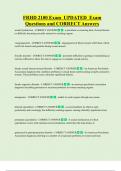
FRHD 2100 Exam UPDATED Exam
Questions and CORRECT Answers
sexual dysfunction - CORRECT ANSWER - a persistent or recurring lack of sexual desure
or difficulty becoming sexually aroused or reaching orgasm
vasogongestion - CORRECT ANSWER - engorgement of blood vessels with blood, which
swells the breasts and genitals during sexual arousal
Erectile disorder - CORRECT ANSWER - persistent difficulty in getting or maintaining an
erection sifficient to allow the man to engage in or complete sexual activity.
female sexual interest/arousal disorder - CORRECT ANSWER - An American Psychiatric
Association diagnosis that combines problems in sexual desire and becoming sexually aroused in
women. These problems cause clinically significant distress.
female orgasmic disorder - CORRECT ANSWER - an american psychiatric association
diagnosis describing persistent or recurrent problems in women reaching orgasm
anorgasmic - CORRECT ANSWER - unable to reach orgasm through any means
delayed ejaculation - CORRECT ANSWER - a sexual problem in which a male
persistently and recurringly has difficulty reaching orgasm, causing clinically significant stress
premature ejactulation - CORRECT ANSWER - A sexual dysfunction in which
ejactulation occurs with minimal sexual stimulation, and before the man desires it.
genito-pelvic pain/penetration disorder - CORRECT ANSWER - An American Psychiatric
Association diagnosis referring to a number of sexual pain problems in women and men.
,Dyspaneunia - CORRECT ANSWER - persistent or recurring pain during sexual activity
vulvodyinia - CORRECT ANSWER - A problem characterized by symptoms such as
severe vulval pain, burning, and itching.
vaginismus - CORRECT ANSWER - vaginal pain accompanied by heightened muscle
tension and fear of penetration
Max has very little sexual interest or desire, which is known as ________
ejaculatory incompetence
dyspareunia
male hypoactive desire disorder
male hyperactive desire disorder. - CORRECT ANSWER - c) male hypoactive desire
disorder
Most sex therapists today would refer to Caleb's inability to attain or maintain an erection as
__________.
frigidity
dyspareunia
impotency
erectile disorder - CORRECT ANSWER - erectile disorder
Tension in the muscles surrounding the vaginal barrel is known as__________.
dyspareunia
vaginismus
vulvodyinia
frigidity - CORRECT ANSWER - vaginismus
, biopsychosical model - CORRECT ANSWER - An approach to explaining sexual
problems and dysfunction that looks at the intereactions of biological, psychological and
sociocultural factors.
tumescence - CORRECT ANSWER - Swelling; erection.
Which of the following is recommended to help men cope with or reverse erectile disorder?
increase current alcohol intake
increase bodily weight
exercise regularly
try to will an erection - CORRECT ANSWER - exercise regularily
Scott has approached his physician about his erectile disorder. His doctor explains that they first
must understand if his problem is biologically based and advises Scott to go to a sleep centre for
evaluation. What will the sleep centre be looking for during Scott's overnight stay?
Does Scott have sleep apnea?
Does Scott have bad dreams?
Does Scott experience the same dysfunction when in a new location?
Does Scott experience nocturnal erections during REM sleep? - CORRECT ANSWER -
does Scott experience nocternal erections during REM sleep?
Canadian researchers MacNeil and Byers (2009) have found that communicating sexual likes
and dislikes in long-term relationships contributes to __________.
performance anxiety
resentment for the perceived sexual inadequacy
improved sexual satisfaction
impaired sexual satisfaction - CORRECT ANSWER - improved sexual satisfaction
Daria has begun to observe and evaluate her own sexual responses during sex, which is called
__________ and can be a cause of sexual problems.
Questions and CORRECT Answers
sexual dysfunction - CORRECT ANSWER - a persistent or recurring lack of sexual desure
or difficulty becoming sexually aroused or reaching orgasm
vasogongestion - CORRECT ANSWER - engorgement of blood vessels with blood, which
swells the breasts and genitals during sexual arousal
Erectile disorder - CORRECT ANSWER - persistent difficulty in getting or maintaining an
erection sifficient to allow the man to engage in or complete sexual activity.
female sexual interest/arousal disorder - CORRECT ANSWER - An American Psychiatric
Association diagnosis that combines problems in sexual desire and becoming sexually aroused in
women. These problems cause clinically significant distress.
female orgasmic disorder - CORRECT ANSWER - an american psychiatric association
diagnosis describing persistent or recurrent problems in women reaching orgasm
anorgasmic - CORRECT ANSWER - unable to reach orgasm through any means
delayed ejaculation - CORRECT ANSWER - a sexual problem in which a male
persistently and recurringly has difficulty reaching orgasm, causing clinically significant stress
premature ejactulation - CORRECT ANSWER - A sexual dysfunction in which
ejactulation occurs with minimal sexual stimulation, and before the man desires it.
genito-pelvic pain/penetration disorder - CORRECT ANSWER - An American Psychiatric
Association diagnosis referring to a number of sexual pain problems in women and men.
,Dyspaneunia - CORRECT ANSWER - persistent or recurring pain during sexual activity
vulvodyinia - CORRECT ANSWER - A problem characterized by symptoms such as
severe vulval pain, burning, and itching.
vaginismus - CORRECT ANSWER - vaginal pain accompanied by heightened muscle
tension and fear of penetration
Max has very little sexual interest or desire, which is known as ________
ejaculatory incompetence
dyspareunia
male hypoactive desire disorder
male hyperactive desire disorder. - CORRECT ANSWER - c) male hypoactive desire
disorder
Most sex therapists today would refer to Caleb's inability to attain or maintain an erection as
__________.
frigidity
dyspareunia
impotency
erectile disorder - CORRECT ANSWER - erectile disorder
Tension in the muscles surrounding the vaginal barrel is known as__________.
dyspareunia
vaginismus
vulvodyinia
frigidity - CORRECT ANSWER - vaginismus
, biopsychosical model - CORRECT ANSWER - An approach to explaining sexual
problems and dysfunction that looks at the intereactions of biological, psychological and
sociocultural factors.
tumescence - CORRECT ANSWER - Swelling; erection.
Which of the following is recommended to help men cope with or reverse erectile disorder?
increase current alcohol intake
increase bodily weight
exercise regularly
try to will an erection - CORRECT ANSWER - exercise regularily
Scott has approached his physician about his erectile disorder. His doctor explains that they first
must understand if his problem is biologically based and advises Scott to go to a sleep centre for
evaluation. What will the sleep centre be looking for during Scott's overnight stay?
Does Scott have sleep apnea?
Does Scott have bad dreams?
Does Scott experience the same dysfunction when in a new location?
Does Scott experience nocturnal erections during REM sleep? - CORRECT ANSWER -
does Scott experience nocternal erections during REM sleep?
Canadian researchers MacNeil and Byers (2009) have found that communicating sexual likes
and dislikes in long-term relationships contributes to __________.
performance anxiety
resentment for the perceived sexual inadequacy
improved sexual satisfaction
impaired sexual satisfaction - CORRECT ANSWER - improved sexual satisfaction
Daria has begun to observe and evaluate her own sexual responses during sex, which is called
__________ and can be a cause of sexual problems.