
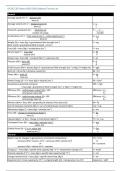
iGCSE CIE Physics 0625 (2020 Syllabus) Formula List
General
Average speed (ms-1) = distance (m)
time (s)
Average velocity (ms-1) = displacement (m) v=s
time (s) t
Period of a pendulum (s) = total time (s) T= t
number of swings number
Acceleration (ms-2) = final velocity (ms-1) – initial velocity (ms-1) a = v-u
time (s) t
Weight (N) = mass (kg) × gravitational field strength (ms-2) F = mg
Note: Earth’s gravitational field strength = 10 ms-2
Force (N) = mass (kg) × acceleration (ms-2) F = ma
-3
Density (kgm ) = mass (kg) ρ=M
volume (m3) V
Hooke’s law: Force (N) = constant (Nm-1) × extension (m) F = kx
Pressure (Pa) = force (N) P=F
area (m2) A
Fluid Pressure (Pa) = density (kgm-3) × gravitational field strength (ms-2 or Nkg-1) × height (m) P = ρgh
Work (J) = force (N) × distance moved (m) ΔE = Fd
Power (W) = work (J) P = ΔE
time (s) t
Kinetic Energy (J) = ½ × mass (kg) × velocity2 (ms-1) KE = ½mv2
Gravitational potential energy (J) GPE = mgh
= mass (kg) × gravitational field strength (ms-2 or Nkg-1) × height (m)
Efficiency (%) = useful power output (W) × 100 Efficiency = Pout
total power input (W) Pin
Efficiency (%) = useful energy output (J) × 100 Efficiency = Eout
total energy input (J) Ein
Moment (Nm) = force (N) × perpendicular distance from pivot (m) M = Fd
Sum of clockwise moments (Nm) = sum of anticlockwise moments (Nm) F1d1 = F2d2
-1 -1
Momentum (kgms ) = mass (kg) × velocity (ms ) p = mv
-1
Force (N) = change in momentum (kgms ) F = Δp
time (s) t
Impulse (kgms-1 or Ns) = change in momentum (kgms-1) Ft = mv -mu
2 -1
Centripetal Force (N) = mass (kg) × velocity (ms ) F = mv2
radius (m) r
Orbital Period (s) = 2 × π × radius (m) T = 2πr
velocity (ms-1) v
Thermal
Boyle’s Law for changes in gas pressure at constant temperature : P1V1 = P2V2
pressure1 (Pa) × volume1 (m3) = pressure2 (Pa)× volume2 (m3) or
or PV = constant
pressure (Pa) × volume (m3) = constant
Energy (J) = mass (kg) × specific heat capacity (Jkg-1°C-1) × temperature change (°C) E = mcΔT
-1 -1 -1
Thermal capacity (J°C ) = mass (kg) × specific heat capacity (Jkg °C ) C = mc
-1
Energy transferred (J) = mass (kg) × specific latent heat (Jkg ) E = ml
-1
Expansion (m) = linear expansivity (°C ) × original length (m) × temperature rise (°C) Expansion = αlΔT


