

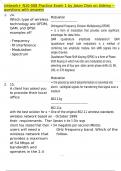
Network+ N10-008 Practice Exam 1 by Jason Dion on Udemy –
questions with answers
1. 24.
Modulation
Which type of wireless
--------------------------------
technology are OFDM,
Orthogonal Frequency Division Multiplexing (OFDM)
QAM, and QPSK
= is a form of modulation that provides some significant
examples of?
advantages for data links.
- Frequency QAM (quadrature amplitude modulation)? QAM
(quadrature ampli- tude modulation) is a method of
- RF interference
combining two amplitude modula- tion (AM) signals into a
- Modulation
single channel.
- Spectrum
Quadrature Phase Shift Keying (QPSK) is a form of Phase
Shift Keying in which two bits are modulated at once,
selecting one of four pos- sible carrier phase shifts (0, 90,
180, or 270 degrees)
Modulation
= The process by which data/information is converted into
2. 15.
A client has asked you electri- cal/digital signals for transferring that signal over a
medium
to provide their local
office 802.11g
---------------------------------------------
802.11a
with the best solution for a • One of the original 802.11 wireless standards
wireless network based on - October 1999
their requirements. The• Operates in the 5 GHz range
client has stated that their • 54 megabits per second (Mbit/s)
users will need a GHz frequency band. Which of the
wireless network that follow-
provides a maximum
of 54 Mbps of
bandwidth and
operates in the 2.4
,Network+ N10-008 Practice Exam 1 by Jason Dion on Udemy –
questions with answers
• Smaller range than 802.11b rules-of-thumb calculate 1/3rd
-Higher frequency is absorbed by the range of 802.11b or
objects in the way 802.11g
-Many • Not commonly seen today
ing wireless network types 802.11b
should you install to • Also an original 802.11 standard
meet their needs? -October 1999
,Network+ N10-008 Practice Exam 1 by Jason Dion on Udemy –
questions with answers
• Operates in the 2.4 GHz range
802.11g
• 11 megabits per second (Mbit/s)
802.11b
• Better range than 802.11a
802.11a
-Less absorption problems
802.11ac
• More frequency conflict
-Baby monitors, cordless
phones, microwave ovens,
Bluetooth
• Not commonly seen today
802.11g
• An "upgrade" to 802.11b - June 2003
• Operates in the 2.4 GHz range
• 54 megabits per second (Mbit/s)
- Same as 802.11a
• Backwards-compatible with 802.11b
• Same 2.4 GHz frequency conflict problems as 802.11b
802.11n (Wi-Fi 4)
• The update to 802.11g, 802.11b, and 802.11a
-October 2009
• Operates at 5 GHz and/or 2.4 GHz
-40 MHz channel widths
• 600 megabits per second (Mbit/s)
-40 MHz mode and 4 antennas
• 802.11n uses MIMO
-Multiple-input multiple-output
-Multiple transmit and receive antennas
802.11ac (Wi-Fi 5)
• Approved in January 2014
- Significant improvements over 802.11n
, Network+ N10-008 Practice Exam 1 by Jason Dion on Udemy –
questions with answers
• Operates in the 5
GHz band
questions with answers
1. 24.
Modulation
Which type of wireless
--------------------------------
technology are OFDM,
Orthogonal Frequency Division Multiplexing (OFDM)
QAM, and QPSK
= is a form of modulation that provides some significant
examples of?
advantages for data links.
- Frequency QAM (quadrature amplitude modulation)? QAM
(quadrature ampli- tude modulation) is a method of
- RF interference
combining two amplitude modula- tion (AM) signals into a
- Modulation
single channel.
- Spectrum
Quadrature Phase Shift Keying (QPSK) is a form of Phase
Shift Keying in which two bits are modulated at once,
selecting one of four pos- sible carrier phase shifts (0, 90,
180, or 270 degrees)
Modulation
= The process by which data/information is converted into
2. 15.
A client has asked you electri- cal/digital signals for transferring that signal over a
medium
to provide their local
office 802.11g
---------------------------------------------
802.11a
with the best solution for a • One of the original 802.11 wireless standards
wireless network based on - October 1999
their requirements. The• Operates in the 5 GHz range
client has stated that their • 54 megabits per second (Mbit/s)
users will need a GHz frequency band. Which of the
wireless network that follow-
provides a maximum
of 54 Mbps of
bandwidth and
operates in the 2.4
,Network+ N10-008 Practice Exam 1 by Jason Dion on Udemy –
questions with answers
• Smaller range than 802.11b rules-of-thumb calculate 1/3rd
-Higher frequency is absorbed by the range of 802.11b or
objects in the way 802.11g
-Many • Not commonly seen today
ing wireless network types 802.11b
should you install to • Also an original 802.11 standard
meet their needs? -October 1999
,Network+ N10-008 Practice Exam 1 by Jason Dion on Udemy –
questions with answers
• Operates in the 2.4 GHz range
802.11g
• 11 megabits per second (Mbit/s)
802.11b
• Better range than 802.11a
802.11a
-Less absorption problems
802.11ac
• More frequency conflict
-Baby monitors, cordless
phones, microwave ovens,
Bluetooth
• Not commonly seen today
802.11g
• An "upgrade" to 802.11b - June 2003
• Operates in the 2.4 GHz range
• 54 megabits per second (Mbit/s)
- Same as 802.11a
• Backwards-compatible with 802.11b
• Same 2.4 GHz frequency conflict problems as 802.11b
802.11n (Wi-Fi 4)
• The update to 802.11g, 802.11b, and 802.11a
-October 2009
• Operates at 5 GHz and/or 2.4 GHz
-40 MHz channel widths
• 600 megabits per second (Mbit/s)
-40 MHz mode and 4 antennas
• 802.11n uses MIMO
-Multiple-input multiple-output
-Multiple transmit and receive antennas
802.11ac (Wi-Fi 5)
• Approved in January 2014
- Significant improvements over 802.11n
, Network+ N10-008 Practice Exam 1 by Jason Dion on Udemy –
questions with answers
• Operates in the 5
GHz band


