M-13 Mobility ATI Quiz
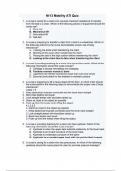
1. A nurse is caring for a client who requires maximum assistance to transfer from the bed to a chair. Which of the following pieces of equipment should the nurse use? A. Pivot disc B. Mechanical lift C. Sit-to-stand lift D. Gait belt 2. A nurse is preparing to transfer a client from a bed to a wheelchair. Which of the following actions by the nurse demonstrates proper use of body mechanics? A. Twisting the torso when transferring the client B. Bending at the waist when transferring the client C. Placing the bed in the high position before transferring the client D. Looking at the client face-to-face when transferring the client 3. A nurse if providing teaching for a client who injured their ankle. Which of the following information should the nurse include? A. Cartilage is always remodeling and changing B. Tendons connect muscle to bone C. Ligaments are flexible connective tissue that coat bony areas D. Synovial joints attach to the skeleton to maintain posture 4. A nurse is preparing to lift a heavy object off the floor. In which order should the nurse perform the following steps to demonstrate the proper use of body mechanics? Listed 1-5 1. Keep abdominal muscles contracted and the lower back straight 2. Bend hips slightly and squat 3. Look straight ahead with shoulders raised up 4. Stand as close to the object as possible 5. Push up from the knees when lifting the object. 4,1,3,2,5 4. Stand as close to the object as possible 1. Keep abdominal muscles contracted and the lower back straight 3. Look straight ahead with shoulders raised up 2. Bend hips slightly and squat 5. Push up from the knees when lifting the object. 5. A nurse is providing teaching for a client who has kyphosis. Which of the following information should the nurse include? A. Kyphosis is when the upper back extends posteriorly to the lower back. B. Kyphosis is an inward curvature of the lower back. C. Kyphosis is a sideways curvature of the spine. D. Kyphosis is a rounded upper back with the pelvis tilted forward. 6. A nurse is caring for a client who has pneumonia. In which of the following positions should the nurse place the client to promote postural drainage? A. Lateral B. Supine C. Prone D. Fowler's 7. A nurse is evaluating a client who has a broken leg and is using crutches. Which of the following actions by the client demonstrates proper use of the crutches? A. The hand grips of the crutches are at the level of the client's umbilicus B. The client's elbows are bent 45 degrees when holding the crutches C. The client places their weight on their axilla when using the crutches. D. The client has the crutches resting 5cm (2in) below their axilla. 8. A nurse is teaching an in-service about the use of ergonomics to a group of staff members. Which of the following information should the nurse include? A. The use of ergonomics improves blood circulation in the body B. The use of ergonomics eliminates costs related to workers' compensation C. The use of ergonomics increases job satisfaction D. The use of ergonomics maintains the body's balance and a lower center of gravity 9. A nurse is performing a focused assessment on an older adult client's mobility. Which of the following findings should indicate to the nurse that the client is experiencing an age- related change to their musculoskeletal system? A. Increased curvature of the thoracic spine B. Reduced depth perception C. Narrower stance when standing D. Quick steps when ambulating 10. A nurse in a long-term care facility is caring for an older adult client and notes their muscles have become smaller and weaker. Which of the following should the nurse suspect the client is experiencing? A. Sarcopenia B. Disuse osteoporosis C. Atrophy D. Joint contracture 11. A nurse is caring for a client who requires assistance with ADLs. Which of the following referrals should the nurse recommend for his client? A. Speech therapist B. Physical therapist C. Respiratory therapist D. Occupational therapist 12. A nurse is caring for a client who is at risk for developing atelectasis. Which of the following actions should the nurse take? A. Reposition the client every 2hr while in bed B. Remind the client to use the incentive spirometer C. Obtain the client's weight daily D. Encourage the client to eat foods that are high in fiber 13. A nurse is planning care for a client who is postoperative. In which of the following positions should the nurse place the client to prevent atelectasis? A. Fowler's B. Lateral C. Prone D. Supine 14. A nurse is teaching a newly hired assistive personnel (AP) about working with clients who require assistance with ADLs. Which of the following activities should the nurse include as an ADL? A. Toileting B. Writing C. Ambulating D. Talking 15. A nurse is discussing proper body mechanics with a group of assistive personnel. Which of the following information should the nurse include? A. A stable center of gravity increases stability and balance B. A wide base lowers the center of gravity C. Proper body alignment involves tightening the abdomen D. Leaning slightly back while carrying an object equalizes the center of gravity E. Bending at the waist when picking up objects stabilizes the spine 16. A nurse is assessing a client's mobility and notes one of the client's feet drags behind them when ambulating. Which of the following conditions should the nurse suspect the client is experiencing? A. Atrophy B. Foot drop C. Joint contracture D. Disuse osteoporosis 17. A nurse is caring for a client who requires total assistance with mobility. When using the Mobility Assessment Tool (MAT), which of the following pieces of equipment should the nurse use to transfer the client? A. Gait belt B. Mechanical lift C. Cane D. Sit-to-stand 18. A nurse is preparing a presentation for a group of clients who are scheduled for joint replacement surgery. Which of the following information should the nurse plan to include regarding flexion of a joint? A. Synovial joints contain sensory receptors that trigger flexion B. The contraction of a muscle results in flexion of a joint C. Neurotransmitters coordinate with cartilage to initiate flexion D. Ligaments extend to enable flexion of a joint 19. A nurse is teaching a client who has an unsteady gait about how to use a walker. Which of the following instructions should the nurse include? A. "The top of the walker should be at the level of your wrist." B. "When using the stairs, place the walker before taking a step." C. "When holding the walker, bend your elbows 30 degrees." D. "Take a step first before moving the walker." 20. A nurse is completing the Mobility Assessment Tool (MAT) for a client and determines that the client is at Level 1 Mobility. The nurse should identify that the client is unable to perform which of the following tasks? A. Sit on the edge of the bed for 1 min B. Stand in place for 5 seconds C. Walk in place D. Step forward and backward 21. A nurse is caring for a client who had a stroke and reports having difficulty with proprioception. The nurse should plan to assess the client for which of the following? A. Restricted movement due to abnormal fixation of a joint B. A drop in blood pressure that occurs with a change in position C. Altered gait with dragging of the toes while ambulating D. Diminished awareness of body position and balance 22. A nurse is caring for a client who had a stroke and is immobile. The nurse should identify that the client is at risk for which of the following conditions. A. Deep vein thrombosis (DVT) B. Asthma C. Hernia D. Hypertension 23. A nurse is performing a skin assessment on a client who has a wound on their heel that is blistered and lighter in color than the client's skin tone. The nurse should identify that the wound is in which of the following stages of damage? A. Deep damage through the skin and tissue B. Damage beyond the skin layer C. Damage into the skin layer D. Damage with the skin intact 24. A nurse is preparing a poster presentation about the musculoskeletal system. The nurse should include that which of the following is responsible for body posture? A. Center of gravity B. Bones C. Muscles D. Synovial joints 25. A nurse is preparing a presentation about muscle function for a group of newly licensed nurses. Which of the following information should the nurse plan to include? A. Muscles store calcium and magnesium. B. Muscles produce red blood cells (RBC) and platelets C. Muscles assist with thermoregulation in the body D. Muscles provide protection of internal organs.
Document information
- Uploaded on
- February 27, 2025
- Number of pages
- 5
- Written in
- 2024/2025
- Type
- Exam (elaborations)
- Contains
- Questions & answers