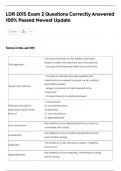
LDR 201S Exam 2 Questions Correctly Answered
100% Passed Newest Update
Save
Terms in this set (59)
-focuses exclusively on the leader (what traits
leaders exhibit, who has them, and who doesn't)
Trait approach
- concept of followership didn't exist at the time
-
- focused on identifying innate qualities and
charcteristics possessed by great social, political,
and military leaders
"great man" theories
- largely comprised of traits deemed to be
"masculine"
- Focused heavily on positional power
1.) extraversion
What are the big five 2.) conscientiousness
personality traits of trait 3.)openness
theory? 4.) Low neuroticism
5.) Agreeableness
the tendency to be depressed, anxious, insecure,
Low neuroticism
vulnerable and hostile
the tendency to be sociable and assertive and to
extraversion
have positive energy
The tendency to be informed, creative, insightful,
openness
and curious
the tendency to be accepting, conforming, trusting,
Agreeableness
and nurturing
, the tendency to be thorough, organized, controlled,
Conscientiousness
dependable, and decisive
Ability to perceive and apply emotions to life's tasks,
reason/understand emotions, express emotions, use
Emotional intelligence
emotions to facilitate thinking, manage emotions
within oneself and relationships
•Undefined
•Endless lists have emerged because the theory fails
to delimit a definitive list of leadership traits
•No Context
•Doesn't take into account situational requirements
where certain traits may make a person a leader in
Criticisms of trait theory
one context and not another
•Highly Subjective
•Personal experience and observation serve as the
basis for this theory, leaving it open to bias
•Not Useful
•Not useful for training and development
- Also focuses exclusively on the leader ( just as trait
theory)
Skills approach
- emphasis on skills that can be learned or
developed (instead of the traits you are born with)
- unidirectional authority relationship (top down)
Management - reduces chaos by increasing order, consistency,
and efficiency
- Multidirectional influence relationship
Leadership
- Produces movement and change
-being knowledgeable and proficient in a specific
type of work
- Specialized competency
Technical Skills
- knowledge of tools and techniques
- hands-on ability with a product or process
- Most important at lower levels of the organization
100% Passed Newest Update
Save
Terms in this set (59)
-focuses exclusively on the leader (what traits
leaders exhibit, who has them, and who doesn't)
Trait approach
- concept of followership didn't exist at the time
-
- focused on identifying innate qualities and
charcteristics possessed by great social, political,
and military leaders
"great man" theories
- largely comprised of traits deemed to be
"masculine"
- Focused heavily on positional power
1.) extraversion
What are the big five 2.) conscientiousness
personality traits of trait 3.)openness
theory? 4.) Low neuroticism
5.) Agreeableness
the tendency to be depressed, anxious, insecure,
Low neuroticism
vulnerable and hostile
the tendency to be sociable and assertive and to
extraversion
have positive energy
The tendency to be informed, creative, insightful,
openness
and curious
the tendency to be accepting, conforming, trusting,
Agreeableness
and nurturing
, the tendency to be thorough, organized, controlled,
Conscientiousness
dependable, and decisive
Ability to perceive and apply emotions to life's tasks,
reason/understand emotions, express emotions, use
Emotional intelligence
emotions to facilitate thinking, manage emotions
within oneself and relationships
•Undefined
•Endless lists have emerged because the theory fails
to delimit a definitive list of leadership traits
•No Context
•Doesn't take into account situational requirements
where certain traits may make a person a leader in
Criticisms of trait theory
one context and not another
•Highly Subjective
•Personal experience and observation serve as the
basis for this theory, leaving it open to bias
•Not Useful
•Not useful for training and development
- Also focuses exclusively on the leader ( just as trait
theory)
Skills approach
- emphasis on skills that can be learned or
developed (instead of the traits you are born with)
- unidirectional authority relationship (top down)
Management - reduces chaos by increasing order, consistency,
and efficiency
- Multidirectional influence relationship
Leadership
- Produces movement and change
-being knowledgeable and proficient in a specific
type of work
- Specialized competency
Technical Skills
- knowledge of tools and techniques
- hands-on ability with a product or process
- Most important at lower levels of the organization