Marriage and Family Therapy
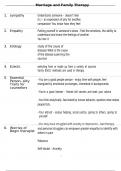
1. sympathy Understand someone - doesn't feel
(n.) - an expression of pity for another,
compassion You know how they feel
2. Empathy Putting yourself in someone's shoes - Feel the emotions, the ability to
understand and share the feelings of another
You feel it
3. Etiology study of the cause of
disease What is the cause
of the disease Learning the
sources
4. Eclectic selecting from or made up from a variety of sources
Varity Elictic methods are used in therapy
5. Essential
Person- ality -You are a good people person - enjoy time with people, feel
Traits for energized by emotional exchanges, interested in backgrounds.
counselors
-You're a good listener - friends tell secrets and seek your advice
-You think analytically -fascinated by human behavior, question what makes
people tick.
-Your altruist - enjoys helping, social justice, giving to others, giving to
yourself.
-You may have struggled with anxiety or depression - own therapy
6. Worries of and personal struggles can empower greater empathy to identify with
Begin therapist
others in pain
Patience
Self-doubt - Anxiety
1/
45
, Marriage and Family Therapy
F ow what I am doing
e
e
l
i
n
g
s
o
f
i
n
c
o
m
p
e
t
e
n
c
e
D
o
I
k
n
2/
45
, Marriage and Family Therapy
Skills vs. being ourselves
Carry client's issues in our daily life
7. Unrealistic Be- Perfectionism - No room for
liefs faced be mistakes Please others-
be- ginning
therapist unselfish giving
Need in control - worry no answers or
solutions Personalizing - Every client should
8. Rules of get better Need to be valued - be ettective
engage- ment all the times
in Therapy
Meet once a week, late fees
9. Six Common
strategies to es-
tablish and
com- municate 1. Use contracts and informed consent. ...
healthy 2. Keep track of time. ...
boundaries in
therapy (Emo- 3. Be mindful of self-disclosure. ...
tional 4. Remain conscious of personal feelings. ...
boundaries 5. Consider the implications of physical touch. ...
established by
culture, religion 6. Practice judicious gift giving.
or belief
system,
community, and
bringing.)
10. Family dynamics The patterns of interactions among relatives, their roles and relationships,
and the various factors that shape their interactions.
Because family members rely on each other for emotional, physical, and economic
support, they are one of the primary sources of relationship security or
stress.
11. True or False:
Families are False. Families come with a mix of emotions and are often worn out and
al- feeling hopeless by the time they get into therapy.
3/
45
, Marriage and Family Therapy
ways excited to
come to
therapy.
open communication
12. Healthy Fam-
ily dynamics emotional support
key shared authority
characteris- responsibilities
tics causing it
to function support
well attention to others
balance between work and home
respect
safet
y
13. What is love
consid- ered a
normal family · A healthy family has some key characteristics that cause it to function well.
dynamic? These include open communication, emotional support, shared authority
and respon- sibilities, support, attention to others, balance between work
and home, respect, safety, and love
14. Hero: The hero role is given to the family member, who is seen as the
'golden child.' They are typically well-behaved overachievers. They may
go overboard in their attempt to maintain the image of perfection. They
often are organized leaders with big goals and plans to achieve them.
This role is usually played in dysfunctional families as unattainable
expectations are placed on a child. They feel the pressure to be perfect
and always do what everyone else wants them to do.
15. Rescuer: The rescuer is the family member that is always doing everything for
everyone else.
They place all of their energy on helping others, making sure others
have what they need, and trying to ensure that no one does anything
they should not do. They seldom focus on themselves and what they
need. In dysfunctional families, this person serves as the one who is left
4/
45
1. sympathy Understand someone - doesn't feel
(n.) - an expression of pity for another,
compassion You know how they feel
2. Empathy Putting yourself in someone's shoes - Feel the emotions, the ability to
understand and share the feelings of another
You feel it
3. Etiology study of the cause of
disease What is the cause
of the disease Learning the
sources
4. Eclectic selecting from or made up from a variety of sources
Varity Elictic methods are used in therapy
5. Essential
Person- ality -You are a good people person - enjoy time with people, feel
Traits for energized by emotional exchanges, interested in backgrounds.
counselors
-You're a good listener - friends tell secrets and seek your advice
-You think analytically -fascinated by human behavior, question what makes
people tick.
-Your altruist - enjoys helping, social justice, giving to others, giving to
yourself.
-You may have struggled with anxiety or depression - own therapy
6. Worries of and personal struggles can empower greater empathy to identify with
Begin therapist
others in pain
Patience
Self-doubt - Anxiety
1/
45
, Marriage and Family Therapy
F ow what I am doing
e
e
l
i
n
g
s
o
f
i
n
c
o
m
p
e
t
e
n
c
e
D
o
I
k
n
2/
45
, Marriage and Family Therapy
Skills vs. being ourselves
Carry client's issues in our daily life
7. Unrealistic Be- Perfectionism - No room for
liefs faced be mistakes Please others-
be- ginning
therapist unselfish giving
Need in control - worry no answers or
solutions Personalizing - Every client should
8. Rules of get better Need to be valued - be ettective
engage- ment all the times
in Therapy
Meet once a week, late fees
9. Six Common
strategies to es-
tablish and
com- municate 1. Use contracts and informed consent. ...
healthy 2. Keep track of time. ...
boundaries in
therapy (Emo- 3. Be mindful of self-disclosure. ...
tional 4. Remain conscious of personal feelings. ...
boundaries 5. Consider the implications of physical touch. ...
established by
culture, religion 6. Practice judicious gift giving.
or belief
system,
community, and
bringing.)
10. Family dynamics The patterns of interactions among relatives, their roles and relationships,
and the various factors that shape their interactions.
Because family members rely on each other for emotional, physical, and economic
support, they are one of the primary sources of relationship security or
stress.
11. True or False:
Families are False. Families come with a mix of emotions and are often worn out and
al- feeling hopeless by the time they get into therapy.
3/
45
, Marriage and Family Therapy
ways excited to
come to
therapy.
open communication
12. Healthy Fam-
ily dynamics emotional support
key shared authority
characteris- responsibilities
tics causing it
to function support
well attention to others
balance between work and home
respect
safet
y
13. What is love
consid- ered a
normal family · A healthy family has some key characteristics that cause it to function well.
dynamic? These include open communication, emotional support, shared authority
and respon- sibilities, support, attention to others, balance between work
and home, respect, safety, and love
14. Hero: The hero role is given to the family member, who is seen as the
'golden child.' They are typically well-behaved overachievers. They may
go overboard in their attempt to maintain the image of perfection. They
often are organized leaders with big goals and plans to achieve them.
This role is usually played in dysfunctional families as unattainable
expectations are placed on a child. They feel the pressure to be perfect
and always do what everyone else wants them to do.
15. Rescuer: The rescuer is the family member that is always doing everything for
everyone else.
They place all of their energy on helping others, making sure others
have what they need, and trying to ensure that no one does anything
they should not do. They seldom focus on themselves and what they
need. In dysfunctional families, this person serves as the one who is left
4/
45