

UNIT 3
Date: Oct 7
Guiding Question:
Word of the Day Question of the Day
Compromise- to agree on a middle ground or Why didn't the Articles of Confederation work?
halfway point in a disagreement The government lacked the power to enforce taxes
and commerce
Key Content Thoughts / Reactions / Possible
Questions
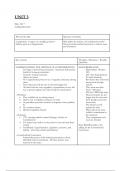
UNDERSTANDING THE ARTICLES OF CONFEDERATION SHAYS REBELLION:
- No kings or powerful governments. Americans had become - Daniel Shays- Western
fearful of strong governments. MA
- Created a weak government - MA- New Eng (patriots)
- Almost no power - To fund American
- No Congressional power to tax or regulate commerce among Revolution they borrowed
states money from foreign
- New nation goes all the way to the mississippi river nations
- All states had one vote, regardless of population or size, this - They went into debt
was to protect against one state having too much power - Taxes = Revenue
- MA has VERY high taxes
→Problems - Western farmers are not
a. They couldn't tax, no raising money happy (for the most part
b. Had no way to regulate commerce in states these people are poorer,
c. No president (executive branch) or Supreme Court (judicial lower class)
b.) - The farmers revolt
d. No common money against the elites
e. Did have legislative branch - Elites call on the army
(which is nonexistent at
→Solutions the moment)
1. 1787, meeting called to amend (change) Articles of - They compromise and
Confederation taxes are lowered
2. Too many issues with it so they throw it out and start from
scratch Shays Rebellion leads to the
3. Established 3 equal branches: legislative, executive, and calling for the Constitutional
judicial with many checks and balances. Convention
→Constitutional Convention
- Limited the powers of the federal government to those
identified in the Constitution. All other powers were
reserved to the states
, - They set up a Bicameral Legislature, made of upper house
and lower house (Represents size of that house)
- Upper: Senate (all states have equal representation, 2)
- Lower: House of Representatives (representation is based on
population)
Date: Oct 11
Word of the Day Question of the Day
Federalism- a type of government that combines the Once the constitution was finished, why didn't
general and regional government into one political everyone love it?
body and dividing their powers Everyone had different opinions on how the United
states should be run and not every single person
was polled about their say on each law. Some people
believed the central government should be more
powerful while others thought it should be less
central. It all depended on political opinions
Key Content Thoughts / Reactions /
Possible Questions
STUDY VUS SLIDES BEFORE TEST
Word Differentiation:
→Federalist- A group of people who believe in a strong central government
(Pro constitution, and becomes a political party)
→Federalism- Political system the divides power between the federal and the
state
→Anti-Federalist- Believed rights need to be written into the constitution,
worried that they will just turn the president into king and that their individual
rights will be violated.
1. To ratify anything they needed a ⅔ majority vote from 13 colonies (9
out of 13)
2. Famous federalists: A. Hamilton, J. Jay, J. Madison
3. Famous anti-federalist: P. Henry, S. Adams, G. Mason
4. In 1789 (same year as beginning of French Revolution) debate over
ratification comes to an end
5. G. Washington gives speech and recommends that they should not
form political parties
Date: Oct 7
Guiding Question:
Word of the Day Question of the Day
Compromise- to agree on a middle ground or Why didn't the Articles of Confederation work?
halfway point in a disagreement The government lacked the power to enforce taxes
and commerce
Key Content Thoughts / Reactions / Possible
Questions
UNDERSTANDING THE ARTICLES OF CONFEDERATION SHAYS REBELLION:
- No kings or powerful governments. Americans had become - Daniel Shays- Western
fearful of strong governments. MA
- Created a weak government - MA- New Eng (patriots)
- Almost no power - To fund American
- No Congressional power to tax or regulate commerce among Revolution they borrowed
states money from foreign
- New nation goes all the way to the mississippi river nations
- All states had one vote, regardless of population or size, this - They went into debt
was to protect against one state having too much power - Taxes = Revenue
- MA has VERY high taxes
→Problems - Western farmers are not
a. They couldn't tax, no raising money happy (for the most part
b. Had no way to regulate commerce in states these people are poorer,
c. No president (executive branch) or Supreme Court (judicial lower class)
b.) - The farmers revolt
d. No common money against the elites
e. Did have legislative branch - Elites call on the army
(which is nonexistent at
→Solutions the moment)
1. 1787, meeting called to amend (change) Articles of - They compromise and
Confederation taxes are lowered
2. Too many issues with it so they throw it out and start from
scratch Shays Rebellion leads to the
3. Established 3 equal branches: legislative, executive, and calling for the Constitutional
judicial with many checks and balances. Convention
→Constitutional Convention
- Limited the powers of the federal government to those
identified in the Constitution. All other powers were
reserved to the states
, - They set up a Bicameral Legislature, made of upper house
and lower house (Represents size of that house)
- Upper: Senate (all states have equal representation, 2)
- Lower: House of Representatives (representation is based on
population)
Date: Oct 11
Word of the Day Question of the Day
Federalism- a type of government that combines the Once the constitution was finished, why didn't
general and regional government into one political everyone love it?
body and dividing their powers Everyone had different opinions on how the United
states should be run and not every single person
was polled about their say on each law. Some people
believed the central government should be more
powerful while others thought it should be less
central. It all depended on political opinions
Key Content Thoughts / Reactions /
Possible Questions
STUDY VUS SLIDES BEFORE TEST
Word Differentiation:
→Federalist- A group of people who believe in a strong central government
(Pro constitution, and becomes a political party)
→Federalism- Political system the divides power between the federal and the
state
→Anti-Federalist- Believed rights need to be written into the constitution,
worried that they will just turn the president into king and that their individual
rights will be violated.
1. To ratify anything they needed a ⅔ majority vote from 13 colonies (9
out of 13)
2. Famous federalists: A. Hamilton, J. Jay, J. Madison
3. Famous anti-federalist: P. Henry, S. Adams, G. Mason
4. In 1789 (same year as beginning of French Revolution) debate over
ratification comes to an end
5. G. Washington gives speech and recommends that they should not
form political parties


