Abnormal Psychology Models of Abnormality
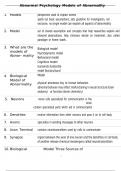
1. Models perspective used to explain events
spells out basic assumptions, sets guideline for investigation, not
exclusive, no single model can explain all aspects of abnormality
2. Model set of shared assumption and concepts that help researches explain and
interpret observations, help clinicians decide on treatment, also called
paradigm or frame- work.
3. What are the Biological model
models of Psychodynamic model
Abnor- mality
Behavioral model
Cognitive model
Humanistic-Existential
model Sociocultural
4. Biological Model
Model of
Abnormality physical processes key to human behaviors
abnormal behavior may reflect malfunctioning in neural structure (brain
anatomy) or function (brain chemistry)
5. Neurons nerve cells specialized for communication in the
brain
-contain specialized parts which aid in communication
6. Dendrites receive information from other neurons and pass it on to cell body
7. Axons specialize in sending messages to other neurons
8. Axon Terminal contains neurotransmitters used by cells to communicate
9. Synapse region between the axon of one neuron and the dendrites or cell body
of another release chemical messengers called neurotransmitters
10. Biological Model Three Sources of
1/
19
, Abnormal Psychology Models of Abnormality
genetics, evolution, and
viral infections
2/
19
, Abnormal Psychology Models of Abnormality
Abnormalities in
Brain Regions
11. Genetics psychological disorders may be inherited (e.g. depression, anxiety,
schizophrenia)
12. Evolution anxiety disorders
13. Viral Infection schizophrenia
14. Biological 1. psychotropic medications
Treat- ments
-antianxiety (anxiolytics) xanax ativan
-antidepressants (prozac, zoloft)
-antibipolar drugs (mood stabilizers) lithium
-antipsychotic drugs (ability, resperdal)
2. electronvulsive therapy (ECT) - treatment resistant depression
3. psychosurgery / neurosurgery
(brain surgery for mental disorders) - experimental
15. Pros of
Biological considerable respect in field
Model biological treatments often
help many drugs are
ettective backed by lots of
research
the brain is central
hard to imagine understanding mental illness without knowing how the
brain work
16. Cons of Biological reductionism
Model non-biological factors are important too
interplay is important
side ettects of drugs some
are severs
song long-term ettects aren't well understood
3/
19
1. Models perspective used to explain events
spells out basic assumptions, sets guideline for investigation, not
exclusive, no single model can explain all aspects of abnormality
2. Model set of shared assumption and concepts that help researches explain and
interpret observations, help clinicians decide on treatment, also called
paradigm or frame- work.
3. What are the Biological model
models of Psychodynamic model
Abnor- mality
Behavioral model
Cognitive model
Humanistic-Existential
model Sociocultural
4. Biological Model
Model of
Abnormality physical processes key to human behaviors
abnormal behavior may reflect malfunctioning in neural structure (brain
anatomy) or function (brain chemistry)
5. Neurons nerve cells specialized for communication in the
brain
-contain specialized parts which aid in communication
6. Dendrites receive information from other neurons and pass it on to cell body
7. Axons specialize in sending messages to other neurons
8. Axon Terminal contains neurotransmitters used by cells to communicate
9. Synapse region between the axon of one neuron and the dendrites or cell body
of another release chemical messengers called neurotransmitters
10. Biological Model Three Sources of
1/
19
, Abnormal Psychology Models of Abnormality
genetics, evolution, and
viral infections
2/
19
, Abnormal Psychology Models of Abnormality
Abnormalities in
Brain Regions
11. Genetics psychological disorders may be inherited (e.g. depression, anxiety,
schizophrenia)
12. Evolution anxiety disorders
13. Viral Infection schizophrenia
14. Biological 1. psychotropic medications
Treat- ments
-antianxiety (anxiolytics) xanax ativan
-antidepressants (prozac, zoloft)
-antibipolar drugs (mood stabilizers) lithium
-antipsychotic drugs (ability, resperdal)
2. electronvulsive therapy (ECT) - treatment resistant depression
3. psychosurgery / neurosurgery
(brain surgery for mental disorders) - experimental
15. Pros of
Biological considerable respect in field
Model biological treatments often
help many drugs are
ettective backed by lots of
research
the brain is central
hard to imagine understanding mental illness without knowing how the
brain work
16. Cons of Biological reductionism
Model non-biological factors are important too
interplay is important
side ettects of drugs some
are severs
song long-term ettects aren't well understood
3/
19