
WGU - C207 – Data-Driven Decision
Making
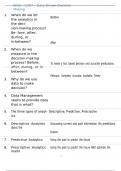
1. When do we do
Before
the analytics in
the deci-
sion-making process?
Be- fore, after,
during, or
in-between? After
2. When do we
measure in the
decision-making
process? Before, To make a fact based decision and accurate predications.
after, during, or in-
between?
Relevant, Complete, Accurate, Available, Timely
3. Why do we use
data to make
decision?
4. Data Management
seeks to provide data
that is what?
5. The three types of analyt- Descriptive, Predictive, Prescriptive
ics
6. Descriptive Analytics Discussing current and past information. No predictions
about the
future
7. Predictive Analytics Using the past to predict the future
8. Prescriptive Analytics Using the past to predict the future AND optimize the
situation.
1/
27
, WGU - C207 – Data-Driven Decision
Making
9. Sorting out your Out of range and Omission
spread- sheet can
help find what?
10. What is a random error? If the error will fix itself, is unknown and unpredictable,
and can be
minimized by a larger sample size
2/
27
, WGU - C207 – Data-Driven Decision
Making
11. What is a systematic If the error will NOT fix itself. You must fix it. Is a constant
er- ror? measurement error, and can be caused by measurement
instruments or experimen- tal design
12. Skewness A measure of the degree to which a probability distribution
"leans" toward one side of the average, where the median
and mean are not the same
13. Relational Database A database structured to recognize relations among stored
items of
information
14. Outlier Observation points that are distant from others
15. Reliable Data Consistent and repeatable
16. Valid Data Measures what is intended to be measured
17. Measurement Bias A prejudice in the data that results in inaccurate measure.
This can
result from faulty measurement tools, misclassification of the
sample, or failing to correctly measure the right variable.
18. Selection Bias A bias introduced within the sample of the study. Sample Size
must
be - Representative, Random, Large Enough (at least 30
samples)
19. Information Respondent says what they believe the questioner wants to hear
(Response) Bias or Surveyor is actively seeking a certain response
20. Big Data Both Structured and Unstructured data in such large
volumes that it's diflcult to process using traditional
database and software tech- niques
3/
27
Making
1. When do we do
Before
the analytics in
the deci-
sion-making process?
Be- fore, after,
during, or
in-between? After
2. When do we
measure in the
decision-making
process? Before, To make a fact based decision and accurate predications.
after, during, or in-
between?
Relevant, Complete, Accurate, Available, Timely
3. Why do we use
data to make
decision?
4. Data Management
seeks to provide data
that is what?
5. The three types of analyt- Descriptive, Predictive, Prescriptive
ics
6. Descriptive Analytics Discussing current and past information. No predictions
about the
future
7. Predictive Analytics Using the past to predict the future
8. Prescriptive Analytics Using the past to predict the future AND optimize the
situation.
1/
27
, WGU - C207 – Data-Driven Decision
Making
9. Sorting out your Out of range and Omission
spread- sheet can
help find what?
10. What is a random error? If the error will fix itself, is unknown and unpredictable,
and can be
minimized by a larger sample size
2/
27
, WGU - C207 – Data-Driven Decision
Making
11. What is a systematic If the error will NOT fix itself. You must fix it. Is a constant
er- ror? measurement error, and can be caused by measurement
instruments or experimen- tal design
12. Skewness A measure of the degree to which a probability distribution
"leans" toward one side of the average, where the median
and mean are not the same
13. Relational Database A database structured to recognize relations among stored
items of
information
14. Outlier Observation points that are distant from others
15. Reliable Data Consistent and repeatable
16. Valid Data Measures what is intended to be measured
17. Measurement Bias A prejudice in the data that results in inaccurate measure.
This can
result from faulty measurement tools, misclassification of the
sample, or failing to correctly measure the right variable.
18. Selection Bias A bias introduced within the sample of the study. Sample Size
must
be - Representative, Random, Large Enough (at least 30
samples)
19. Information Respondent says what they believe the questioner wants to hear
(Response) Bias or Surveyor is actively seeking a certain response
20. Big Data Both Structured and Unstructured data in such large
volumes that it's diflcult to process using traditional
database and software tech- niques
3/
27


