

Advanced Practice in Primary Care
Question 1
The presence of which of the following would be supportive diagnosis of pheochromocytoma?
a. Positive findings of a renal mass on CT scan of abdomen and pelvis
b. Improved muscle strength after pyridostigmine administration
c. Low levels of metanephrines in serum
d. Elevated metanephrines in serum and urine
ANS: d
Question 2
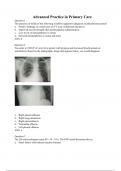
You order a CXR (P-A view) for a patient with dyspnea and decreased breath sounds on
auscultation. Based on the radiographic image that appears below, you would diagnose;
a. Right pleural effusion
b. Right lung pneumonia
c. Right pneumothorax
d. Pericardial effusion
e. Left pleural effusion
ANS: a
Question 3
The 2D-echocardiogram reads EF= 30 - 35%. The FNP would document this as:
a. Heart failure with reduced ejection fraction
,b. Right heart failure
c. NYHA Class-III
d. Diastolic heart failure
e. Heart failure with preserved ejection fraction
ANS: a
Question 4
Entresto was the #1 FDA approved combined medication for the treatment of HFrEF or systolic
heart failure. However, it should not be administered concomitantly with: (select only 1 answer)
a. Antibiotic
b. Beta blocker
c. ACEIV
d. Antihistamine medication
ANS: c
Question 5
A young patient with a 3-day sore throat, fever, minimal cough, yellow to greenish pharyngeal
exudate, and anterior cervical lymphadenopathy is undergoing testing. Which of the following
would be supportive of the most likely diagnosis?
a. Positive RADT V
b. Positive IgG antibodies against diphtheria toxoid = 0.1 IU/mL.
c. Positive EBV antibodies
d. Positive culture for B. pertussis
ANS: a
Question 6
A middle-aged female presents with complaints of fatigue, constipation, and cold intolerance.
She feels like "dragging" herself around every day and has noticed shortness of breath when
attempting to walk faster. and while laying down in bed. She has a hoarse voice but is afebrile
with soft blood pressure, and slightly bradycardic. Her neck appears diffusely enlarged at the
base on examination, and according to the patient, it has been going on for a few years now, but
it seems bigger now. The FNP suspects Hashimoto's thyroiditis. Which of the following would be
next to do as initial testing? (Select only 1 answer)
a. Measurement of serum TSH
b. Measurement of free T4 & T3
c. Thyroid ultrasound
d. Measurement of TPO antibodies
e. Measurement of free T4
ANS: a
Question 7
, An older woman with recent history of nervousness and unintentional weight loss is brought to
the clinic with complaints of new onset palpitations. Her temperature is within normal limits but
closer to the high limit. She denies chills, nause, vomiting, dysuria, or recent infection.
Her pulse is above 100 bpm and her BP reads 108/68 mm Hg. A 12-Lead EKG displays atrial
fibrillation. Which of the following tests would be diagnostic in this case?
a. U/A
b. BMP
c. CBC
d. TSH
ANS: d
Question 8
The following are the most common causes of viral pneumonia in the US. Please select the
correct order starting from most frequent to least frequent.
A. Influenza viruses
B. Respiratory syncytial virus (RSV)
C. SARS-CoV-2 (COVID-19) |
a. A, B, and C
b. B, A and C
c C,A, and B
d. B, C, and A
ANS: a
Question 9
Which of the following is NOT a common cause of community acquired typical bacterial
pneumonia in the adult?
a. Streptococcal pneumoniae
b. Haemophilus influenzae
c. Mycoplasma pneumoniae
d. Moraxella catarrhalis
ANS: c
Question 10
An adult that presents with hypertension and proximal muscle weakness with wasting of the
extremities that is found to have an obese abdomen with purplish striae as well as supraclavicular
fat pads whose face appears swollen, puffy, and erythematous or darker colored should undergo:
a. TSH with reflex to free T4
b. Glycated hemoglobin A1c
c. Dexamethasone suppression test
d. CBC with differential
ANS: c
Question 11
Question 1
The presence of which of the following would be supportive diagnosis of pheochromocytoma?
a. Positive findings of a renal mass on CT scan of abdomen and pelvis
b. Improved muscle strength after pyridostigmine administration
c. Low levels of metanephrines in serum
d. Elevated metanephrines in serum and urine
ANS: d
Question 2
You order a CXR (P-A view) for a patient with dyspnea and decreased breath sounds on
auscultation. Based on the radiographic image that appears below, you would diagnose;
a. Right pleural effusion
b. Right lung pneumonia
c. Right pneumothorax
d. Pericardial effusion
e. Left pleural effusion
ANS: a
Question 3
The 2D-echocardiogram reads EF= 30 - 35%. The FNP would document this as:
a. Heart failure with reduced ejection fraction
,b. Right heart failure
c. NYHA Class-III
d. Diastolic heart failure
e. Heart failure with preserved ejection fraction
ANS: a
Question 4
Entresto was the #1 FDA approved combined medication for the treatment of HFrEF or systolic
heart failure. However, it should not be administered concomitantly with: (select only 1 answer)
a. Antibiotic
b. Beta blocker
c. ACEIV
d. Antihistamine medication
ANS: c
Question 5
A young patient with a 3-day sore throat, fever, minimal cough, yellow to greenish pharyngeal
exudate, and anterior cervical lymphadenopathy is undergoing testing. Which of the following
would be supportive of the most likely diagnosis?
a. Positive RADT V
b. Positive IgG antibodies against diphtheria toxoid = 0.1 IU/mL.
c. Positive EBV antibodies
d. Positive culture for B. pertussis
ANS: a
Question 6
A middle-aged female presents with complaints of fatigue, constipation, and cold intolerance.
She feels like "dragging" herself around every day and has noticed shortness of breath when
attempting to walk faster. and while laying down in bed. She has a hoarse voice but is afebrile
with soft blood pressure, and slightly bradycardic. Her neck appears diffusely enlarged at the
base on examination, and according to the patient, it has been going on for a few years now, but
it seems bigger now. The FNP suspects Hashimoto's thyroiditis. Which of the following would be
next to do as initial testing? (Select only 1 answer)
a. Measurement of serum TSH
b. Measurement of free T4 & T3
c. Thyroid ultrasound
d. Measurement of TPO antibodies
e. Measurement of free T4
ANS: a
Question 7
, An older woman with recent history of nervousness and unintentional weight loss is brought to
the clinic with complaints of new onset palpitations. Her temperature is within normal limits but
closer to the high limit. She denies chills, nause, vomiting, dysuria, or recent infection.
Her pulse is above 100 bpm and her BP reads 108/68 mm Hg. A 12-Lead EKG displays atrial
fibrillation. Which of the following tests would be diagnostic in this case?
a. U/A
b. BMP
c. CBC
d. TSH
ANS: d
Question 8
The following are the most common causes of viral pneumonia in the US. Please select the
correct order starting from most frequent to least frequent.
A. Influenza viruses
B. Respiratory syncytial virus (RSV)
C. SARS-CoV-2 (COVID-19) |
a. A, B, and C
b. B, A and C
c C,A, and B
d. B, C, and A
ANS: a
Question 9
Which of the following is NOT a common cause of community acquired typical bacterial
pneumonia in the adult?
a. Streptococcal pneumoniae
b. Haemophilus influenzae
c. Mycoplasma pneumoniae
d. Moraxella catarrhalis
ANS: c
Question 10
An adult that presents with hypertension and proximal muscle weakness with wasting of the
extremities that is found to have an obese abdomen with purplish striae as well as supraclavicular
fat pads whose face appears swollen, puffy, and erythematous or darker colored should undergo:
a. TSH with reflex to free T4
b. Glycated hemoglobin A1c
c. Dexamethasone suppression test
d. CBC with differential
ANS: c
Question 11


