
Psychology Exam #4
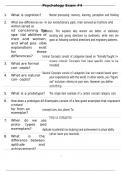
1. What is cognition? Mental processing: memory, learning, perception and thinking
2. What sex-differences ex- In our evolutionary past, men served as hunters and
women served as
ist concerning the gatherers. This explains why women are better at stationary
spa- tial abilities of locating and giving directions by landmarks, while men are
men and women, good at following cardinal directions and migratory patterns.
and what pos- sible
explanations exist
for these
differences? Formal Concepts consist of categories based on "formally"taught in-
clusion criteria. Concepts that have specific rules to be
3. What are formal included.
con- cepts?
Natural Concepts consist of categories that are created based upon
4. What are natural
your experiences with the world. In other words, you "figure
con- cepts?
out" inclusion criteria on your own. However you define
something
5. What is a prototype? The single best example of a certain concept category (car)
6. How does a prototype dif-Exemplars consist of a few good examples that represent
a natural
fer from an concept (cars, bus, plane) To
exemplar?
help us categorize
7. When do we use
proto- types and
exemplars? Aptitude is potential (no studying) and achievement is actual ability
(what have you learned)
8. What is the
difference between
aptitude and
achievement?
1/
23
, Psychology Exam #4
9. History of the SAT Meant to keep "undeserving" (jews) people out of college.
Kaplan was
jew and did not get into college but taught kids to study for the
SAT, proving it was not a test of aptitude.
10. What was the SAT aptitude
initial- ly meant to
measure?
2/
23
, Psychology Exam #4
11. Is the modern SAT a pure no
measure of aptitude?
12. What was the Mental Age/Chronological age X 100
original formula
used to deter-
mine IQ among
chil- dren?
13. What does IQ predict? success in life
14. What is stereotype When you are reminded of a negative stereotype associated
with your
threat? Give an example. group, you are more likely to perform in line with that
stereotype. Such
as women being told men usually do better on a test, so in turn
they do worse due to increased anxiety.
15. What is a Heuristic? Short-cuts we use to helps solve problems. Heuristics help us
when we
are making decisions under uncertainty.
16. What is the 20. Pros and cons of algo- rithms?
availability
heuristic?
17. What is the
representa- tiveness
heuristic?
18. Pros and cons of
trial and error?
19. Pros and cons of
heuris- tics?
3/
23
1. What is cognition? Mental processing: memory, learning, perception and thinking
2. What sex-differences ex- In our evolutionary past, men served as hunters and
women served as
ist concerning the gatherers. This explains why women are better at stationary
spa- tial abilities of locating and giving directions by landmarks, while men are
men and women, good at following cardinal directions and migratory patterns.
and what pos- sible
explanations exist
for these
differences? Formal Concepts consist of categories based on "formally"taught in-
clusion criteria. Concepts that have specific rules to be
3. What are formal included.
con- cepts?
Natural Concepts consist of categories that are created based upon
4. What are natural
your experiences with the world. In other words, you "figure
con- cepts?
out" inclusion criteria on your own. However you define
something
5. What is a prototype? The single best example of a certain concept category (car)
6. How does a prototype dif-Exemplars consist of a few good examples that represent
a natural
fer from an concept (cars, bus, plane) To
exemplar?
help us categorize
7. When do we use
proto- types and
exemplars? Aptitude is potential (no studying) and achievement is actual ability
(what have you learned)
8. What is the
difference between
aptitude and
achievement?
1/
23
, Psychology Exam #4
9. History of the SAT Meant to keep "undeserving" (jews) people out of college.
Kaplan was
jew and did not get into college but taught kids to study for the
SAT, proving it was not a test of aptitude.
10. What was the SAT aptitude
initial- ly meant to
measure?
2/
23
, Psychology Exam #4
11. Is the modern SAT a pure no
measure of aptitude?
12. What was the Mental Age/Chronological age X 100
original formula
used to deter-
mine IQ among
chil- dren?
13. What does IQ predict? success in life
14. What is stereotype When you are reminded of a negative stereotype associated
with your
threat? Give an example. group, you are more likely to perform in line with that
stereotype. Such
as women being told men usually do better on a test, so in turn
they do worse due to increased anxiety.
15. What is a Heuristic? Short-cuts we use to helps solve problems. Heuristics help us
when we
are making decisions under uncertainty.
16. What is the 20. Pros and cons of algo- rithms?
availability
heuristic?
17. What is the
representa- tiveness
heuristic?
18. Pros and cons of
trial and error?
19. Pros and cons of
heuris- tics?
3/
23


