

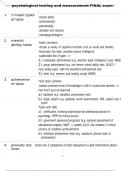
psychological testing and measurement FINAL exam
1. 5 major types
-mental ability
of tests
-achievement
-personality
-attitudes and interests
-neuropsychological
2. mental
*most common
ability tests
-include a variety of cognitive functions such as vocab and memory
-historically has been centered around intelligence
-subdivided into 3 types -->
1) individually administered (e.g. weschler adult intelligence scale: WAIS)
2) group administered (e.g. otis lennon school ability test: OLSAT) *
most widely used - with the standford achievement test
3) other (e.g. memory (just testing vocab) WAMS)
3. achieveme
*2nd most common
nt tests
-assess a persons level of knowledge or skill in a particular domain -->
how much you've learned
a) batteries (e.g. standford achievement test)
b) single subject (e.g. graduate record examinations: GRE, subject test in
pysch
*taken with GRE)
c) certification, licensing (examination for professional practice in
psychology EPPP for clinical psych)
d) goverment sponsored programs (e.g. national assessment of
educational progress: NAEP --> grades 4,8,12 aka students in critical
juncture of academic achievement)
e) individual achievement tests (e.g. woodcock johnson tests of
achievement)
4. personality tests -there are 3 categories of tests designed to yield information about
human
,psychological testing and measurement FINAL exam
personality:
1) objective - they are objectively scored (e.g. Minnesota Multiphasic
Personality Inventory MMPI --> true false multiple choice )
, psychological testing and measurement FINAL exam
2) projective - the examiner interprets the examinee's responses to
ambiguous, unstructured stimuli /tasks as potential indicators of
personality (e.g. Rorscach inkblot test --> vague pictures project
personality
3) other approaches: all other techniques devised to assess
personality (e.g. interview)
5. interests and atti- -2 types:
tudes a) vocational interests: help individuals explore carrers relevant to their
interests what do you want to be when you grow up
b)attitude scale: measure attitudes towards topics, groups, and
pratices (e.g. attitudes toward an older aldut
6. neuropsychologi- -designed to yield info about the functioning of the central nervous
system
cal tests (especially the brain)
* a comprehensive neuropsychological assessment covers a broad range of
doamins (e.g. attention, processing speed, memory, language,
intelligence, per- sonality)
7. 5 ways to catego- -paper and pencil vs performance
rize tests 9. speed vs power (Ways to catego- rize)
8. paper and
pencil vs
performance
(Ways to
catego- rize)
, psychological testing and measurement FINAL exam
ed vs power
vidual vs group
imum vs typical performance
med referenced vs criterion
referenced
minees respond to a set of
questions using paper and
pencil such as multiple choice
and t/f questions
-examiness completes
actions such as assembling
a project, delivering a
speech, conducting an
experiment, or leading
fast the examinee can perform
the task vs
-tests the limits of a
persons knowledge or
ability (no time limit- just
looks at how much you
know)
1. 5 major types
-mental ability
of tests
-achievement
-personality
-attitudes and interests
-neuropsychological
2. mental
*most common
ability tests
-include a variety of cognitive functions such as vocab and memory
-historically has been centered around intelligence
-subdivided into 3 types -->
1) individually administered (e.g. weschler adult intelligence scale: WAIS)
2) group administered (e.g. otis lennon school ability test: OLSAT) *
most widely used - with the standford achievement test
3) other (e.g. memory (just testing vocab) WAMS)
3. achieveme
*2nd most common
nt tests
-assess a persons level of knowledge or skill in a particular domain -->
how much you've learned
a) batteries (e.g. standford achievement test)
b) single subject (e.g. graduate record examinations: GRE, subject test in
pysch
*taken with GRE)
c) certification, licensing (examination for professional practice in
psychology EPPP for clinical psych)
d) goverment sponsored programs (e.g. national assessment of
educational progress: NAEP --> grades 4,8,12 aka students in critical
juncture of academic achievement)
e) individual achievement tests (e.g. woodcock johnson tests of
achievement)
4. personality tests -there are 3 categories of tests designed to yield information about
human
,psychological testing and measurement FINAL exam
personality:
1) objective - they are objectively scored (e.g. Minnesota Multiphasic
Personality Inventory MMPI --> true false multiple choice )
, psychological testing and measurement FINAL exam
2) projective - the examiner interprets the examinee's responses to
ambiguous, unstructured stimuli /tasks as potential indicators of
personality (e.g. Rorscach inkblot test --> vague pictures project
personality
3) other approaches: all other techniques devised to assess
personality (e.g. interview)
5. interests and atti- -2 types:
tudes a) vocational interests: help individuals explore carrers relevant to their
interests what do you want to be when you grow up
b)attitude scale: measure attitudes towards topics, groups, and
pratices (e.g. attitudes toward an older aldut
6. neuropsychologi- -designed to yield info about the functioning of the central nervous
system
cal tests (especially the brain)
* a comprehensive neuropsychological assessment covers a broad range of
doamins (e.g. attention, processing speed, memory, language,
intelligence, per- sonality)
7. 5 ways to catego- -paper and pencil vs performance
rize tests 9. speed vs power (Ways to catego- rize)
8. paper and
pencil vs
performance
(Ways to
catego- rize)
, psychological testing and measurement FINAL exam
ed vs power
vidual vs group
imum vs typical performance
med referenced vs criterion
referenced
minees respond to a set of
questions using paper and
pencil such as multiple choice
and t/f questions
-examiness completes
actions such as assembling
a project, delivering a
speech, conducting an
experiment, or leading
fast the examinee can perform
the task vs
-tests the limits of a
persons knowledge or
ability (no time limit- just
looks at how much you
know)


